Race-ethnicity, gender, age, and insurance status were not associated with interpreter use among LEP surgical patients
Source
Jenny Cevallos (2024). Use of Professional Interpreters for Patients With Limited English Proficiency Undergoing Surgery. JAMA Network Open.
Description #
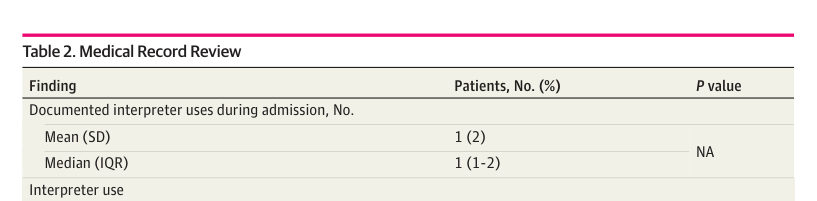
On univariate analysis, self-identified race and ethnicity, gender, age, and insurance status were not associated with interpreter use among the 117 LEP surgical patients (Table 2). This is a null result: apart from preferred language (Spanish/Chinese vs other), none of the a priori demographic or insurance covariates predicted whether an interpreter was documented. The language-group difference was also observed only for first-24-hour use and not for the other interpreter-use outcomes.
"Race and ethnicity, gender, age, and insurance status were not associated with interpreter use in univariate analyses (Table 2)." (Cevallos, 2024, p. 2)
"but these differences were not observed for any other of the assessed primary outcomes." (Cevallos, 2024, p. 2)
Methods Context #
What? #ⓘ
The observable: the association between a priori patient covariates (race/ethnicity, gender, age, insurance status) and documented interpreter use.
"Primary variables chosen a priori according to prior literature were self-identified race and ethnicity and language, gender, age, and insurance status." (Cevallos, 2024, p. 1)
How? #ⓘ
Univariate (unadjusted) analysis in Stata, testing each a priori covariate against interpreter-use outcomes; significance set at 2-sided P < .05.
"Data were analyzed from May to October 2021 using univariate analysis with Stata statistical software version 16.1 (StataCorp). Significance was set at 2-sided P < .05." (Cevallos, 2024, p. 1)
Who? #ⓘ
117 LEP patients aged ≥18 admitted for appendectomy, cholecystectomy, or colectomy at a single urban academic center, 2019–2020 (63.3% female; 53.9% White, 30.8% Latinx, 11.1% Asian; 53.0% Medicare, 28.2% Medicaid).
"Of the 130 patients with LEP, the analytical cohort included 117 patients (74 female [63.3%]; mean [SD] age, 64 [17.3] years)." (Cevallos, 2024, p. 1)
Other Notes #
This null must oppose any claim that demographic/insurance characteristics predict interpreter access; it supports the claim that they do not.
Caveats #
- Small single-center cohort analyzed only with unadjusted univariate statistics (Cevallos 2024) [Inferred] The language-group associations rest on a small (n = 117), single-center retrospective EHR cohort from one urban academic center over 2019–2020, analyzed only with unadjusted univariate statistics. The odds-ratio estimates are consequently imprecise (wide 95% CIs spanning roughly 1.1 to 7.8) and unadjusted for confounders such as case mix, insurance, or clinician; the single-site design limits generalizability to other settings. No multivariable adjustment was performed.