Chinese-speaking LEP patients were ~3x more likely than other-language patients to have an interpreter in the first 24 hours
Source
Jenny Cevallos (2024). Use of Professional Interpreters for Patients With Limited English Proficiency Undergoing Surgery. JAMA Network Open.
Description #
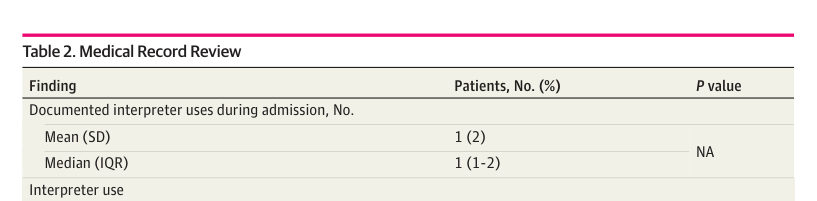
On univariate analysis, Chinese-language (Cantonese, Mandarin, Toishanese) LEP patients were about 3 times more likely than patients speaking a language other than Spanish or Chinese to have an interpreter documented in the first 24 hours (Table 2). Source inconsistency: the Results text assigns Chinese an odds ratio of 2.98 (95% CI, 1.13–7.84; P = .03), whereas Table 2 assigns Chinese an odds ratio of 2.87 (95% CI, 1.17–7.05; P = .02) — the OR/CI/P values for Spanish and Chinese are swapped between the text and the table. Both are quoted verbatim below; the reviewer should resolve which mapping is correct. Either way the estimate is ~2.9, statistically significant, with "other language" as the reference.
"Patients speaking Spanish or Chinese languages were approximately 3 times more likely than those speaking another language to have an interpreter used in the first 24 hours (Spanish, odds ratio, 2.87; 95% CI, 1.17-7.05, P = .02; Chinese language, odds ratio, 2.98; 95% CI, 1.13-7.84; P = .03)" (Cevallos, 2024, pp. 1–2)
"Chinese, OR (95% CI) / 2.87 (1.17-7.05) / .02" (Cevallos, 2024, p. 2, Table 2)
Methods Context #
What? #ⓘ
The observable: the odds of a professional interpreter being documented within the first 24 hours for Chinese-language patients relative to the "other language" reference group.
"Interpreter use first 24 h / Other / 1 [Reference]" (Cevallos, 2024, p. 2, Table 2)
How? #ⓘ
Univariate (unadjusted) analysis in Stata, with preferred-language group as the exposure and first-24-hour interpreter use as the outcome; "other, non-English" language was the reference.
"Data were analyzed from May to October 2021 using univariate analysis with Stata statistical software version 16.1 (StataCorp). Significance was set at 2-sided P < .05." (Cevallos, 2024, p. 1)
Who? #ⓘ
117 LEP patients (46 Chinese [39.3%], 34 Spanish [29.1%], 37 other non-English [31.6%]) aged ≥18 admitted for appendectomy, cholecystectomy, or colectomy at a single urban academic center, 2019–2020.
"Languages included Chinese (Cantonese, Mandarin, and Toishanese) languages (46 patients [39.3%]) and Spanish (34 patients [29.1%]), with the remaining 37 (31.6%) categorized as other, comprising 13 additional languages (Table 1)." (Cevallos, 2024, p. 1)
Other Notes #
Text vs Table 2 OR swap (Chinese 2.98 in text / 2.87 in table) flagged for reviewer; both quoted verbatim.
Caveats #
- Small single-center cohort analyzed only with unadjusted univariate statistics (Cevallos 2024) [Inferred] The language-group associations rest on a small (n = 117), single-center retrospective EHR cohort from one urban academic center over 2019–2020, analyzed only with unadjusted univariate statistics. The odds-ratio estimates are consequently imprecise (wide 95% CIs spanning roughly 1.1 to 7.8) and unadjusted for confounders such as case mix, insurance, or clinician; the single-site design limits generalizability to other settings. No multivariable adjustment was performed.
- Self-reported language preference may misclassify the LEP cohort (Cevallos 2024) The cohort and its language groups are defined by self-reported preferred language, which is susceptible to self-reporting bias: patients may underreport limited English proficiency because of perceptions or social desirability. This can misclassify who counts as LEP and which language group they fall into, biasing both the composition of the cohort and the language-group association estimates.