LEP surgical inpatients had a median of 1 documented interpreter use during their stay
Source
Jenny Cevallos (2024). Use of Professional Interpreters for Patients With Limited English Proficiency Undergoing Surgery. JAMA Network Open.
Description #
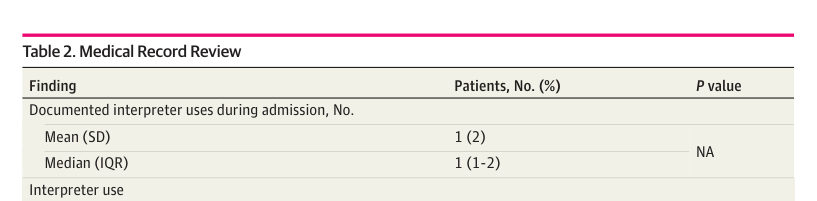
Across the whole LEP surgical cohort, the number of documented professional interpreter uses over the length of stay was low: mean (SD) of 1 (2) and median (IQR) of 1 (1–2) uses (Table 2). Even among a cohort with a mean length of stay of about 4 days, the typical patient had only a single documented interpreter encounter.
"Overall, the study population had a mean (SD) of 1 (2) (median [IQR], 1 [1-2]) interpreter uses documented throughout their LOS." (Cevallos, 2024, p. 1)
"Documented interpreter uses during admission, No. / Mean (SD) / 1 (2) / Median (IQR) / 1 (1-2)" (Cevallos, 2024, p. 2, Table 2)
Methods Context #
What? #ⓘ
The observable: the count of professional interpreter uses (in-person or telehealth) documented in the EHR across the admission.
"Documented interpreter uses during admission, No." (Cevallos, 2024, p. 2, Table 2)
How? #ⓘ
Retrospective EHR-based cohort study using univariate analysis in Stata; interpreter uses were tallied from the medical record.
"Data were analyzed from May to October 2021 using univariate analysis with Stata statistical software version 16.1 (StataCorp)." (Cevallos, 2024, p. 1)
Who? #ⓘ
117 LEP patients aged ≥18 admitted for appendectomy, cholecystectomy, or colectomy at a single urban academic center, 2019–2020 (mean length of stay 4 [SD 1.6] days).
"Of the 130 patients with LEP, the analytical cohort included 117 patients (74 female [63.3%]; mean [SD] age, 64 [17.3] years)." (Cevallos, 2024, p. 1)
Caveats #
- EHR documentation likely undercounts actual interpreter use (Cevallos 2024) Because the interpreter-use measures are derived from EHR documentation in an observational study, they capture only documented interpreter use, which the authors expect to undercount actual use. The low documented rates (88% ever, median 1 use, 53% first-24-hour, 3.4% at discharge) may therefore overstate true underutilization: real interpreter usage likely exceeds what the record shows. This is why the authors argue that language-concordant discharge forms — which exist in the EHR only when actually provided — are a more reliable metric of deficiency than interpreter documentation.