Hip arthroplasty patients showed higher proxy-interpreter agreement than knee patients across outcomes
Source
Xue (2019). Interpreter proxy versus healthcare interpreter for administration of patient surveys following arthroplasty: a pilot study. BMC Med Res Methodol.
Description #
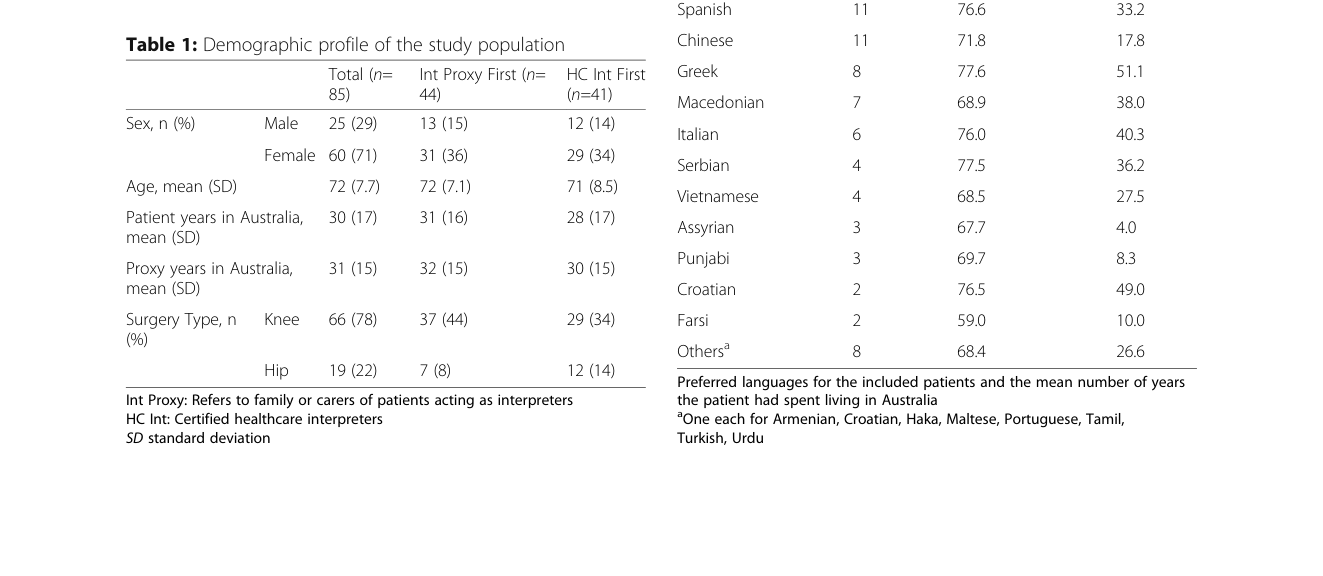
Patients who had undergone hip arthroplasty consistently showed higher proxy-versus-interpreter agreement than knee arthroplasty patients across outcomes (all except the complications item), even though the only questioning differences were the three joint-specific Oxford items. The authors attribute this to knee patients experiencing greater day-to-day variability in pain and function, which lowers agreement on daily-situation measures such as the EQ-5D. This is a text-only subgroup observation; no separate hip-vs-knee agreement table is reported (the study population was n = 66 knee, n = 19 hip; Table 1).
"Patients who underwent hip arthroplasty consistently demonstrated a higher level of agreement when compared with knee arthroplasty patients." (Xue, 2019, p. 4)
"The results showed that patients who had a hip arthroplasty recorded higher levels of agreement for all outcomes apart from complication, despite the only differences in questioning being the three joint-specific items in the Oxford questionnaires." (Xue, 2019, p. 6)
Methods Context #
What? #ⓘ
The observable: proxy-versus-interpreter agreement stratified by surgery type (hip vs knee arthroplasty).
"Patients who underwent hip arthroplasty consistently demonstrated a higher level of agreement when compared with knee arthroplasty patients." (Xue, 2019, p. 4)
How? #ⓘ
Qualitative comparison of the agreement levels between hip and knee subgroups (no formal statistical test of the difference reported); the authors interpret the gap mechanistically via day-to-day symptom variability. See A-0009ArtifactA-0009Initial AI draftInterpreter proxy survey administration (family or carer, 2-way telephone)A pragmatic, low-cost method for administering patient-reported outcome surveys by telephone to LEP patients, using the patient's own family member or carer as the interpreter proxy in place of a certified professional h….
"This may have been due to the fact that patients who undergo knee operations experience greater day-to-day variability in their pain and function levels (possibly even dependent on weather conditions), which would account for the lower agreement levels in the EQ-5D which assesses daily situation compared with the Oxford scores which assess the most recent 4 week period." (Xue, 2019, pp. 6, 8)
Who? #ⓘ
85 LEP arthroplasty patients, of whom 66 (78%) had knee and 19 (22%) had hip surgery.
"Surgery Type, n (%) Knee 66 (78) ... Hip 19 (22)" (Xue, 2019, p. 4, Table 1)
Other Notes #
Because the hip subgroup was small (n = 19), this subgroup difference is exploratory; the paper reports no confidence interval or significance test for it.
Caveats #
- Per-language effects on proxy-interpreter agreement could not be assessed (insufficient n, many languages) The study could not assess whether the level of proxy-versus-interpreter agreement varied by the patient's specific language, because the sample (85 patients across at least 13 language groups) was too small and too linguistically fragmented for per-language analysis. Agreement may plausibly differ across languages (and the cultural framing of survey items), so the pooled agreement estimates could mask language-specific reliability problems.