Complication responses showed lower proxy-interpreter agreement (kappa 0.69) attributed to an ambiguous complication definition
Source
Xue (2019). Interpreter proxy versus healthcare interpreter for administration of patient surveys following arthroplasty: a pilot study. BMC Med Res Methodol.
Description #
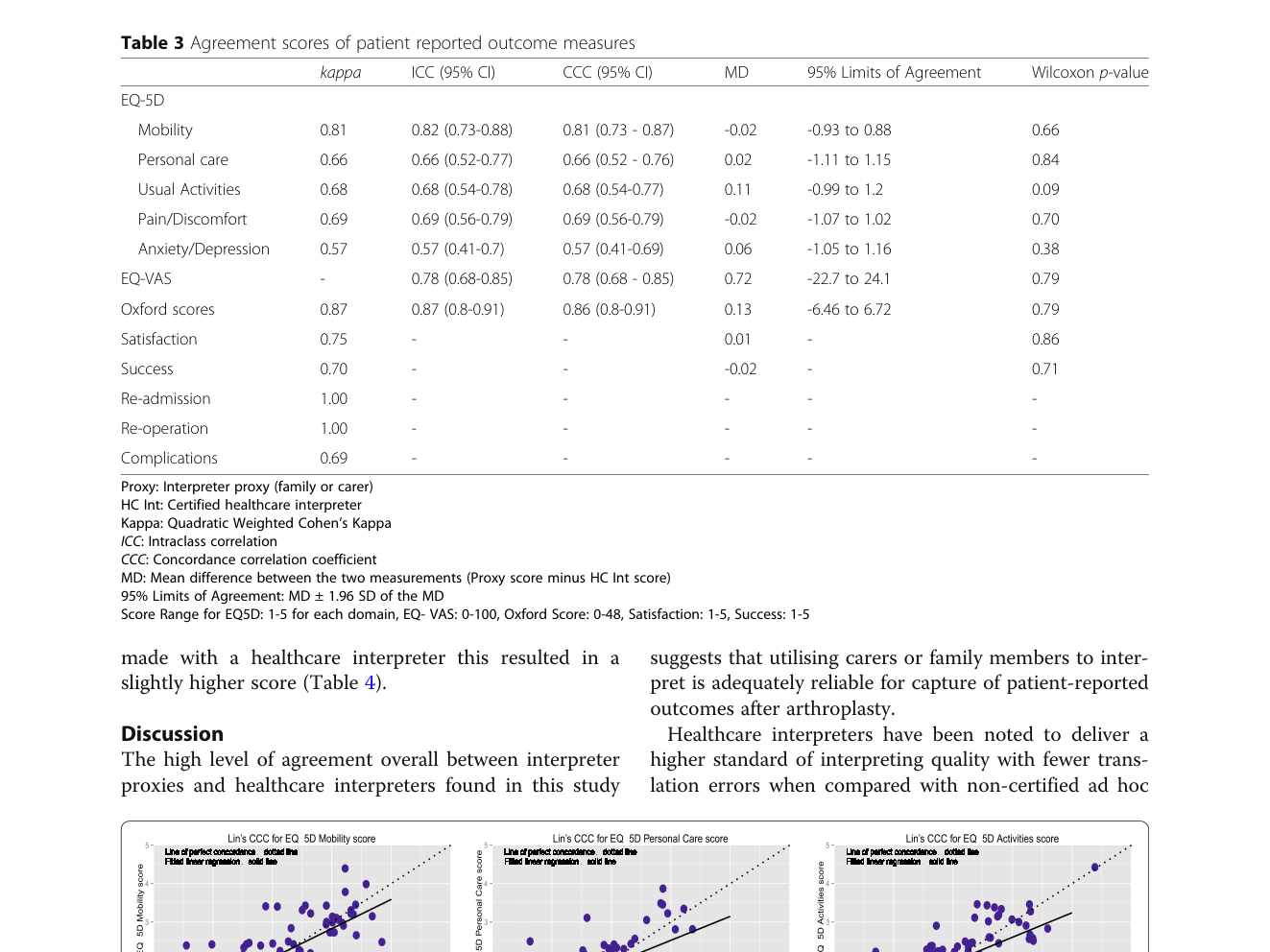
The complications item showed the lowest agreement among the yes/no event questions, with kappa = 0.69 (substantial but not perfect) between interpreter-proxy and healthcare-interpreter administration (Table 3). The authors attribute this to uncertainty over what counts as a complication (defined as requiring active management but not readmission or reoperation), unlike the discrete readmission/reoperation events that reached kappa = 1.00.
"Complications 0.69 - - - - -" (Xue, 2019, p. 5, Table 3)
"Agreement for determining complication was lower (kappa = 0.69), a discrepancy which may have been due to uncertainty over the exact nature of a complication, which was defined as requiring active management but not readmission or reoperation." (Xue, 2019, p. 6)
Methods Context #
What? #ⓘ
The observable: agreement between the two administration methods on the yes/no complications item.
"Complications: 'Have you experienced any complications after the operation since being discharged from hospital'; a standard list of common complications was read out." (Xue, 2019, p. 3)
How? #ⓘ
Nominal data were analysed with an unweighted Cohen's kappa on the paired proxy/interpreter responses from each participant's two randomised interviews. See A-0009ArtifactA-0009Initial AI draftInterpreter proxy survey administration (family or carer, 2-way telephone)A pragmatic, low-cost method for administering patient-reported outcome surveys by telephone to LEP patients, using the patient's own family member or carer as the interpreter proxy in place of a certified professional h….
"Nominal data measures were analysed with an unweighted Cohen's kappa coefficient." (Xue, 2019, p. 3)
Who? #ⓘ
85 LEP hip or knee arthroplasty patients at their routine 6-month registry follow-up.
"Eighty-five patients successfully received both methods of follow-up calls and were included in the data analysis." (Xue, 2019, p. 3)
Other Notes #
This is the one event item that did not reach perfect agreement; the authors treat the ambiguous item definition, not the interpreter type, as the likely driver.