Readmission and reoperation responses showed perfect proxy-interpreter agreement (kappa 1.00) after arthroplasty
Source
Xue (2019). Interpreter proxy versus healthcare interpreter for administration of patient surveys following arthroplasty: a pilot study. BMC Med Res Methodol.
Description #
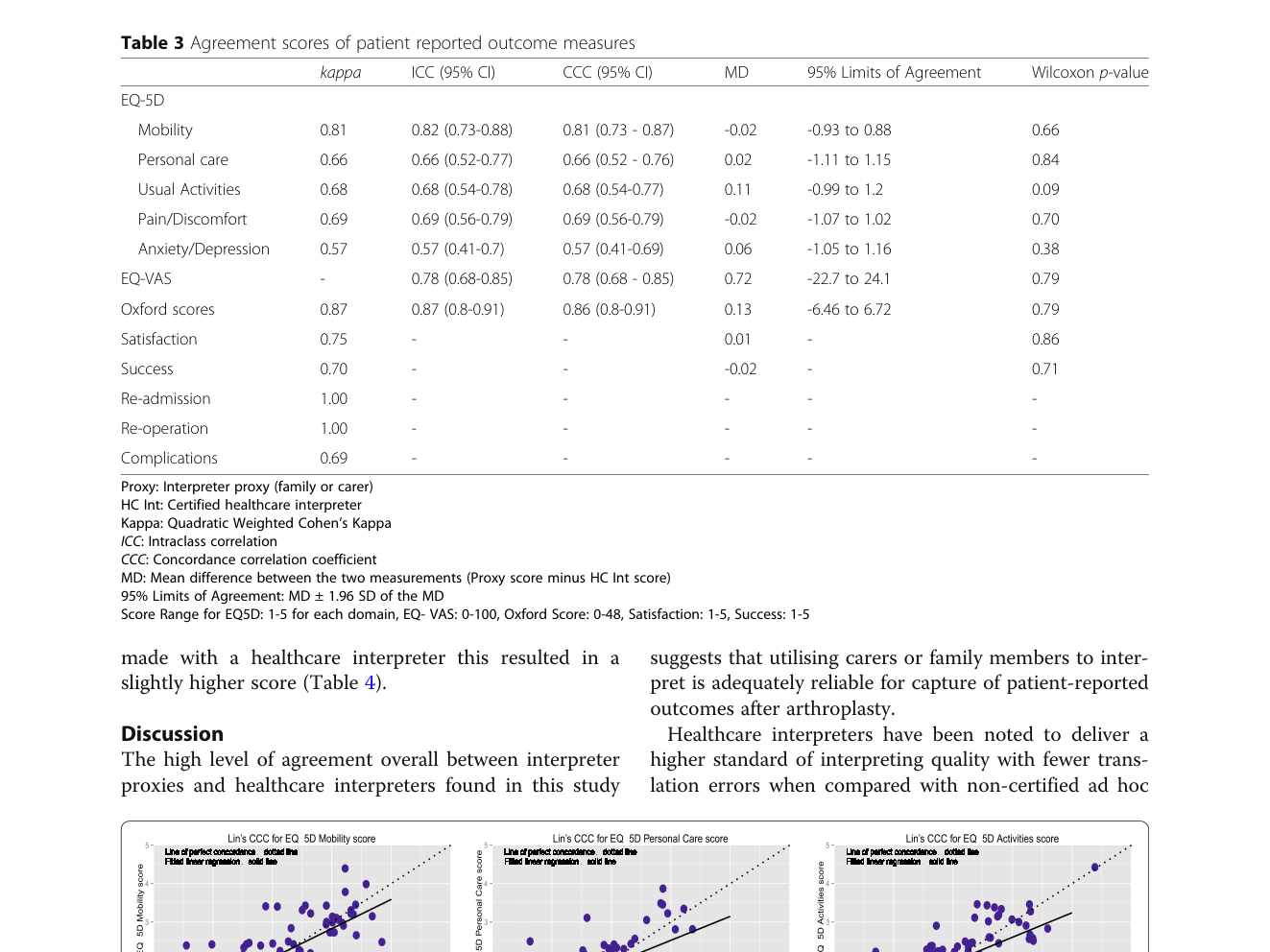
The two nominal (yes/no) event items — hospital readmission and reoperation on the same joint — showed perfect agreement between interpreter-proxy and healthcare-interpreter administration, each with an unweighted kappa of 1.00 (Table 3). The authors interpret this as expected, since readmission and reoperation are salient, memorable events accurately reported through either interpreter type.
"Re-admission 1.00 - - - - -" (Xue, 2019, p. 5, Table 3)
"The perfect agreement (kappa = 1) between the responses regarding readmission and reoperation was expected assuming that the question was accurately asked by both types of interpreters as these are significant events for the patient." (Xue, 2019, p. 6)
Methods Context #
What? #ⓘ
The observable: agreement between the two administration methods on the yes/no readmission and reoperation items.
"Readmission: 'Were you admitted to hospital again since leaving hospital after the knee/hip replacement?' answered as yes or no." (Xue, 2019, p. 3)
How? #ⓘ
Nominal data were analysed with an unweighted Cohen's kappa on the paired proxy/interpreter responses from each participant's two randomised interviews. See A-0009ArtifactA-0009Initial AI draftInterpreter proxy survey administration (family or carer, 2-way telephone)A pragmatic, low-cost method for administering patient-reported outcome surveys by telephone to LEP patients, using the patient's own family member or carer as the interpreter proxy in place of a certified professional h….
"Nominal data measures were analysed with an unweighted Cohen's kappa coefficient." (Xue, 2019, p. 3)
Who? #ⓘ
85 LEP hip or knee arthroplasty patients at their routine 6-month registry follow-up.
"Eighty-five patients successfully received both methods of follow-up calls and were included in the data analysis." (Xue, 2019, p. 3)
Other Notes #
Perfect agreement (kappa = 1.00) on these discrete objective events contrasts with the lower agreement (0.69) on the complications item, which had an ambiguous definition — supporting a differential-agreement-by-item-type pattern.