EQ-5D-5L domain agreement varied from 0.57 (anxiety-depression) to 0.81 (mobility) between proxy and interpreter
Source
Xue (2019). Interpreter proxy versus healthcare interpreter for administration of patient surveys following arthroplasty: a pilot study. BMC Med Res Methodol.
Description #
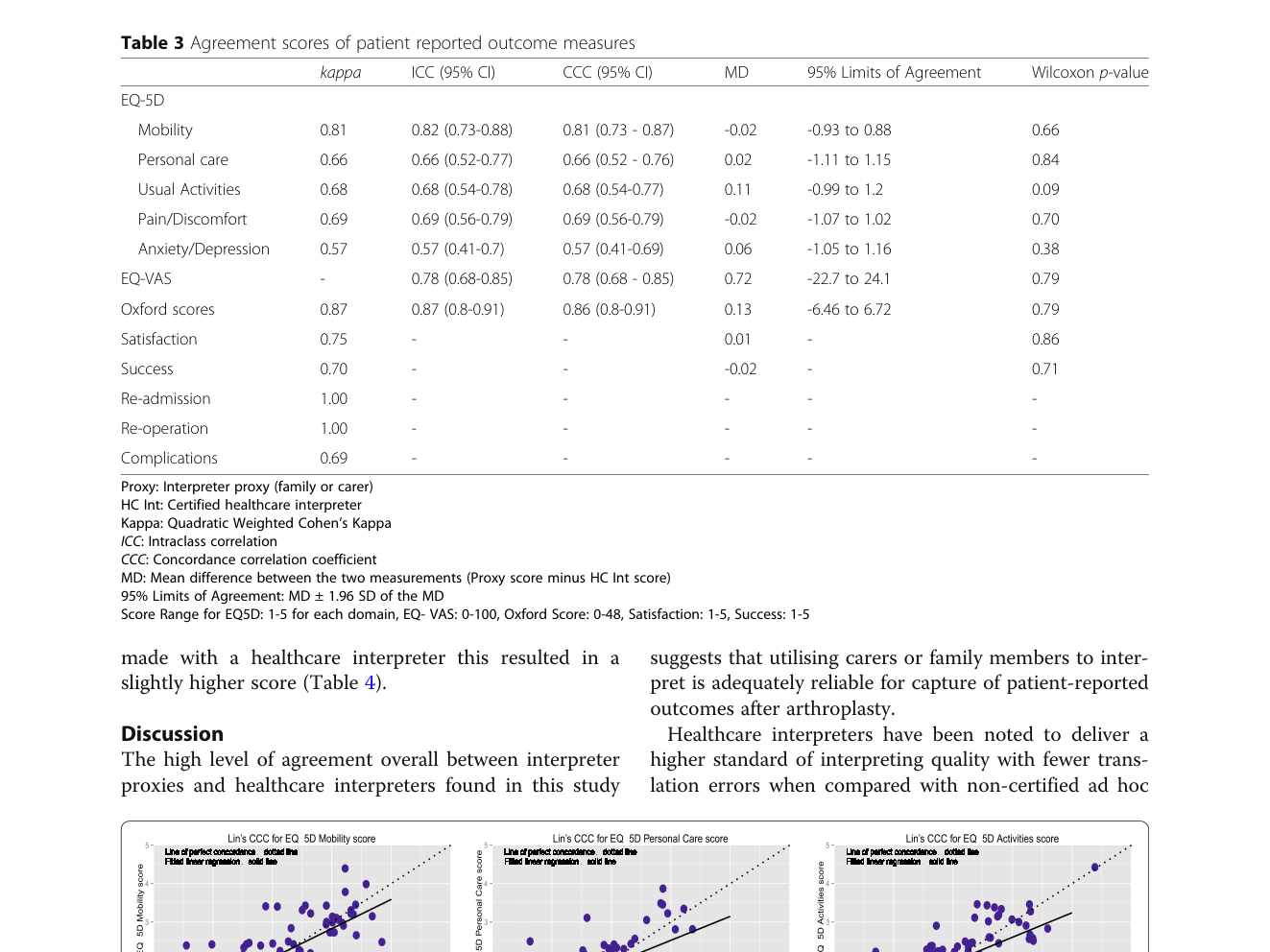
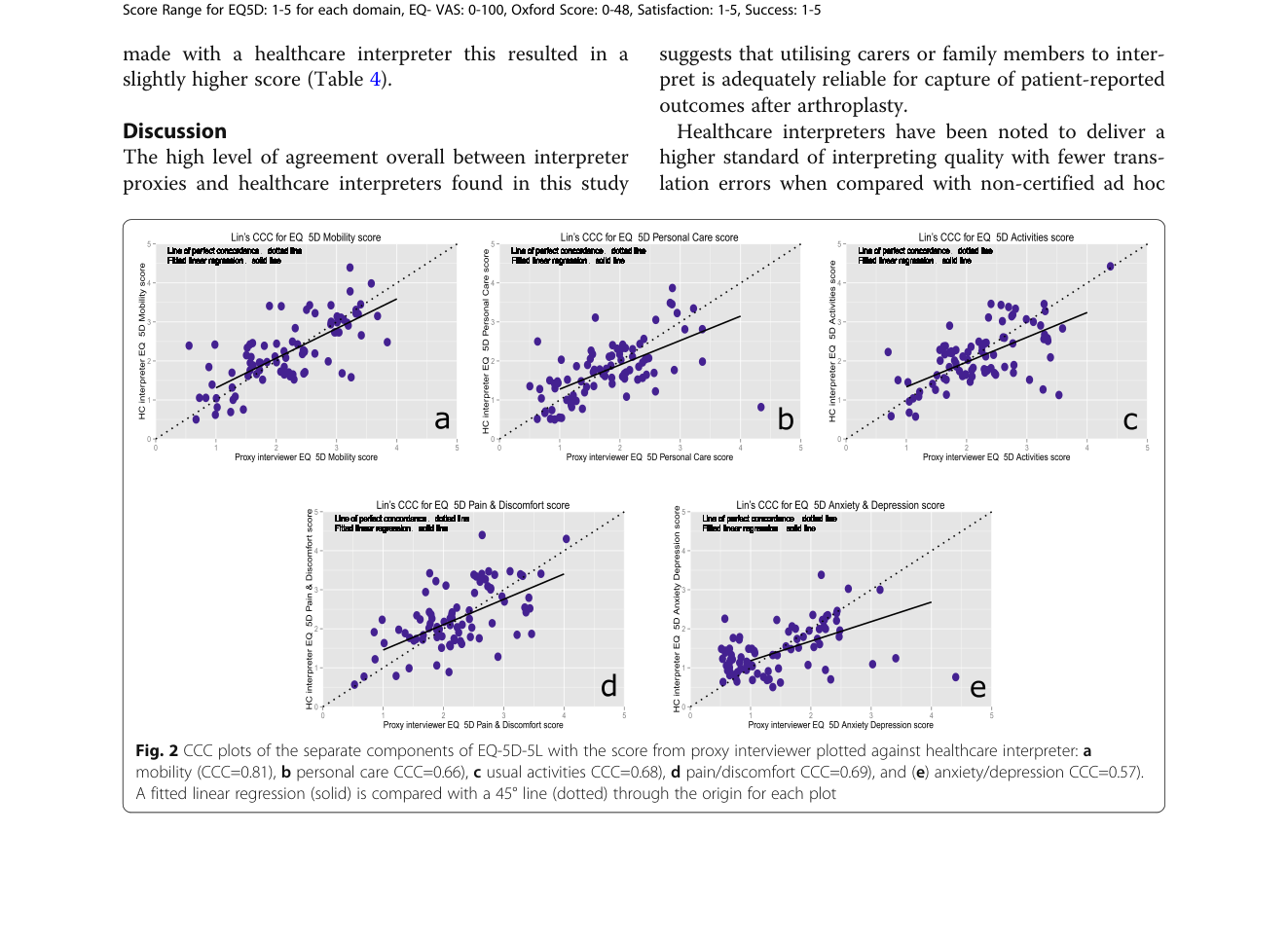
Agreement between interpreter-proxy and healthcare-interpreter administration varied considerably across the five EQ-5D-5L domains (Table 3, Fig. 2): mobility highest (kappa/ICC/CCC = 0.81), then pain/discomfort (0.69), usual activities (0.68), personal care (0.66), and anxiety/depression lowest (0.57 — the single measure falling below the "substantial" 0.60 threshold). Anxiety/depression was thus the only EQ-5D domain that did not reach at least substantial agreement.
"Agreement for different sections of the EQ-5D varied considerably with scores from 0.57 anxiety/depression to 0.81 for mobility." (Xue, 2019, p. 4)
"Anxiety/Depression 0.57 0.57 (0.41-0.7) 0.57 (0.41-0.69) 0.06 -1.05 to 1.16 0.38" (Xue, 2019, p. 5, Table 3)
Methods Context #
What? #ⓘ
The observable: agreement between the two administration methods on each of the five EQ-5D-5L health domains (mobility, personal care, usual activities, pain/discomfort, anxiety/depression), each a 5-point Likert item.
"The EQ-5D-5 L rates the patient's mobility, personal care, usual activities, pain/discomfort and anxiety/depression levels in separate 5-point Likert scales, in which for each category a score of '1' represents the best outcome and a score of '5' the worst." (Xue, 2019, p. 3)
How? #ⓘ
Each domain's ordinal paired scores were analysed with quadratic-weighted kappa, ICC, and CCC; CCC plots per domain are shown in Fig. 2. See A-0009ArtifactA-0009Initial AI draftInterpreter proxy survey administration (family or carer, 2-way telephone)A pragmatic, low-cost method for administering patient-reported outcome surveys by telephone to LEP patients, using the patient's own family member or carer as the interpreter proxy in place of a certified professional h….
"Ordinal data were analysed using quadratic weighted Cohen's kappa coefficients, intraclass coefficients (ICC) measuring absolute agreement and Lin's concordance correlation coefficient (CCC) for each outcome measure" (Xue, 2019, p. 3)
Who? #ⓘ
85 LEP hip or knee arthroplasty patients at their routine 6-month registry follow-up.
"Eighty-five patients successfully received both methods of follow-up calls and were included in the data analysis." (Xue, 2019, p. 3)
Other Notes #
The authors attribute the lower EQ-5D agreement (versus Oxford) to the EQ-5D assessing the current daily situation, which is subject to greater day-to-day variability, versus the Oxford's most-recent-4-week window.
Caveats #
- English-version surveys (not language-specific translations) plus variable proxy linguistic skill may have affected accuracy The validated surveys were administered in their English versions and translated on the fly by the interpreter or proxy, rather than using language-specific validated translations. Because of this, variation in the linguistic skill of the (untrained) proxy interpreters may have affected accuracy — an uncontrolled source of measurement error that could inflate or deflate the observed agreement.