Oxford hip-knee score showed almost perfect proxy-interpreter agreement (kappa-ICC 0.87, CCC 0.86) after arthroplasty
Source
Xue (2019). Interpreter proxy versus healthcare interpreter for administration of patient surveys following arthroplasty: a pilot study. BMC Med Res Methodol.
Description #
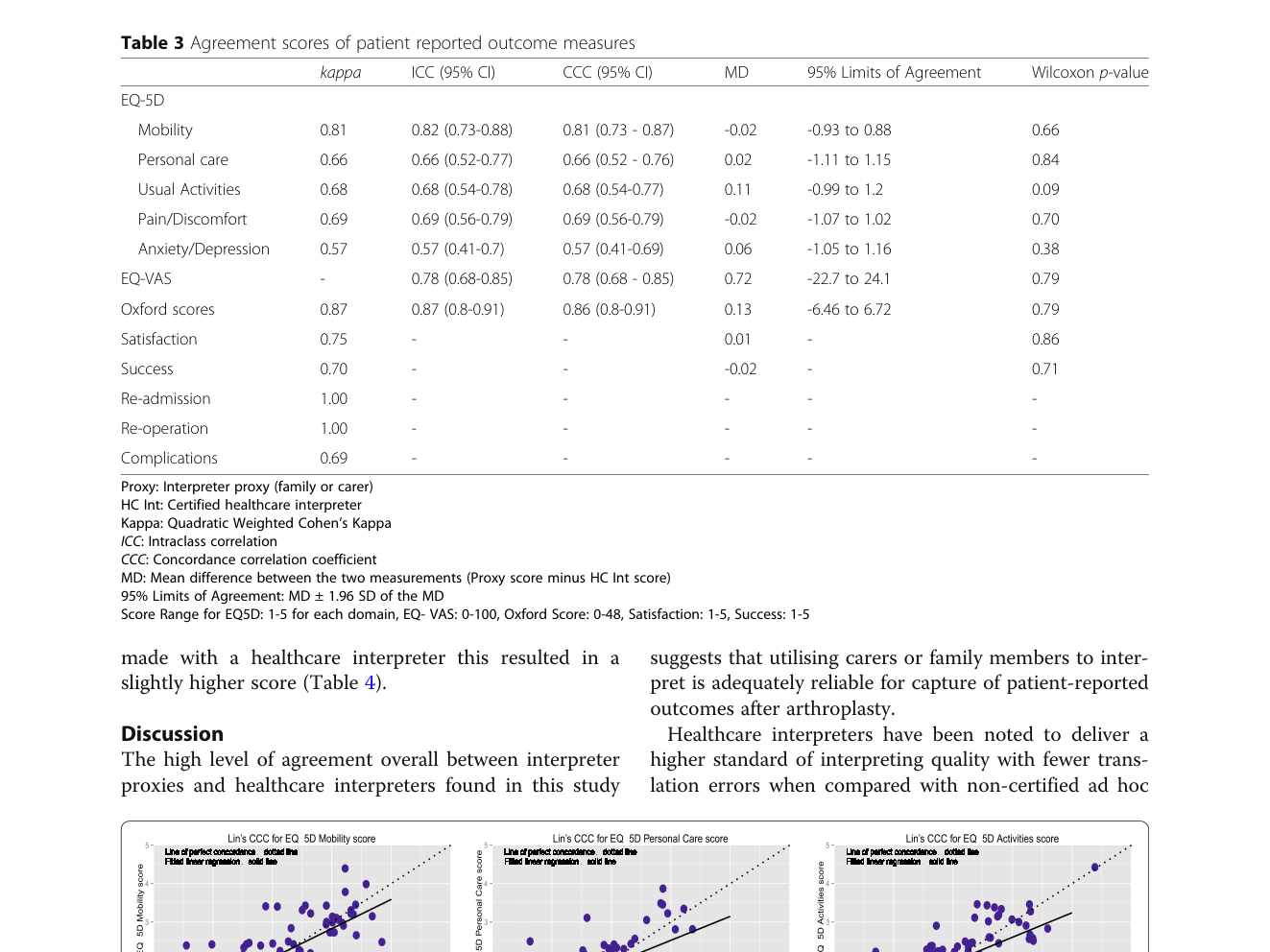
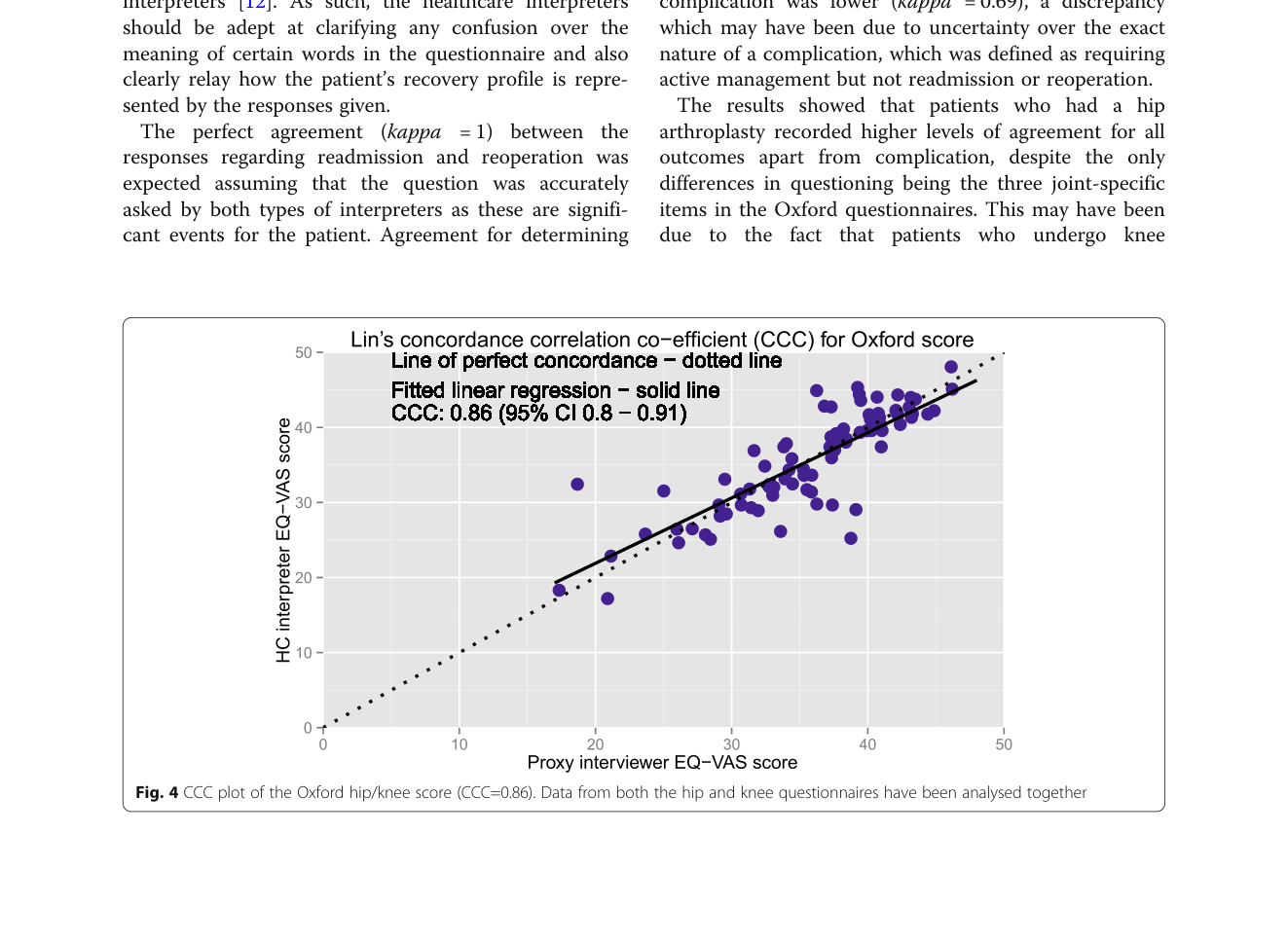
The joint-specific Oxford Hip/Knee Score (a 12-item, 0–48 pain-and-function PROM) showed almost perfect agreement between interpreter-proxy and healthcare-interpreter administration: kappa = 0.87, ICC = 0.87 (95% CI 0.8–0.91), and CCC = 0.86 (95% CI 0.8–0.91), with a mean difference of just 0.13 points (Table 3, Fig. 4). This was the highest agreement of any continuous/ordinal scale in the study.
"Perfect agreement was seen in re-admission and reoperation responses and almost perfect agreement was seen in the Oxford score responses (kappa and ICC = 0.87, CCC = 0.86)." (Xue, 2019, p. 4)
"Oxford scores 0.87 0.87 (0.8-0.91) 0.86 (0.8-0.91) 0.13 -6.46 to 6.72 0.79" (Xue, 2019, p. 5, Table 3)
Methods Context #
What? #ⓘ
The observable: agreement between the two administration methods on the total Oxford Hip/Knee Score, a joint-specific patient-reported pain-and-function instrument scored 0–48 (higher = better).
"Joint-specific patient-reported pain and function was assessed using the Oxford Hip Score (OHS) and Oxford Knee Score (OKS) (English version). This is a 12-question survey using a Likert scale (0–4)... The summary score minimum is 0 and the maximum score of 48 denotes the best outcome" (Xue, 2019, p. 3)
How? #ⓘ
Paired scores from the same participant's two interviews (proxy and healthcare interpreter, randomised order) were compared with quadratic-weighted kappa, ICC (absolute agreement), and Lin's CCC; hip and knee questionnaire data were analysed together. See A-0009ArtifactA-0009Initial AI draftInterpreter proxy survey administration (family or carer, 2-way telephone)A pragmatic, low-cost method for administering patient-reported outcome surveys by telephone to LEP patients, using the patient's own family member or carer as the interpreter proxy in place of a certified professional h….
"Ordinal data were analysed using quadratic weighted Cohen's kappa coefficients, intraclass coefficients (ICC) measuring absolute agreement and Lin's concordance correlation coefficient (CCC) for each outcome measure to assess the magnitude of agreement between interpreter proxy and healthcare interpreter." (Xue, 2019, p. 3)
Who? #ⓘ
85 LEP hip or knee arthroplasty patients at their routine 6-month registry follow-up.
"Eighty-five patients successfully received both methods of follow-up calls and were included in the data analysis." (Xue, 2019, p. 3)
Other Notes #
The Bland-Altman analysis (Fig. 6) gives a mean difference of 0.13 (1.1% of total score) with 95% limits of agreement −6.46 to 6.72, narrower relative to score range than the EQ-VAS.
Caveats #
- Findings limited to arthroplasty follow-up and may not generalize to socially sensitive survey topics The reliability findings come only from routine, low-stigma arthroplasty outcome questions. The authors caution that they may not generalise to other settings, and in particular to socially sensitive topics, where using a family or carer as the interpreter proxy could compromise disclosure and thereby reduce the accuracy of proxy interpreting. The favourable agreement should therefore not be assumed to hold for sensitive clinical content.