Private insurance predicted greater colposcopy consent comprehension (b=-1.05 for non-private, p=.005)
Source
Krankl (2011). Patient predictors of colposcopy comprehension of consent among English- and Spanish-speaking women. Womens Health Issues.
Description #
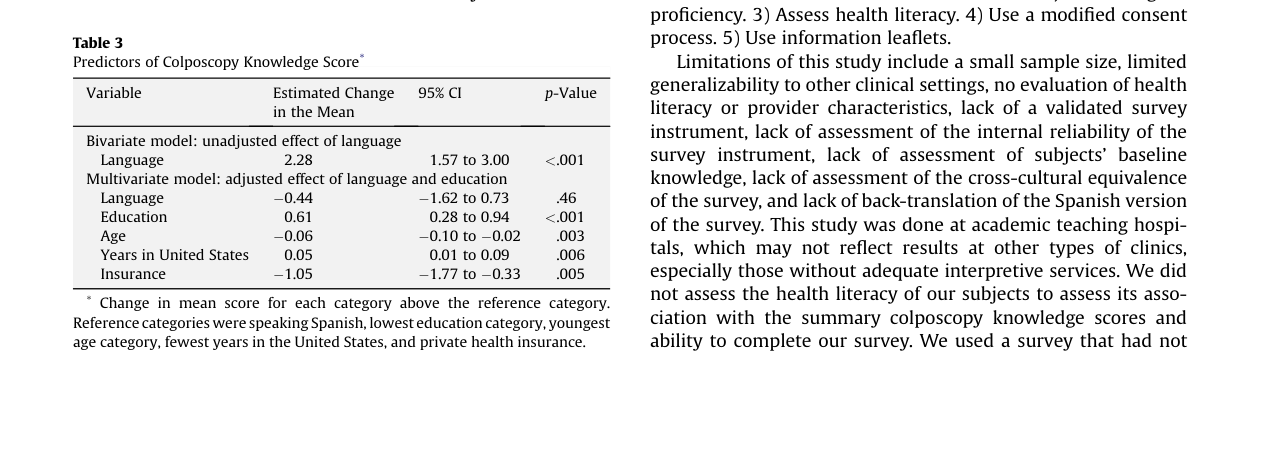
In the adjusted multivariate model, insurance status independently predicted colposcopy comprehension (β = −1.05; 95% CI −1.77 to −0.33; p = .005) (Table 3). Private insurance was the reference category, so non-private insurance was associated with a 1.05-point lower summary knowledge score; the authors frame this as private insurance predicting greater comprehension. Insurance differed sharply by language group (71% of English speakers vs 21% of Spanish speakers had private insurance).
"We also found that … private health insurance status (β = −1.05; p = .005) were associated with increased comprehension of informed consent." (Krankl, 2011, p. 83)
"Insurance −1.05 −1.77 to −0.33 .005" (Krankl, 2011, p. 84)
Methods Context #
What? #ⓘ
The observable: the adjusted effect of insurance status on the summary colposcopy knowledge score.
"Insurance −1.05 −1.77 to −0.33 .005" (Krankl, 2011, p. 84)
How? #ⓘ
Robust multivariate linear regression; insurance retained as a confounder (p < .05), estimated as change in mean score per category above the private-insurance reference category.
"Reference categories were speaking Spanish, lowest education category, youngest age category, fewest years in the United States, and private health insurance." (Krankl, 2011, p. 84)
Who? #ⓘ
The 149 complete-data colposcopy patients at two Boston hospitals; private-insurance coverage differed markedly by language group.
"Insurance Private 78 (70.9) 8 (21.1) <.001" (Krankl, 2011, p. 83)
Caveats #
- Exploratory analysis with no adjustment for multiple comparisons The analysis was exploratory and the type I error was not adjusted for multiple comparisons, so the many reported p-values should be interpreted cautiously and some significant associations may be chance findings. The authors argue the number of significant associations exceeds what chance alone would produce, but the secondary adjusted predictors (age, years in the US, insurance) in particular should be read as hypothesis-generating rather than confirmatory.