Education was the strongest predictor of colposcopy consent comprehension (b=0.61, p<.001)
Source
Krankl (2011). Patient predictors of colposcopy comprehension of consent among English- and Spanish-speaking women. Womens Health Issues.
Description #
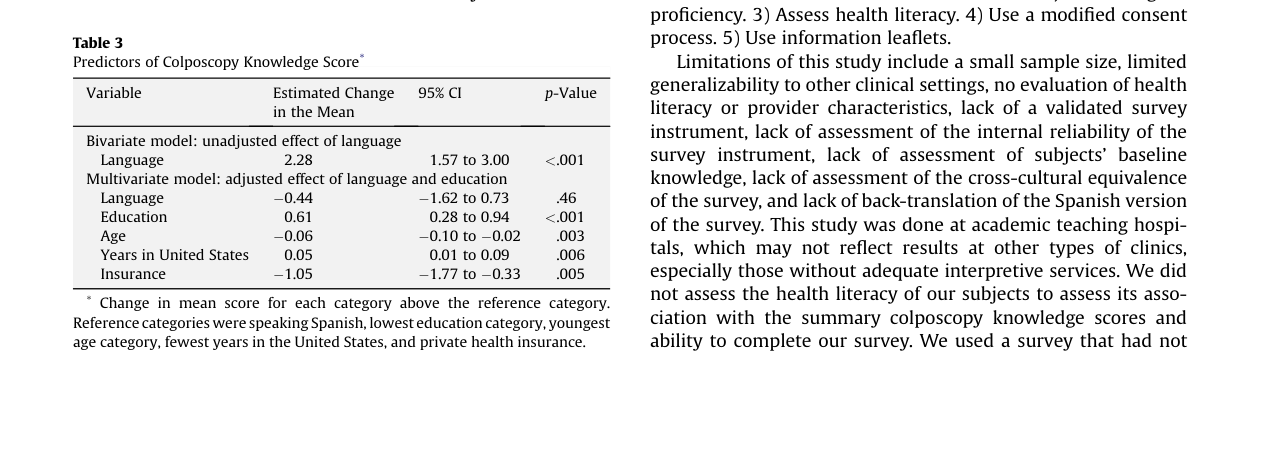
In the adjusted multivariate model, education was the most significant predictor of colposcopy comprehension: each step up in highest completed education level was associated with a 0.61-point increase in the summary knowledge score (β = 0.61; 95% CI 0.28 to 0.94; p < .001) (Table 3). More educated subjects had greater understanding of colposcopy for informed consent, and this effect persisted where language did not — grounding the authors' thesis that the observed language gap was a proxy for education.
"Education was the most significant predictor of subjects' comprehension of colposcopy information for informed consent (β = 0.61; p < .001), with more educated subjects having greater understanding of colposcopy." (Krankl, 2011, p. 83)
"Rather, education was the most significant predictor of colposcopy knowledge (p < .001)." (Krankl, 2011, p. 80)
Methods Context #
What? #ⓘ
The observable: the adjusted effect of education (highest completed level) on the summary colposcopy knowledge score, as a regression coefficient with 95% CI.
"Education 0.61 0.28 to 0.94 <.001" (Krankl, 2011, p. 84)
How? #ⓘ
Robust multivariate linear regression; education was retained as a confounder (p < .05) and estimated as the change in mean score per category above the reference (lowest education category).
"That is, each increase in highest level of completed education (i.e., from junior high school or less to high school/graduate equivalency diploma) was associated with an increase in score of 0.61 of 11 on the summary colposcopy knowledge score." (Krankl, 2011, p. 83)
Who? #ⓘ
The 149 complete-data colposcopy patients; education differed sharply by language group (e.g., 58% of Spanish speakers had junior high or less vs 3% of English speakers, Table 1).
"Education … Junior high school or less 3 (2.7) 22 (57.9) <.001" (Krankl, 2011, p. 83)
Caveats #
- No baseline knowledge measured; education effect may reflect pre-procedure self-research The study measured comprehension only after counseling and did not assess subjects' baseline knowledge of colposcopy or their change in knowledge. The authors note more educated patients may have researched colposcopy beforehand, giving them greater baseline knowledge; without a baseline measure it is impossible to know whether the observed education effect (and the post-counseling scores generally) reflects knowledge acquired during provider counseling or pre-existing knowledge. This directly undercuts causal interpretation of education as a predictor of consent comprehension.