English speakers scored higher than Spanish speakers on colposcopy consent comprehension in unadjusted analysis (8.50 vs 6.21)
Source
Krankl (2011). Patient predictors of colposcopy comprehension of consent among English- and Spanish-speaking women. Womens Health Issues.
Description #
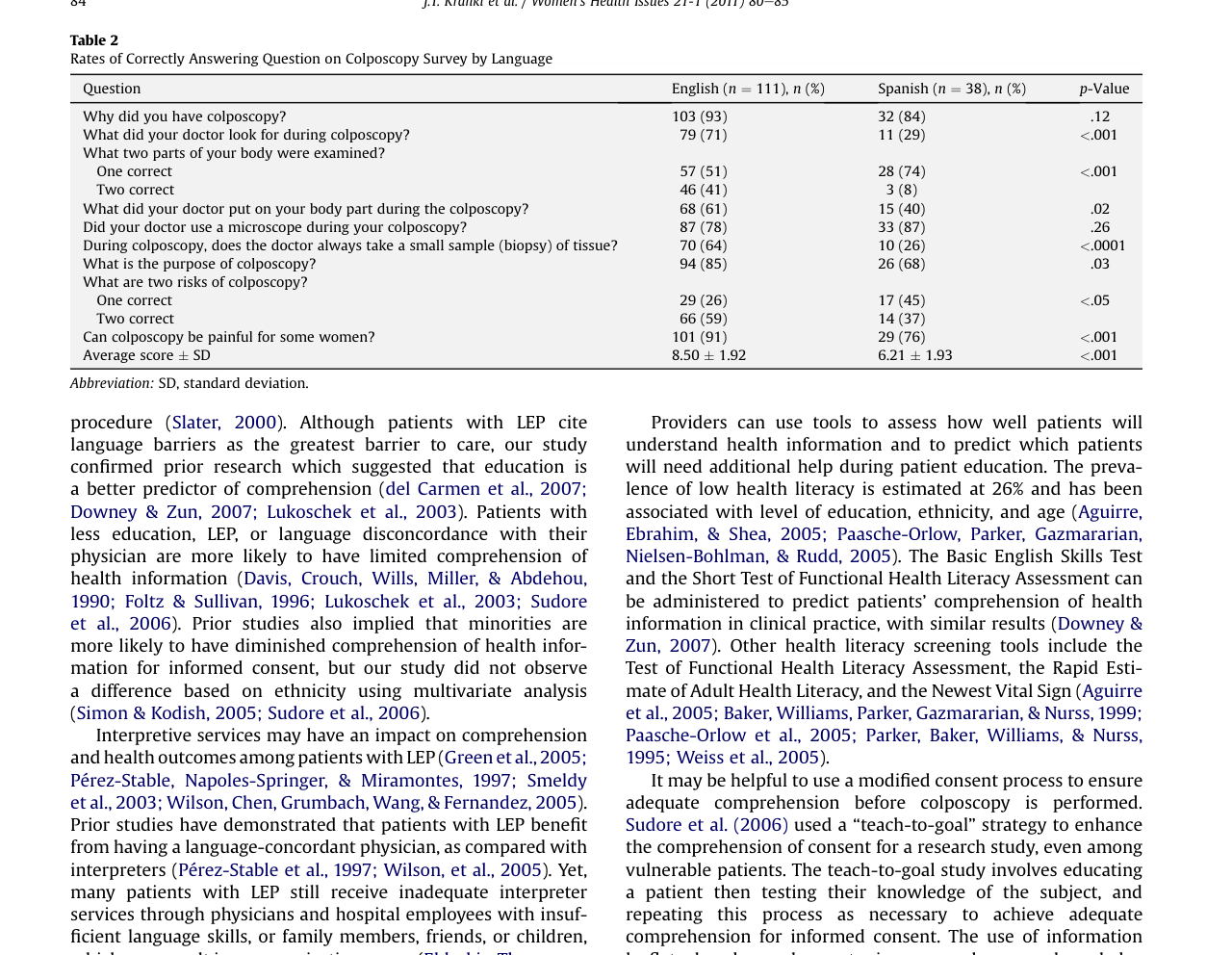
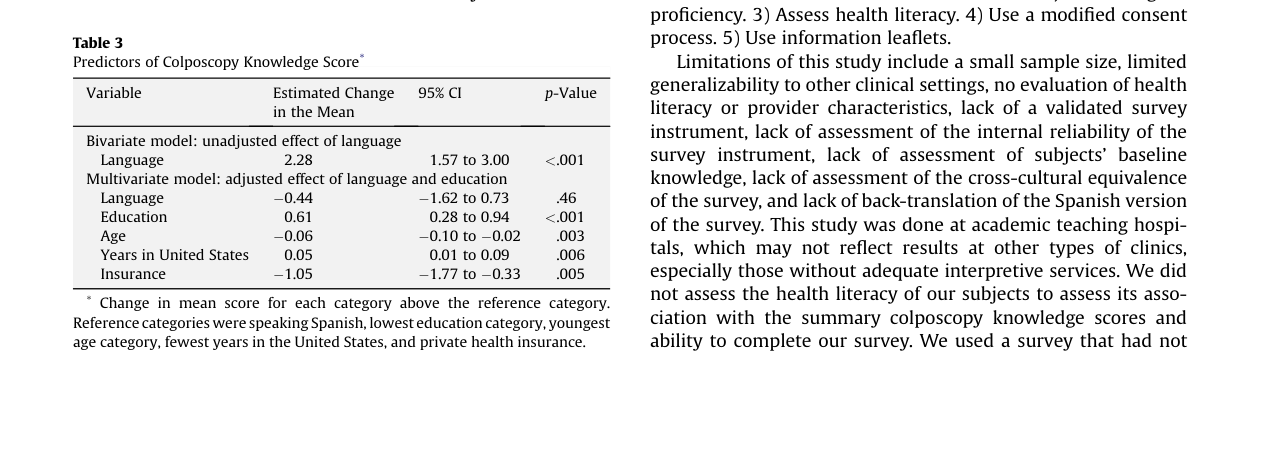
In unadjusted (bivariate) analysis, English speakers correctly answered more colposcopy knowledge-survey questions than Spanish speakers: 8.50 ± 1.92 (77%) versus 6.21 ± 1.93 (56%), p < .001 (Table 2). Expressed as the unadjusted effect of language, speaking English rather than Spanish was associated with a 2.28-point higher summary knowledge score (95% CI 1.57 to 3.00; p < .001) (Table 3). This raw gap is confounded and is later reframed by the authors as a proxy for education (see multivariate EVD and the education-proxy claim).
"English speakers answered more questions correctly than Spanish speakers (8.50 ± 1.92 [77%] vs 6.21 ± 1.93 [56%]; p < .001)." (Krankl, 2011, p. 80)
"In bivariate analysis, speaking English as opposed to Spanish was associated with an increase in summary colposcopy knowledge score of 2.28 of 11 (p < .001)." (Krankl, 2011, p. 83)
Methods Context #
What? #ⓘ
The observable: the summary colposcopy knowledge score (0–11) compared between English- and Spanish-speaking groups.
"English speakers correctly answered 8.50 questions of 11 (77.3%), as compared with only 6.21 questions of 11 (56.5%) for Spanish speakers (p < .001)." (Krankl, 2011, p. 83)
How? #ⓘ
Bivariate comparison of continuous scores between the two language groups; the unadjusted effect of language was also estimated as a change in mean score (Table 3, bivariate model).
"In bivariate analyses, the nonparametric Wilcoxon rank-sum test was used for comparing continuous outcome variables between the two groups." (Krankl, 2011, p. 82)
Who? #ⓘ
111 English-speaking and 38 Spanish-speaking colposcopy patients with complete data at two Boston hospitals (2007); subjects were classed by the language they elected to speak with clinicians.
"This study actually accrued 111 English speakers and 38 Spanish speakers." (Krankl, 2011, p. 82)
Other Notes #
Item-level breakdowns (Table 2) mostly favored English speakers and are consciously folded into this summary finding — e.g., identifying that the doctor looks for cervical cancer (71% English vs 29% Spanish, p < .001) and that a biopsy is not always taken (64% vs 26%, p < .0001). One item ran the other way and was not significant: knowing a microscope is used (78% English vs 87% Spanish, p = .26).
Caveats #
- Small sample with few Spanish speakers, underpowered to detect interpretive-service differences The study had a small overall sample and, in particular, only 38 Spanish-speaking subjects, who were then further divided into interpretive-service subgroups (19 bilingual physician, 10 professional interpreter, 8 nurse-interpreter, 1 both). The authors state this Spanish-speaking sample was likely too small to detect comprehension differences among interpretive-service types if they existed, so the null interpretive-service finding is a Type II-vulnerable result rather than evidence of true equivalence. The small subgroup sizes also widen uncertainty on the between-group comparisons.
- Unvalidated, non-back-translated colposcopy survey with no reliability or cross-cultural equivalence assessment The colposcopy comprehension outcome was measured with a survey instrument that had not been previously validated, whose internal reliability was not assessed, whose cross-cultural equivalence across English and Spanish speakers was not established, and whose Spanish version was translated but not back-translated. This weakens confidence that the summary knowledge score measured comprehension equivalently across language groups, so both the absolute comprehension level and the English–Spanish comparison rest on an unvalidated measure.