Colposcopy patients answered only 72% of consent-comprehension questions correctly on average
Source
Krankl (2011). Patient predictors of colposcopy comprehension of consent among English- and Spanish-speaking women. Womens Health Issues.
Description #
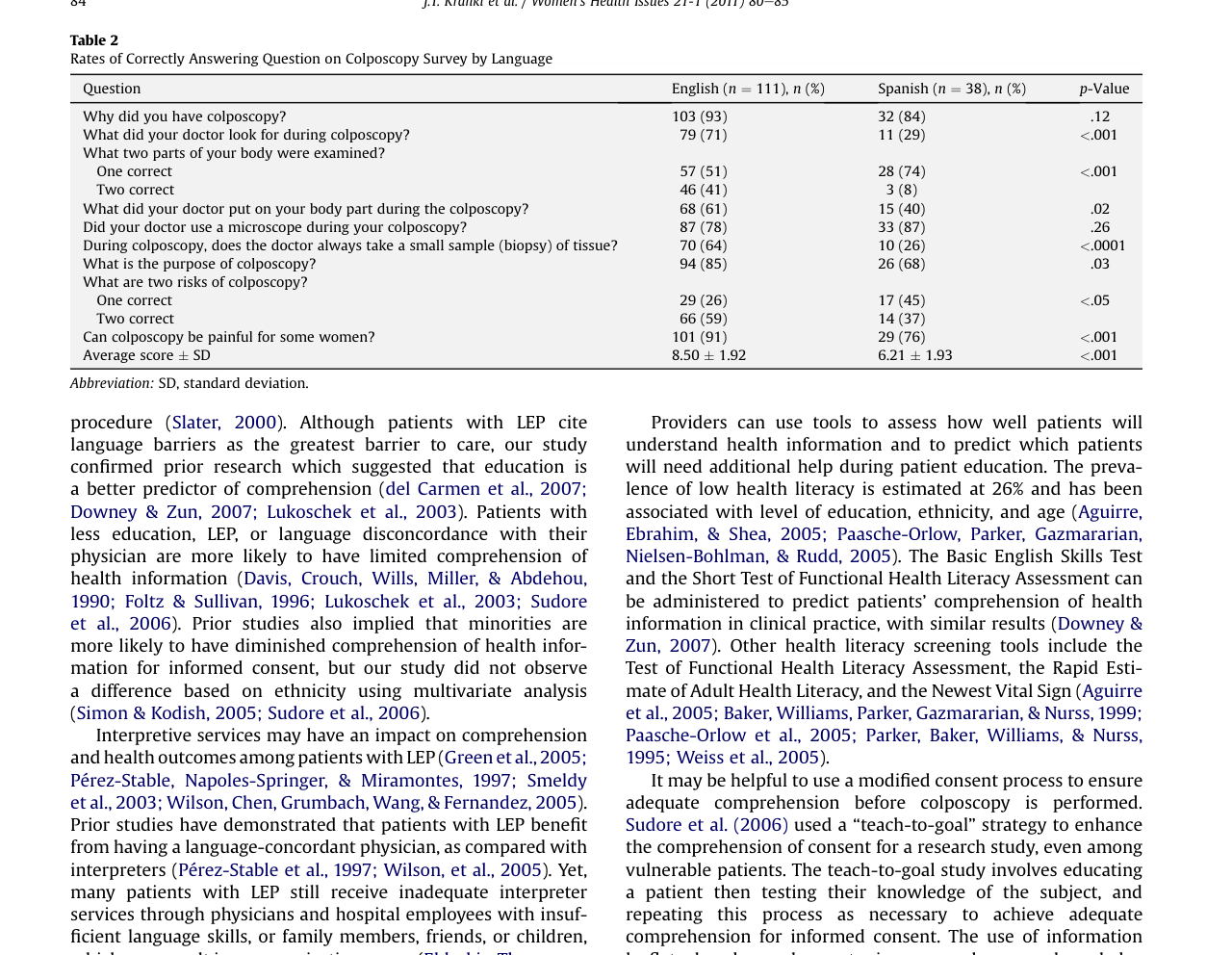
Across all 149 colposcopy patients (English and Spanish speakers combined), subjects correctly answered an average of 7.91 ± 2.16 of the 11 colposcopy knowledge-survey questions — 72% — leading the authors to conclude that many patients did not understand the procedure well enough to give informed consent. Per-group summary scores are tabulated (Table 2); the 72% overall figure is a text/abstract summary of the pooled sample.
"Subjects correctly answered an average of 7.91 ± 2.16 (72%) of 11 colposcopy survey questions." (Krankl, 2011, p. 80)
"On average, subjects correctly answered only 72% of the questions, confirming prior research that suggests that many women undergoing colposcopy do not fully understand the procedure." (Krankl, 2011, p. 83)
Methods Context #
What? #ⓘ
The observable: a summary colposcopy knowledge score (0–11), one point per correctly answered survey question, quantifying comprehension of colposcopy for informed consent.
"A colposcopy knowledge score was created for all subjects. Subjects were given 1 point for each correctly answered question, with the highest possible score being 11." (Krankl, 2011, p. 82)
How? #ⓘ
A self-administered post-procedure survey of purpose, risks, benefits, alternatives, and nature of colposcopy, completed after the usual pre-colposcopy consent counseling, in a cross-sectional design.
"After the colposcopy, subjects completed a brief survey (Figure 1) to assess their understanding of the purpose, risks, benefits, alternatives, and nature of colposcopy." (Krankl, 2011, p. 81)
Who? #ⓘ
149 English- and Spanish-speaking colposcopy patients (≥18 years, fluent/literate in English or Spanish) with complete data, recruited at one tertiary care and one community hospital in Boston, June–August 2007.
"We obtained complete data on 111 English speakers and 38 Spanish speakers." (Krankl, 2011, p. 80)
Caveats #
- Unvalidated, non-back-translated colposcopy survey with no reliability or cross-cultural equivalence assessment The colposcopy comprehension outcome was measured with a survey instrument that had not been previously validated, whose internal reliability was not assessed, whose cross-cultural equivalence across English and Spanish speakers was not established, and whose Spanish version was translated but not back-translated. This weakens confidence that the summary knowledge score measured comprehension equivalently across language groups, so both the absolute comprehension level and the English–Spanish comparison rest on an unvalidated measure.
- No baseline knowledge measured; education effect may reflect pre-procedure self-research The study measured comprehension only after counseling and did not assess subjects' baseline knowledge of colposcopy or their change in knowledge. The authors note more educated patients may have researched colposcopy beforehand, giving them greater baseline knowledge; without a baseline measure it is impossible to know whether the observed education effect (and the post-counseling scores generally) reflects knowledge acquired during provider counseling or pre-existing knowledge. This directly undercuts causal interpretation of education as a predictor of consent comprehension.