LEP patients had longer length of hospitalization than EP (2.79 vs 2.29 days) after knee arthroplasty
Source
Kh (2022). Language barriers and postoperative opioid prescription use after total knee arthroplasty.. Exploratory research in clinical and social pharmacy.
Description #
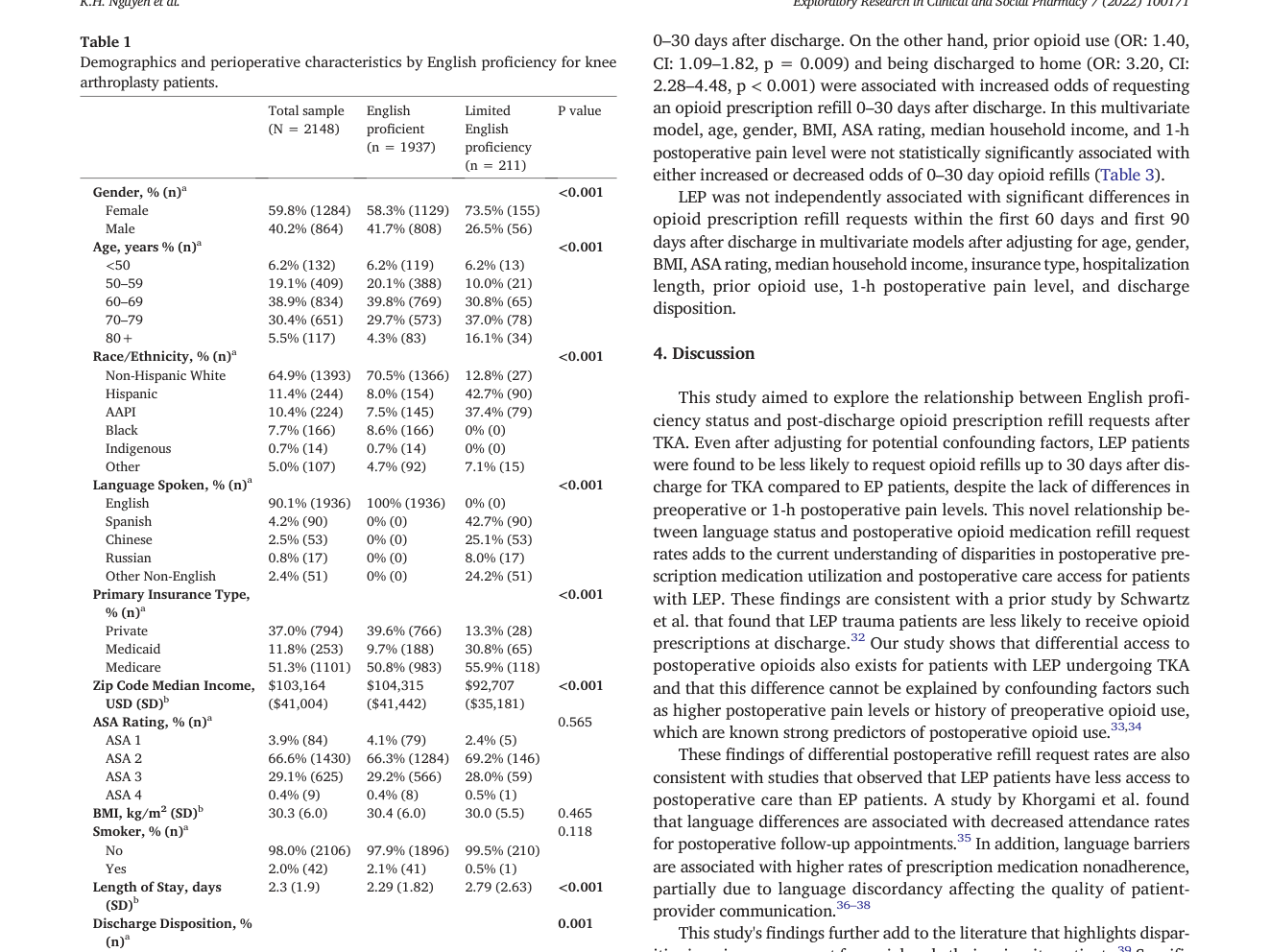
LEP patients had a significantly longer length of hospitalization than EP patients after total knee arthroplasty (2.79 ± 2.63 days vs 2.29 ± 1.82 days, p < 0.001) (Table 1). This is a secondary (baseline) perioperative characteristic reported in the cohort, consistent with prior arthroplasty literature on LEP and length of stay.
"Postoperatively, LEP patients, relative to EP patients, had a longer length of hospitalization (2.79 ± 2.63 days vs. 2.29 ± 1.82 days, p < 0.001) and were less likely to be discharged home (72.0% vs 82.4%, p = 0.001) (Table 1)." (Nguyen et al., 2022, p. 2)
Methods Context #
What? #ⓘ
The observable: total length of hospitalization (days).
"Perioperative and postoperative variables included preoperative pain level, 1-h postoperative pain level, total length of hospitalization, and discharge disposition." (Nguyen et al., 2022, p. 2)
How? #ⓘ
Two-sample t-test comparing mean length of stay between EP and LEP groups within the retrospective EHR cohort.
"Bivariate analyses comparing EP and LEP patient characteristics were performed using a t-test for continuous variables and Fisher's exact test for categorical variables." (Nguyen et al., 2022, p. 2)
Who? #ⓘ
2148 adults (≥18 years) who underwent TKA at a single academic medical center between 2015 and 2019; 9.8% (211) were classified as LEP.
"A total of 2148 patients underwent TKA between January 2015 and December 2019. Overall, 9.8% (211) of these patients were classified as having LEP." (Nguyen et al., 2022, p. 2)
Other Notes #
Longer LEP length of stay was itself associated with lower 0–30-day refill odds in the adjusted model (OR 0.91 per day), one of the perioperative factors examined alongside language.
Caveats #
- Single-center single-service retrospective cohort with race excluded for collinearity (Nguyen TKA opioid study) The findings come from a retrospective observational cohort at a single academic medical center, all discharged from the same surgical service — which limits generalizability and cannot establish causation for the LEP–refill association. The study collected no qualitative data from patients or providers to elucidate the mechanisms behind the disparity. Additionally, race/ethnicity was excluded from the multivariable model because of high collinearity with LEP status [Inferred: this means the independent effects of language versus race/ethnicity cannot be disentangled in the adjusted analysis], so residual confounding by the closely related dimensions of race, ethnicity, and socioeconomic status cannot be ruled out.