LEP patients were less likely than EP to be discharged home (72.0% vs 82.4%) after knee arthroplasty
Source
Kh (2022). Language barriers and postoperative opioid prescription use after total knee arthroplasty.. Exploratory research in clinical and social pharmacy.
Description #
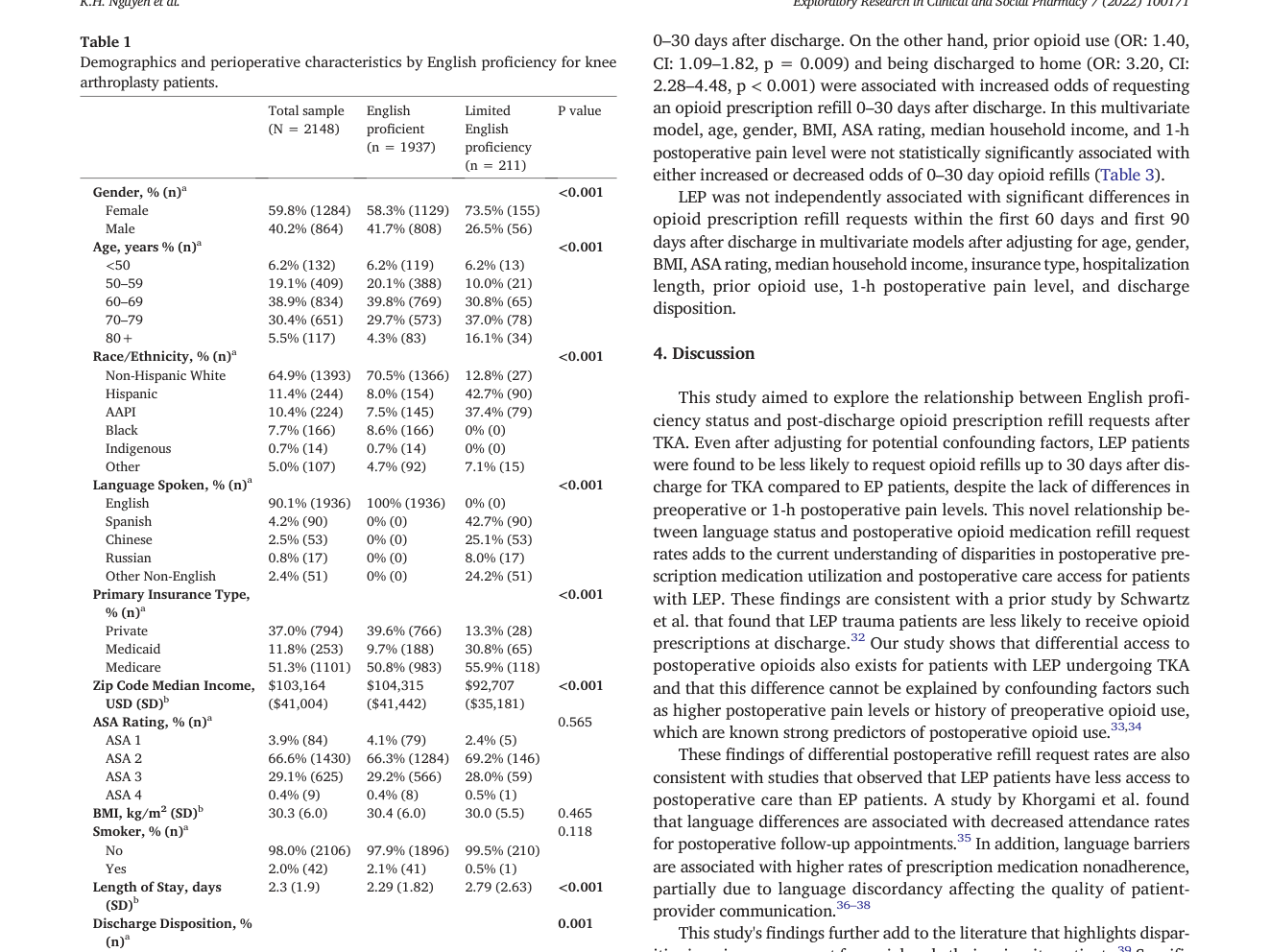
LEP patients were significantly less likely than EP patients to be discharged home (rather than to a skilled nursing facility, acute rehabilitation, or acute care hospital) after total knee arthroplasty (72.0% vs 82.4%, p = 0.001) (Table 1). This is a secondary (baseline) perioperative characteristic reported in the cohort.
"Postoperatively, LEP patients, relative to EP patients, had a longer length of hospitalization (2.79 ± 2.63 days vs. 2.29 ± 1.82 days, p < 0.001) and were less likely to be discharged home (72.0% vs 82.4%, p = 0.001) (Table 1)." (Nguyen et al., 2022, p. 2)
Methods Context #
What? #ⓘ
The observable: discharge disposition, dichotomized as discharged home versus other inpatient disposition.
"Discharge disposition was categorized as either being discharged home (with self-care or home health) or other inpatient dispositions (including skilled nursing facilities, acute rehabilitation facilities, and acute care hospitals)." (Nguyen et al., 2022, p. 2)
How? #ⓘ
Fisher's exact test comparing the proportion discharged home between EP and LEP groups within the retrospective EHR cohort.
"Bivariate analyses comparing EP and LEP patient characteristics were performed using a t-test for continuous variables and Fisher's exact test for categorical variables." (Nguyen et al., 2022, p. 2)
Who? #ⓘ
2148 adults (≥18 years) who underwent TKA at a single academic medical center between 2015 and 2019; 9.8% (211) were classified as LEP.
"A total of 2148 patients underwent TKA between January 2015 and December 2019. Overall, 9.8% (211) of these patients were classified as having LEP." (Nguyen et al., 2022, p. 2)
Other Notes #
In the adjusted refill model, home discharge was strongly associated with higher 0–30-day refill odds (OR 3.20), so the lower home-discharge rate among LEP patients is one plausible mediator of their lower refill requests.
Caveats #
- Single-center single-service retrospective cohort with race excluded for collinearity (Nguyen TKA opioid study) The findings come from a retrospective observational cohort at a single academic medical center, all discharged from the same surgical service — which limits generalizability and cannot establish causation for the LEP–refill association. The study collected no qualitative data from patients or providers to elucidate the mechanisms behind the disparity. Additionally, race/ethnicity was excluded from the multivariable model because of high collinearity with LEP status [Inferred: this means the independent effects of language versus race/ethnicity cannot be disentangled in the adjusted analysis], so residual confounding by the closely related dimensions of race, ethnicity, and socioeconomic status cannot be ruled out.