Prior opioid use did not differ between LEP and EP knee arthroplasty patients
Source
Kh (2022). Language barriers and postoperative opioid prescription use after total knee arthroplasty.. Exploratory research in clinical and social pharmacy.
Description #
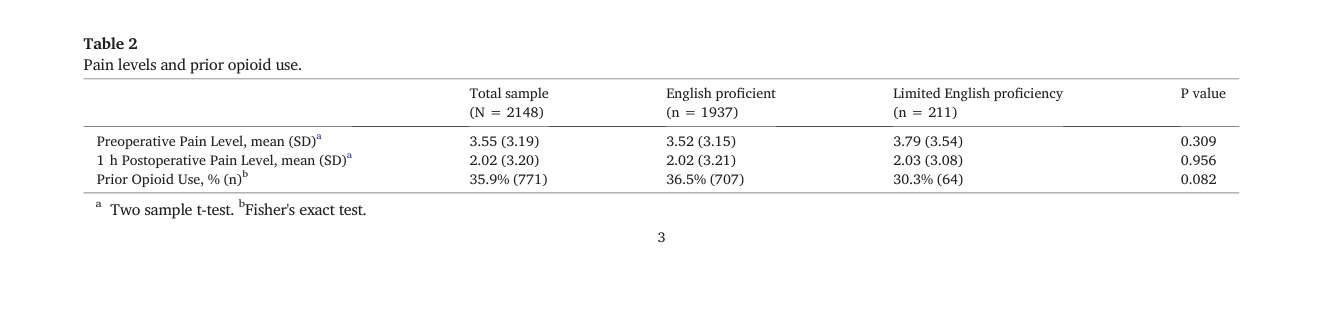
The proportion of patients reporting prior opioid use did not differ significantly between LEP and EP patients (30.3% vs 36.5%, p = 0.082) (Table 2). Since prior opioid use — a strong known predictor of postoperative opioid use — was comparable between groups, it does not confound the observed refill-request disparity, again supporting an access rather than a lower-need explanation.
"The proportions of patients who reported prior opioid use also did not differ between LEP and EP patients (Table 2)." (Nguyen et al., 2022, p. 2)
"Prior Opioid Use, % (n) ... 36.5% (707) 30.3% (64) 0.082" (Nguyen et al., 2022, p. 3, Table 2)
Methods Context #
What? #ⓘ
The observable: proportion of patients with documented prior (preoperative) opioid use.
"Preoperative health metrics included the American Society of Anesthesiologists (ASA) rating, body mass index (BMI), smoking status, and prior opioid use." (Nguyen et al., 2022, p. 2)
How? #ⓘ
Fisher's exact test comparing the proportion with prior opioid use between EP and LEP groups within the retrospective EHR cohort.
"Pain levels and prior opioid use. ... b Fisher's exact test." (Nguyen et al., 2022, p. 3, Table 2)
Who? #ⓘ
2148 adults (≥18 years) who underwent TKA at a single academic medical center between 2015 and 2019; 9.8% (211) were classified as LEP.
"A total of 2148 patients underwent TKA between January 2015 and December 2019. Overall, 9.8% (211) of these patients were classified as having LEP." (Nguyen et al., 2022, p. 2)
Other Notes #
Prior opioid use was, however, an independent predictor of higher refill odds in the multivariable model (OR 1.40) — it simply did not differ by language group.