LEP independently predicted lower odds of a 30-day opioid refill request (aOR 0.61) after knee arthroplasty
Source
Kh (2022). Language barriers and postoperative opioid prescription use after total knee arthroplasty.. Exploratory research in clinical and social pharmacy.
Description #
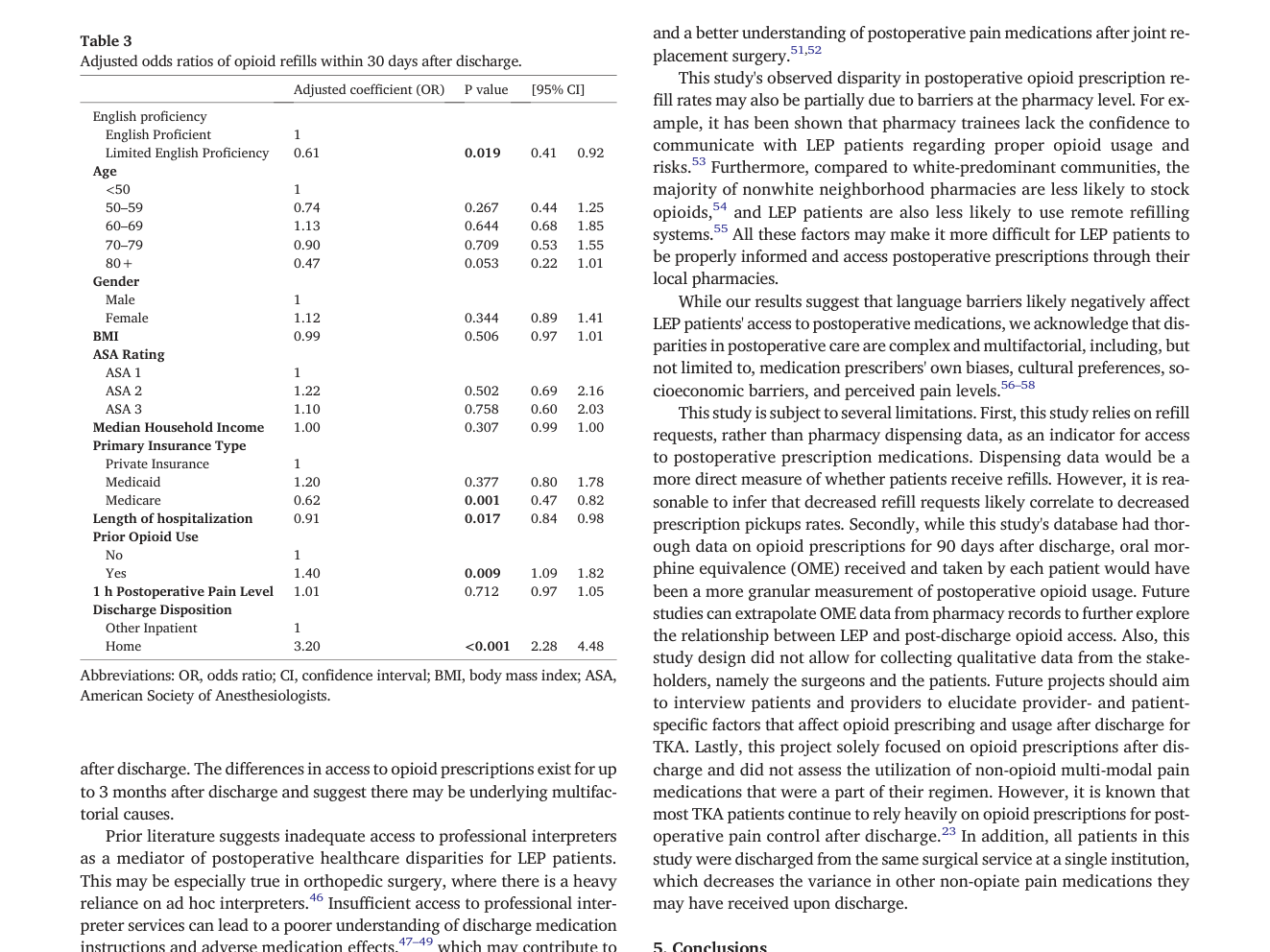
On multivariable logistic regression adjusting for age, gender, BMI, ASA rating, median household income, insurance type, length of hospitalization, prior opioid use, 1-h postoperative pain, and discharge disposition, LEP status was independently associated with lower odds of requesting an opioid prescription refill within 0–30 days of discharge (OR 0.61, 95% CI 0.41–0.92, p = 0.019) (Table 3). The association held even after removing the influence of confounders including pain level and prior opioid use. (Race/ethnicity was excluded from the model due to collinearity with LEP status.)
"In multivariate logistic regression models, being classified as LEP was significantly associated with lower odds of requesting an opioid prescription refill 0–30 days after discharge (OR: 0.61, CI: 0.41–0.92, p = 0.019)." (Nguyen et al., 2022, p. 3)
Methods Context #
What? #ⓘ
The observable: opioid pain-medication refill requests recorded in the EHR within 0–30 days of discharge, modeled as the binary dependent variable.
"Primary outcome variables included opioid pain medication refill requests between 0 and 30 days, 0–60 days, and 0–90 days from discharge after TKA." (Nguyen et al., 2022, p. 2)
How? #ⓘ
Multivariable logistic regression with a priori covariates chosen from prior TKA literature; race/ethnicity was excluded for collinearity with LEP.
"Multivariable logistic regression modeling was performed to calculate the odds ratio of opioid refill requests 0–30 days after discharge. Covariates, chosen a priori based on prior TKA literature and availability in the dataset, included age, gender, BMI, ASA rating, median income based on residential zip code, insurance type, length of hospitalization, history of preoperative opioid use, 1-h postoperative pain scores, and discharge disposition." (Nguyen et al., 2022, p. 2)
Who? #ⓘ
2148 adults (≥18 years) who underwent TKA at a single academic medical center between 2015 and 2019; 9.8% (211) were classified as LEP, defined by non-English primary language plus a request for interpreter services.
"The primary predictor variable in this analysis was English proficiency status, where LEP was defined as self-reporting a non-English primary language and requesting interpreter services at the time of admission." (Nguyen et al., 2022, p. 2)
Other Notes #
Other independent predictors in the same model: Medicare insurance (OR 0.62) and longer hospitalization (OR 0.91) lowered refill odds, while prior opioid use (OR 1.40) and home discharge (OR 3.20) raised them (Table 3).
Caveats #
- Opioid refill requests (not pharmacy dispensing or OME) are an indirect proxy for postoperative medication access The outcome is a refill request recorded in the EHR, not pharmacy dispensing data or oral morphine equivalence (OME) actually received. Dispensing data would be a more direct measure of whether patients obtained refills, and OME would give a more granular measure of postoperative opioid usage. The authors infer that fewer refill requests likely correlate with fewer pickups, but the study cannot confirm actual medication access or consumption — so the observed disparity may over- or under-state the true difference in postoperative opioid access between LEP and EP patients.
- Single-center single-service retrospective cohort with race excluded for collinearity (Nguyen TKA opioid study) The findings come from a retrospective observational cohort at a single academic medical center, all discharged from the same surgical service — which limits generalizability and cannot establish causation for the LEP–refill association. The study collected no qualitative data from patients or providers to elucidate the mechanisms behind the disparity. Additionally, race/ethnicity was excluded from the multivariable model because of high collinearity with LEP status [Inferred: this means the independent effects of language versus race/ethnicity cannot be disentangled in the adjusted analysis], so residual confounding by the closely related dimensions of race, ethnicity, and socioeconomic status cannot be ruled out.