LEP patients requested fewer opioid refills than EP within 30 days (35.3% vs 52.4%) after knee arthroplasty
Source
Kh (2022). Language barriers and postoperative opioid prescription use after total knee arthroplasty.. Exploratory research in clinical and social pharmacy.
Description #
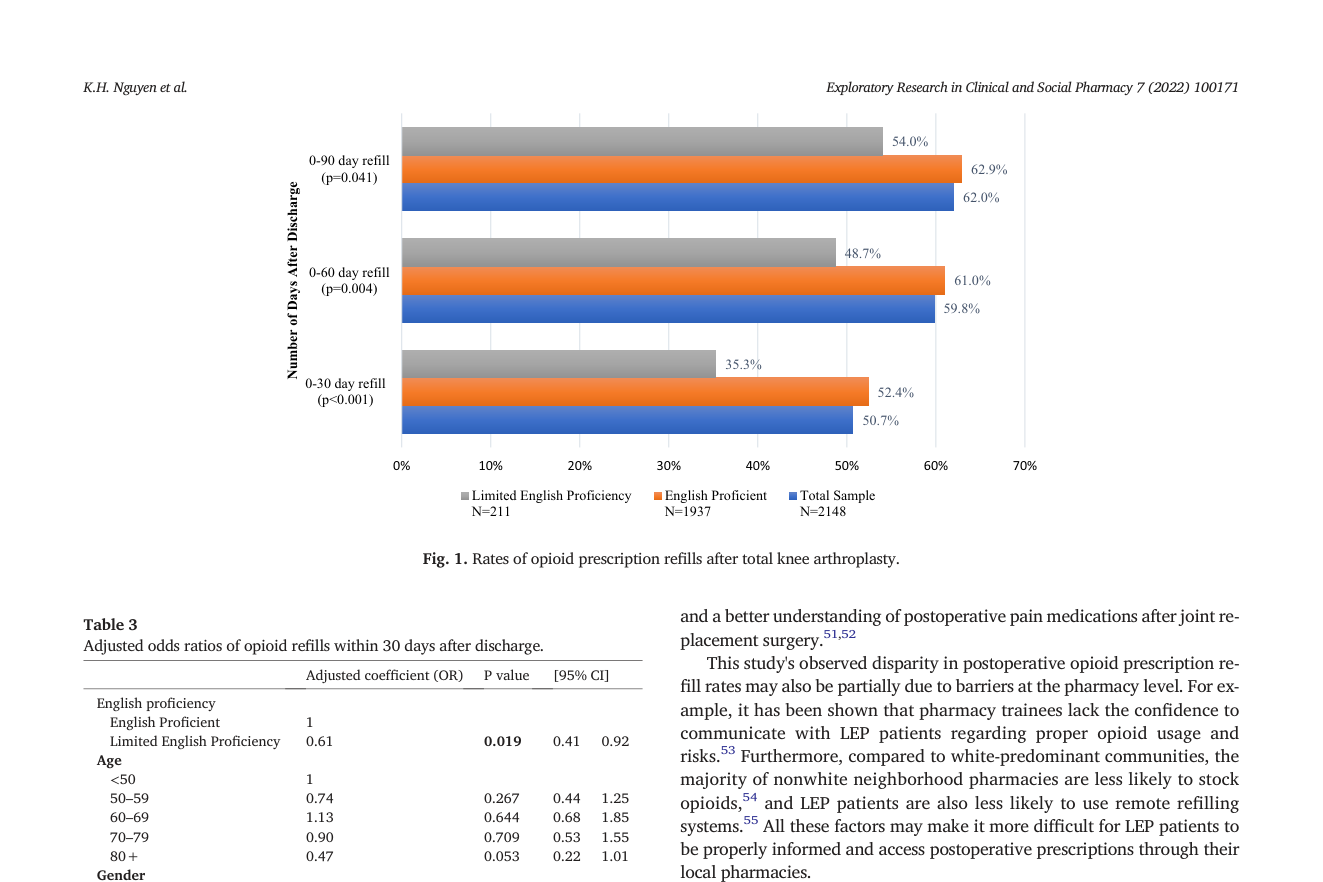
In unadjusted bivariate analysis, patients with limited English proficiency (LEP) were less likely than English-proficient (EP) patients to request an opioid prescription refill within the first 30 days after discharge for total knee arthroplasty (35.3% vs 52.4%, p < 0.001) (Fig. 1). This was the largest and most statistically significant of the three refill windows examined.
"LEP patients were less likely to request an opioid prescription refill within 30 days (35.3% vs 52.4%, p < 0.001), 60 days (48.7% vs 61.0%, p = 0.004), and 90 days (54.0% vs 62.9%, p = 0.041) after discharge." (Nguyen et al., 2022, p. 1)
Methods Context #
What? #ⓘ
The observable: opioid pain-medication refill requests recorded in the EHR within 0–30 days of discharge.
"Primary outcome variables included opioid pain medication refill requests between 0 and 30 days, 0–60 days, and 0–90 days from discharge after TKA." (Nguyen et al., 2022, p. 2)
How? #ⓘ
Bivariate comparison of refill-request proportions between EP and LEP patients using Fisher's exact test, within a retrospective EHR cohort study.
"Bivariate analyses comparing EP and LEP patient characteristics were performed using a t-test for continuous variables and Fisher's exact test for categorical variables." (Nguyen et al., 2022, p. 2)
Who? #ⓘ
2148 adults (≥18 years) who underwent TKA at a single academic medical center between 2015 and 2019; 9.8% (211) were classified as LEP based on non-English primary language plus a request for interpreter services.
"A total of 2148 patients underwent TKA between January 2015 and December 2019. Overall, 9.8% (211) of these patients were classified as having LEP." (Nguyen et al., 2022, p. 2)
Other Notes #
The observed disparity is unadjusted; the 30-day difference persisted after multivariable adjustment (see companion EVD on the adjusted odds ratio).
Caveats #
- Opioid refill requests (not pharmacy dispensing or OME) are an indirect proxy for postoperative medication access The outcome is a refill request recorded in the EHR, not pharmacy dispensing data or oral morphine equivalence (OME) actually received. Dispensing data would be a more direct measure of whether patients obtained refills, and OME would give a more granular measure of postoperative opioid usage. The authors infer that fewer refill requests likely correlate with fewer pickups, but the study cannot confirm actual medication access or consumption — so the observed disparity may over- or under-state the true difference in postoperative opioid access between LEP and EP patients.