Preoperative and postoperative pain levels did not differ between LEP and EP knee arthroplasty patients
Source
Kh (2022). Language barriers and postoperative opioid prescription use after total knee arthroplasty.. Exploratory research in clinical and social pharmacy.
Description #
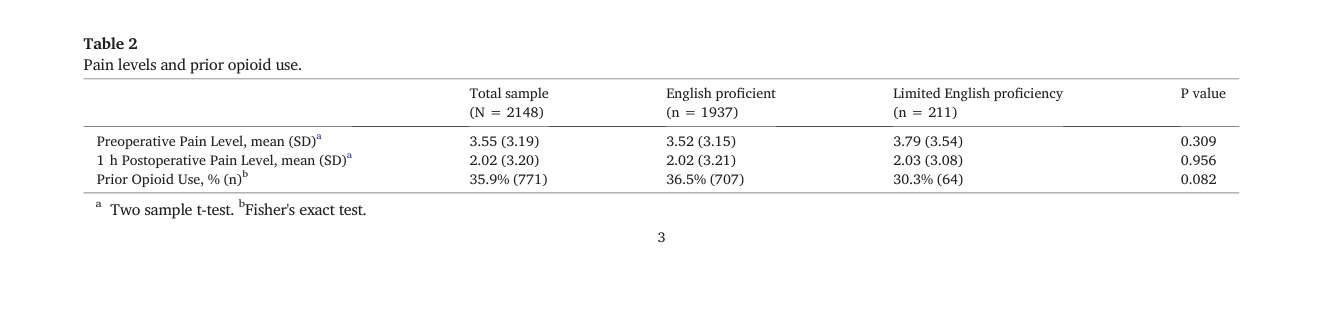
Self-reported preoperative and 1-hour postoperative pain levels (0–10 scale) did not differ between LEP and EP patients: preoperative 3.79 vs 3.52 (p = 0.309) and 1-h postoperative 2.03 vs 2.02 (p = 0.956) (Table 2). Because pain intensity was equivalent between groups, the lower refill-request rate among LEP patients cannot be attributed to lower postoperative pain — supporting an access-barrier rather than lower-need interpretation.
"Self-reported preoperative and 1-h postoperative pain levels did not differ between LEP and EP patients." (Nguyen et al., 2022, p. 2)
"Preoperative Pain Level, mean (SD) ... 3.52 (3.15) 3.79 (3.54) 0.309 / 1 h Postoperative Pain Level, mean (SD) ... 2.02 (3.21) 2.03 (3.08) 0.956" (Nguyen et al., 2022, p. 3, Table 2)
Methods Context #
What? #ⓘ
The observable: patient-reported preoperative and 1-hour postoperative pain scores on a 0–10 scale.
"Preoperative and 1-h postoperative pain levels were patient-reported scores based on a 0–10 scale." (Nguyen et al., 2022, p. 2)
How? #ⓘ
Two-sample t-test comparing mean pain scores between EP and LEP groups within the retrospective EHR cohort.
"Pain levels and prior opioid use. ... a Two sample t-test." (Nguyen et al., 2022, p. 3, Table 2)
Who? #ⓘ
2148 adults (≥18 years) who underwent TKA at a single academic medical center between 2015 and 2019; 9.8% (211) were classified as LEP.
"A total of 2148 patients underwent TKA between January 2015 and December 2019. Overall, 9.8% (211) of these patients were classified as having LEP." (Nguyen et al., 2022, p. 2)
Other Notes #
This equivalence in pain is central to the paper's interpretation that the refill disparity reflects differential access rather than differential clinical need.