Anxiety or depression was more frequent among patients needing translation services (p=0.011)
Source
Kapoor (2023). The Impact of the Need for Language Assistance Services on the Use of Regional Anesthesia, Postoperative Pain Scores and Opioid Administration in Surgical Oncology Patients. J Pers Med.
Description #
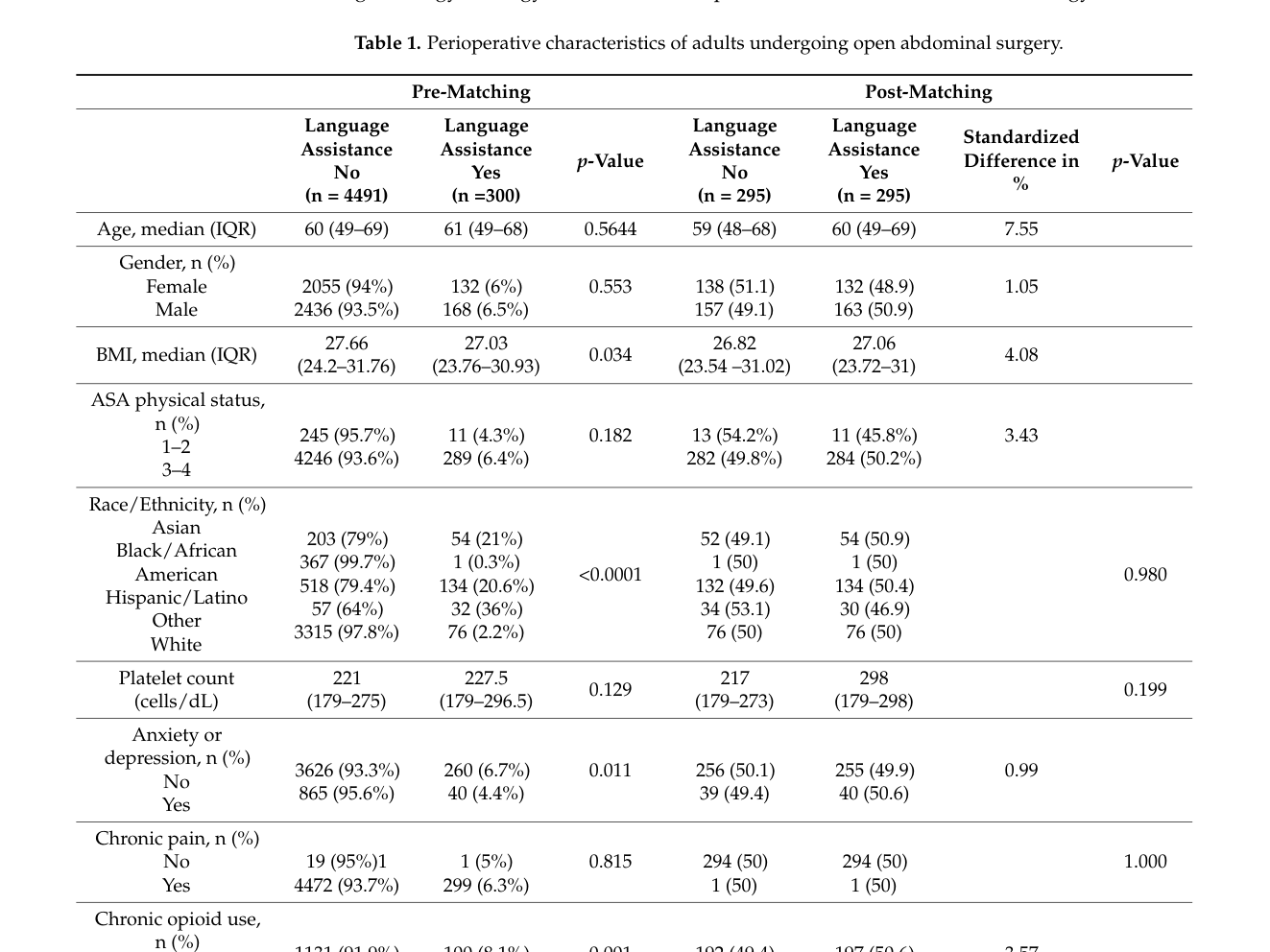
In the full unmatched cohort, a diagnosis of anxiety or depression was significantly more frequent among patients needing translation services than among English-proficient patients (p = 0.011) (Table 1). This is a baseline comorbidity association characterizing the population needing language assistance.
"A diagnosis of anxiety or depression was significantly more frequent in patients in patients needing (n = 260, 6.7%) translation services than those who were English proficient (n = 40, 4.4%, p = 0.011)." (Kapoor, 2023, p. 4)
Source note (flagged): the reported cell counts/percentages are confusingly presented (the "n = 260, 6.7%" and "n = 40, 4.4%" appear to be transposed from the Table 1 anxiety/depression rows, where 260/40 fall under the LAS-Yes column split by anxiety status). The verbatim quote is copied exactly; the finding is captured at the level the authors assert — a significant association (p = 0.011) with anxiety/depression more frequent among LAS-needing patients.
Methods Context #
What? #ⓘ
The observable: prevalence of a history of anxiety or depression, compared by need for translation services.
"comorbidities (i.e., American Society of Anesthesiology [ASA] physical status, history of anxiety or depression, history of smoking and alcohol disorder and history of chronic pain and opioid use)... were obtained from electronic medical records (EMR)." (Kapoor, 2023, p. 2)
How? #ⓘ
Retrospective EMR review; categorical association tested with chi-square / Fisher's exact test on the unmatched cohort.
"The chi-square test or Fisher's exact test was used to evaluate the association between two categorical variables." (Kapoor, 2023, p. 2)
Who? #ⓘ
The full unmatched cohort of 4791 adults undergoing open abdominal oncologic surgery at a single academic cancer center, 2016–2021.
"A total of 4791 patients were included from our database (Table 1)." (Kapoor, 2023, p. 3)
Other Notes #
Anxiety/depression was one of the covariates subsequently included in the propensity-score model, so this baseline imbalance was adjusted for in the matched analysis.