Need for language assistance was not associated with total perioperative opioid use (33 vs 30 MEDD, p=0.099) after matching
Source
Kapoor (2023). The Impact of the Need for Language Assistance Services on the Use of Regional Anesthesia, Postoperative Pain Scores and Opioid Administration in Surgical Oncology Patients. J Pers Med.
Description #
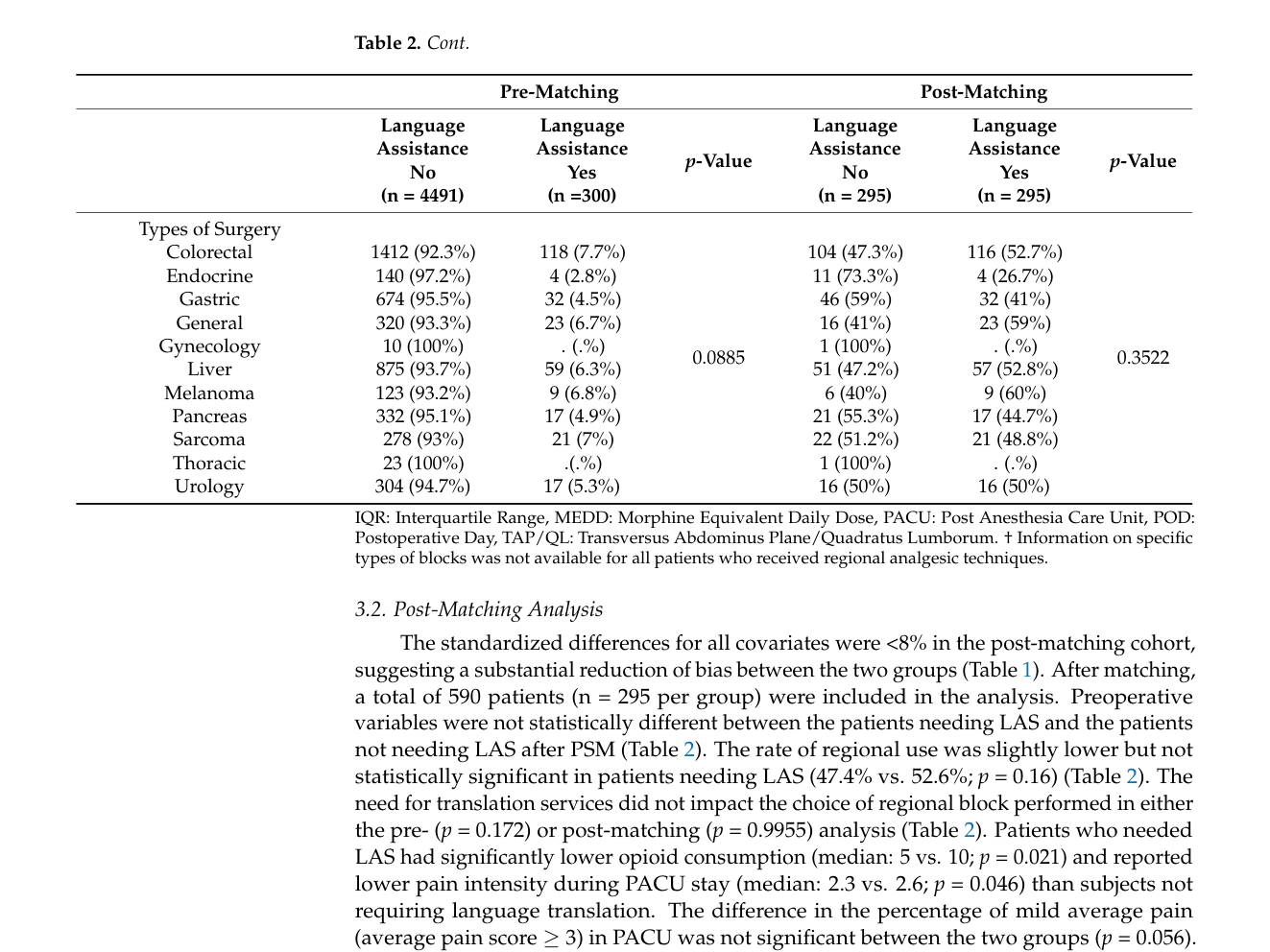
In the propensity-score-matched cohort (295 per group), total perioperative opioid consumption did not differ significantly by need for language assistance services (LAS): median morphine-equivalent daily dose (MEDD) 33 (IQR 20–50) for LAS-needing patients vs 30 (IQR 20–45) for non-LAS patients; p = 0.0989 (Table 2). This is a null result — and the point estimate is numerically slightly higher in the LAS-needing group — in contrast to the significantly lower PACU-specific opioid use in the same patients.
"In terms of length of stay, anesthesia duration, total perioperative opioid use and opioid use specifically in PACU, there were no statistically significant differences." (Kapoor, 2023, p. 4)
Methods Context #
What? #ⓘ
The observable: total perioperative opioid consumption, recorded as morphine-equivalent daily dose (MEDD).
"Secondary endpoints included opioid use in PACU and the use of regional analgesia." (Kapoor, 2023, p. 2)
How? #ⓘ
Retrospective cohort with propensity-score matching; continuous distributions compared with the Wilcoxon rank-sum test.
"Wilcoxon rank-sum test was used to compare location parameters of continuous distributions between patient groups." (Kapoor, 2023, p. 2)
Who? #ⓘ
The propensity-matched cohort of 590 adults (295 per group) undergoing open abdominal oncologic surgery at a single academic cancer center, 2016–2021.
"After matching, a total of 590 patients (n = 295 per group) were included in the analysis." (Kapoor, 2023, p. 5)
Other Notes #
Total opioid MEDD (Table 2): pre-matching 30 (20–50) vs 33 (20–50), p = 0.369; post-matching 30 (20–45) vs 33 (20–50), p = 0.0989 (LAS-No vs LAS-Yes). The cited prose sentence describes the pre-matching finding; the post-matching p = 0.0989 is from Table 2. This null on total opioid opposes a general claim that LAS-needing patients receive less opioid overall.
Caveats #
- Retrospective single-institution cancer-center study with residual confounding The study is retrospective and conducted at a single cancer center, so its estimates are vulnerable to residual confounding from unmeasured variables that could have influenced opioid-prescribing and pain outcomes, and its findings are tied to institution-specific practices (types of surgeries and regional anesthesia techniques). Although propensity-score matching reduced measured baseline imbalance, no prior sample-size analysis was performed and unknown confounders remain. This limits causal interpretation and external generalizability of the pain, opioid, and regional-anesthesia associations.