LEP surgical patients spanned 18 primary languages led by Arabic Spanish and Somali
Source
Burkle (2017). Assessment of the efficiency of language interpreter services in a busy surgical and procedural practice. BMC Health Services Research.
Description #
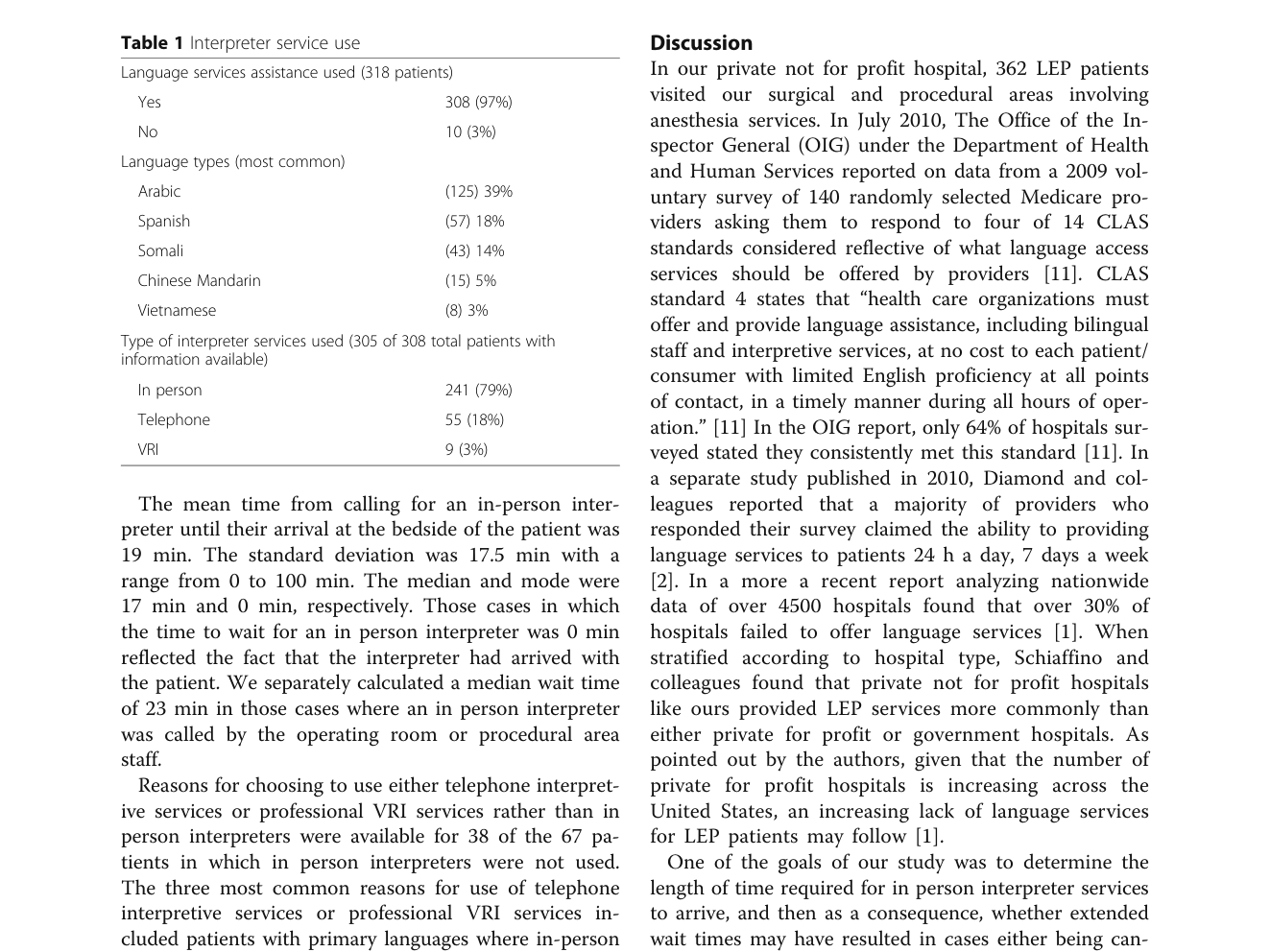
LEP patients presenting to the surgical and procedural centers spoke a total of 18 unique primary languages, with need concentrated in a few dominant languages and a long tail: the five most common were Arabic 125 (39%), Spanish 57 (18%), Somali 43 (14%), Chinese Mandarin 15 (5%), and Vietnamese 8 (3%), with the remaining languages each making up less than 2% (Table 1).
"Over the study period, LEP patients with a total of 18 unique primary languages visited our surgical and procedural centers. The five most common primary languages were Arabic, Spanish, Somali, Chinese Mandarin, and Vietnamese with the remainder making up less than 2% of the total languages among LEP patients." (Burkle, 2017, p. 2)
"Language types (most common) Arabic (125) 39% Spanish (57) 18% Somali (43) 14% Chinese Mandarin (15) 5% Vietnamese (8) 3%" (Burkle, 2017, p. 3, Table 1)
Methods Context #
What? #ⓘ
The observable: the count and distribution of LEP patients' primary languages presenting to surgical/procedural areas.
"the primary language of each patient using this service." (Burkle, 2017, p. 2)
How? #ⓘ
Prospective observational logging of each LEP encounter's primary language over ~2.5 months in 2016, tabulated with descriptive statistics.
"Information obtained for each encounter with an LEP patient included whether assistance for language needs was requested and the primary language of each patient using this service." (Burkle, 2017, p. 2)
Who? #ⓘ
LEP patients (318 analyzed) in the surgical and outpatient procedural areas of a single private, not-for-profit, quaternary-care US institution serving patients from all 50 states and internationally.
"serving patients from all 50 States as well as a large number of international patients." (Burkle, 2017, p. 2)
Other Notes #
The Arabic-dominant language mix here (39%) is atypical of most US LEP populations (usually Spanish-dominant) and reflects this quaternary center's large international-patient draw, constraining generalizability of the specific language distribution.
Caveats #
- Single quaternary referral center with unusually comprehensive language services limits generalizability All findings come from a single private, not-for-profit, quaternary/tertiary-care institution serving patients from all 50 states and internationally, with an unusually comprehensive, well-resourced language-services program (43 FTE in-person interpreters, three modalities). The authors explicitly caution that this patient population and service capacity may not represent most US hospitals, so the short wait times, zero cancellations, high service uptake, modality mix, and Arabic-dominant language distribution may not transfer to lower-resourced or differently-composed settings.