In-person interpreting was the predominant modality (79 percent) over telephone (18 percent) and VRI (3 percent)
Source
Burkle (2017). Assessment of the efficiency of language interpreter services in a busy surgical and procedural practice. BMC Health Services Research.
Description #
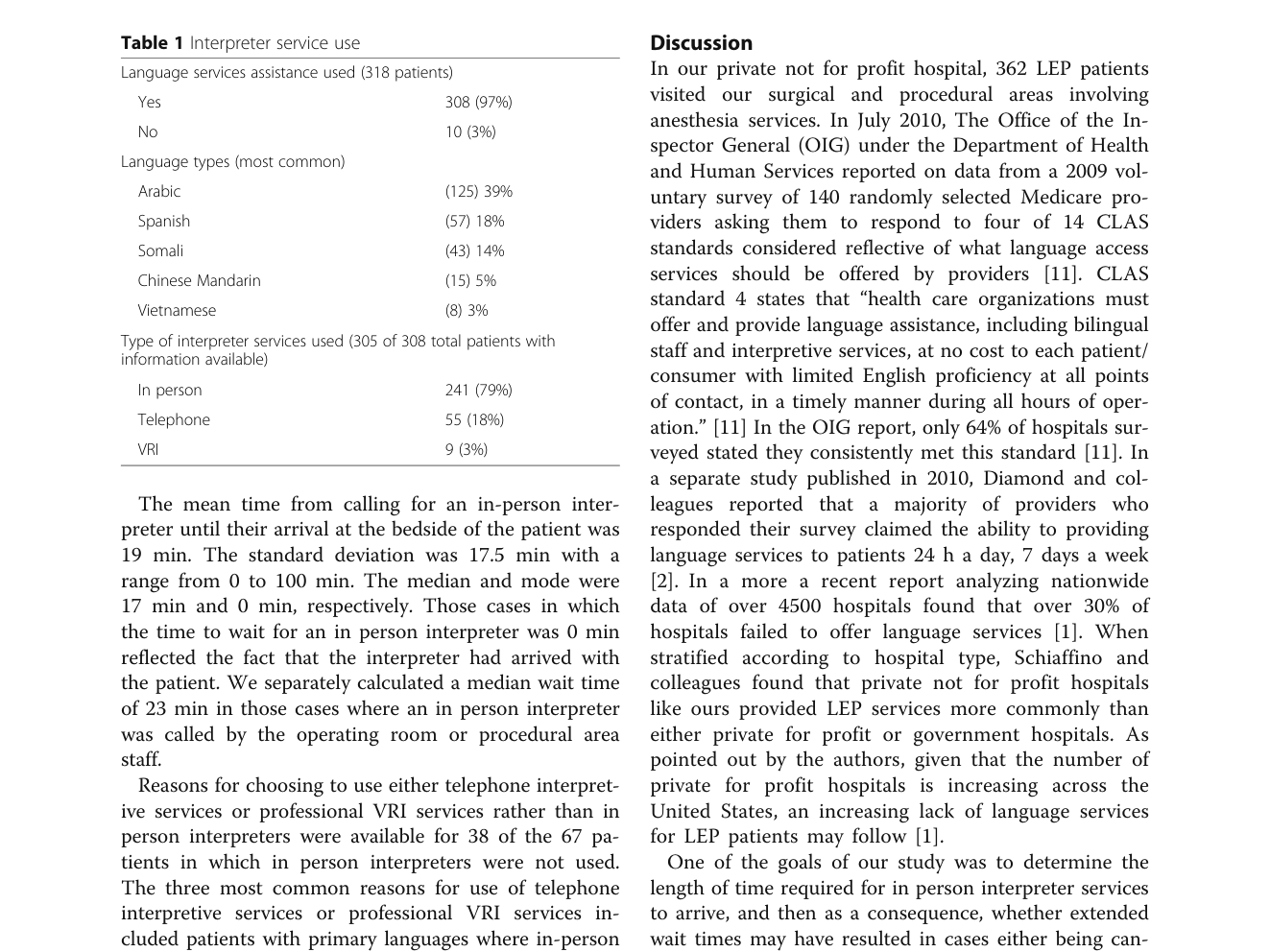
Among the 305 of 308 patients for whom modality information was available, in-person professional interpreters were used overwhelmingly most often, accounting for 241 encounters (79%), followed by telephone interpretive services at 55 (18%) and professional video remote interpreting (VRI) at 9 (3%) (Table 1).
"Type of interpreter services used (305 of 308 total patients with information available) In person 241 (79%) Telephone 55 (18%) VRI 9 (3%)" (Burkle, 2017, p. 3, Table 1)
"Overwhelmingly, in person language interpreters were used most commonly for providing interpretive services." (Burkle, 2017, p. 2)
Methods Context #
What? #ⓘ
The observable: the distribution of interpreter-service encounters across the three modalities offered (in-person, telephone, VRI).
"the type of language service provided (in person professional interpreters, telephone interpretive services, professional videoconference services) was also recorded." (Burkle, 2017, p. 2)
How? #ⓘ
Prospective observational logging of the modality used for each LEP encounter over ~2.5 months in 2016, tabulated with descriptive statistics. See A-0008ArtifactA-0008Initial AI draftMayo Clinic tri-modal professional language services (in-person, telephone, VRI)The language-services department of a private, not-for-profit, quaternary-care US institution (Mayo Clinic) provides interpretive assistance to LEP patients across its surgical and procedural areas, aiming to meet federa….
"The secondary goal of this study was to determine how often each of these particular language service modalities was used by patients" (Burkle, 2017, p. 2)
Who? #ⓘ
305 of 308 LEP patients (with modality data) using hospital services in the surgical and outpatient procedural areas of a single private, not-for-profit, quaternary-care US institution.
"Type of interpreter services used (305 of 308 total patients with information available)" (Burkle, 2017, p. 3, Table 1)
Other Notes #
VRI's very low share (3%) partly reflects the institution's staffing model, in which most common languages were served by on-staff in-person interpreters; telephone/VRI were reserved for languages without on-staff interpreters or when in-person was slow/unavailable.
Caveats #
- Single quaternary referral center with unusually comprehensive language services limits generalizability All findings come from a single private, not-for-profit, quaternary/tertiary-care institution serving patients from all 50 states and internationally, with an unusually comprehensive, well-resourced language-services program (43 FTE in-person interpreters, three modalities). The authors explicitly caution that this patient population and service capacity may not represent most US hospitals, so the short wait times, zero cancellations, high service uptake, modality mix, and Arabic-dominant language distribution may not transfer to lower-resourced or differently-composed settings.