97 percent of LEP surgical patients used hospital interpreter services rather than family or acquaintances
Source
Burkle (2017). Assessment of the efficiency of language interpreter services in a busy surgical and procedural practice. BMC Health Services Research.
Description #
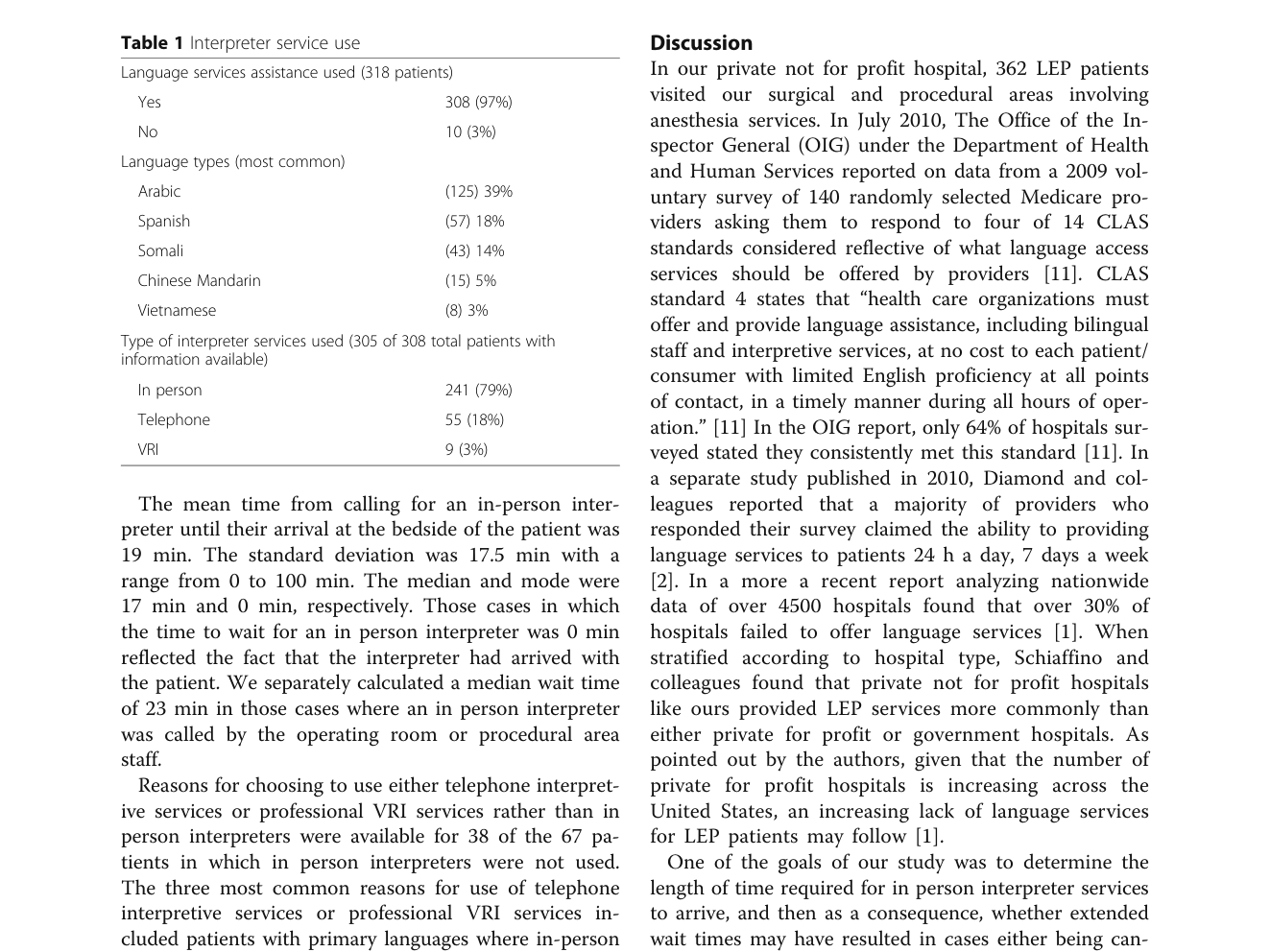
Among the 318 analyzable LEP patient records, 308 patients (97%) chose the hospital's professional language services, while only 10 patients (3%) opted instead for assistance from a family member or other acquaintance. The authors note this 3% ad hoc rate is far below the ~24%-to-59% range other emergency-department studies have reported (Table 1).
"Among those 318 LEP patient records, 308 patients (97%) chose the assistance of the hospital language services available to them while 10 patients (3%) opted for assistance from either a family member or other acquaintance. (Table 1)" (Burkle, 2017, p. 2)
"Despite access to either in person professional interpreters, telephone interpretive services, or professional VRI services, 10 patients (3%) in our study refused the assistance of hospital based interpretive services with either family members or other acquaintances providing interpreter language assistance instead." (Burkle, 2017, p. 4)
Methods Context #
What? #ⓘ
The observable: the proportion of LEP patients who used hospital-provided language services versus a family member / acquaintance as interpreter.
"Language services assistance used (318 patients) Yes 308 (97%) No 10 (3%)" (Burkle, 2017, p. 3, Table 1)
How? #ⓘ
Prospective observational logging of each LEP encounter's language-service request and modality over ~2.5 months in 2016, with descriptive statistics; the institution has a written policy strongly discouraging family-member interpreters except in life-threatening situations. See A-0008ArtifactA-0008Initial AI draftMayo Clinic tri-modal professional language services (in-person, telephone, VRI)The language-services department of a private, not-for-profit, quaternary-care US institution (Mayo Clinic) provides interpretive assistance to LEP patients across its surgical and procedural areas, aiming to meet federa….
"Our institution has a written policy that strongly discourages the use of family members as interpreters except in 'life threatening situation(s)' when interpretive services are not available in a timely manner or when a patient refuses such services." (Burkle, 2017, p. 4)
Who? #ⓘ
318 analyzable LEP patient records (of 354 who visited) in the surgical and outpatient procedural areas of a single private, not-for-profit, quaternary-care US institution.
"Among those 318 LEP patient records, 308 patients (97%) chose the assistance of the hospital language services available to them" (Burkle, 2017, p. 2)
Other Notes #
The high uptake likely reflects the institution's comprehensive service availability and restrictive family-interpreter policy, limiting generalizability to lower-resourced settings.
Caveats #
- Single quaternary referral center with unusually comprehensive language services limits generalizability All findings come from a single private, not-for-profit, quaternary/tertiary-care institution serving patients from all 50 states and internationally, with an unusually comprehensive, well-resourced language-services program (43 FTE in-person interpreters, three modalities). The authors explicitly caution that this patient population and service capacity may not represent most US hospitals, so the short wait times, zero cancellations, high service uptake, modality mix, and Arabic-dominant language distribution may not transfer to lower-resourced or differently-composed settings.