Shorter LOS in top two interpreting-frequency quartiles was robust across five operative-complexity adjustment models
Source
Claire de Crescenzo (2022). Increasing Frequency of Interpreting Services is Associated With Shorter Peri-operative Length of Stay. Journal of Surgical Research.
Description #
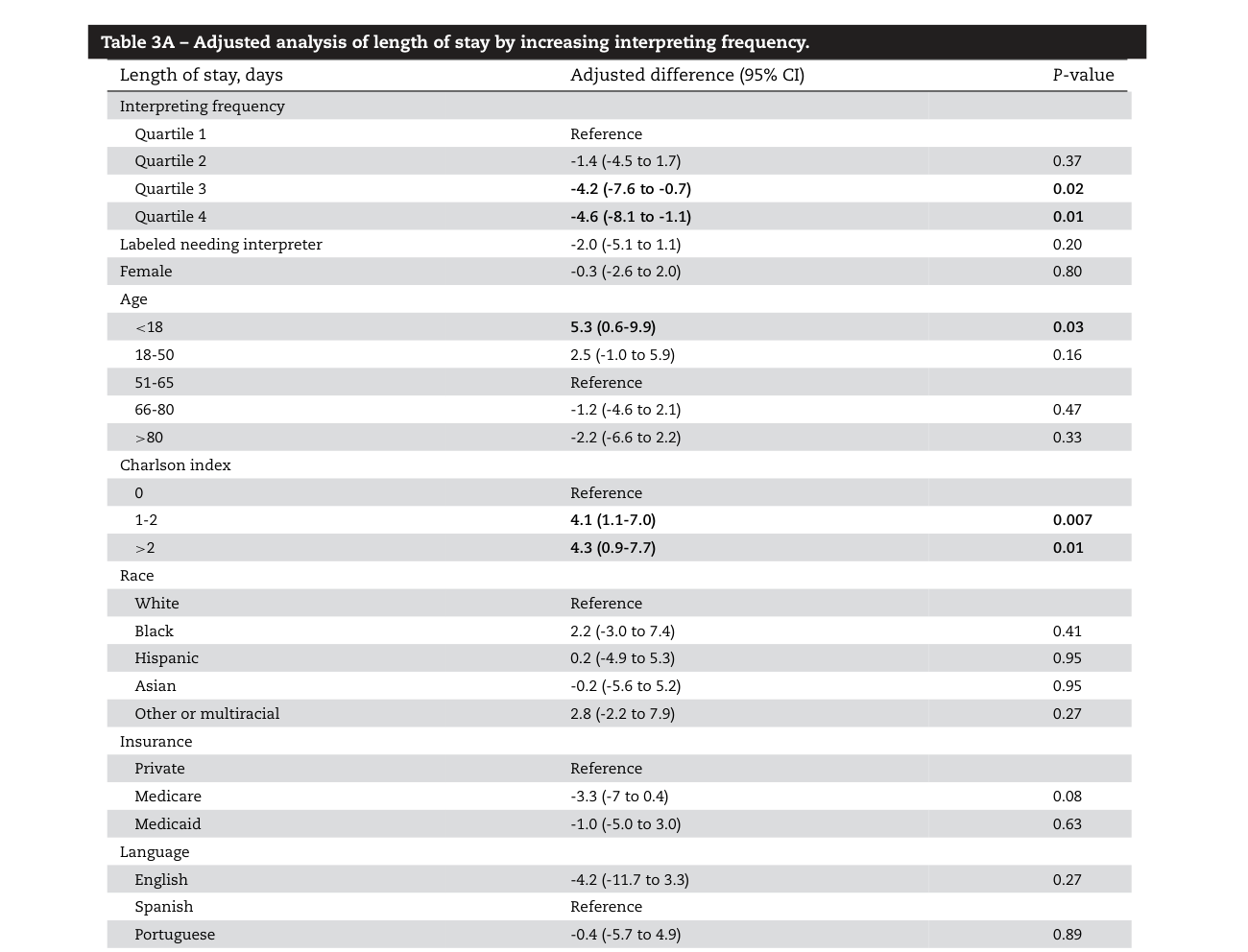
A sensitivity analysis re-ran the regression under five different models for adjusting operative complexity (organ system alone; organ system + category; organ system + category + technique; RVU quartiles; organ system + RVU quartiles). Across all five models, the third and fourth interpreting-frequency quartiles remained associated with a statistically significantly shorter length of stay: the quartile-3 adjusted difference ranged from -3.5 to -5.2 days and quartile-4 from -3.7 to -5.4 days, with the second quartile never reaching significance (Table 3B). This robustness to the complexity-adjustment scheme argues the exposure-response finding is not an artifact of one particular case-mix model.
"Increasing interpreting frequency in the third and fourth quartiles remained associated with statistically significant shorter length of stay in these regression models." (de Crescenzo, 2022, p. 183–184)
"Model 4 Reference -1.7 (-4.7 to 1.3) 0.23 -5.2 (-8.4 to -1.9) 0.003 -5.4 (-8.7 to -2.2) 0.002" (de Crescenzo, 2022, p. 184, Table 3B)
Methods Context #
What? #ⓘ
The observable: peri-operative length of stay in days, the regression outcome, re-estimated under alternative operative-complexity adjustment schemes.
"The primary outcome was length of stay in days and the independent variable of interest was frequency of interpreting, measured in interpreting events per day." (de Crescenzo, 2022, p. 179)
How? #ⓘ
Five multiple linear regression models differing only in how operative complexity was represented (CPT organ-system/category/technique groupings and RVU quartiles), holding the interpreting-frequency exposure and other covariates fixed.
"Sensitivity analysis was performed with qualitatively similar multiple regression analyses with different models of accounting for operative complexity (Table 3B)." (de Crescenzo, 2022, p. 183)
Who? #ⓘ
The same 2018 peri-operative admissions of patients who used interpreting services at a Boston academic medical center (n = 574 admissions, minus missing-data exclusions).
"A total of 545 patients used interpreting services at least once during 574 peri-operative admissions." (de Crescenzo, 2022, p. 180)
Other Notes #
The five models are defined in the Table 3B footnotes (Model 1: organ system; Model 2: organ system + category; Model 3: + technique; Model 4: RVU quartiles; Model 5: organ system + RVU quartiles). Quartile-3 significance ranged P = 0.003–0.045 and quartile-4 P = 0.002–0.03 across models.
Caveats #
- Cross-sectional design cannot establish causality and interpreting-events-per-day has LOS in its denominator (Claire 2022) The study is cross-sectional and, as the authors state, was not designed to demonstrate causality; the association between higher interpreting frequency and shorter LOS could reflect reverse or confounded pathways rather than an effect of interpreting. A specific structural concern reinforces this: the exposure is interpreting events per day, i.e. total interpreting events divided by length of stay, so length of stay is in the denominator of the exposure. Mechanically, a short admission (few days) tends to yield a higher events-per-day value for the same or fewer total encounters, which can manufacture an inverse exposure-outcome association independent of any causal benefit. The authors frame the finding as motivating an interventional study rather than as evidence of a causal effect.
- Small single-institution study of heterogeneous operations with incomplete operative-complexity adjustment (Claire 2022) This is a small, single-institution study whose patients underwent a heterogeneous array of operations of varying complexity, and operative complexity is a strong determinant of length of stay. The complexity-correction factors used (CPT groupings and RVU quartiles) do not exhaustively capture those differences, leaving residual confounding by case mix as a plausible partial explanation for the shorter LOS at higher interpreting frequencies. The single-center, single-year setting also limits generalizability, since medical interpreting services are not standardized and vary substantially across institutions and geographic locations. The authors ran a five-model sensitivity analysis as a partial mitigation but acknowledge it does not fully correct for complexity.