Second interpreting-frequency quartile showed no significant adjusted LOS difference vs lowest (P=0.37)
Source
Claire de Crescenzo (2022). Increasing Frequency of Interpreting Services is Associated With Shorter Peri-operative Length of Stay. Journal of Surgical Research.
Description #
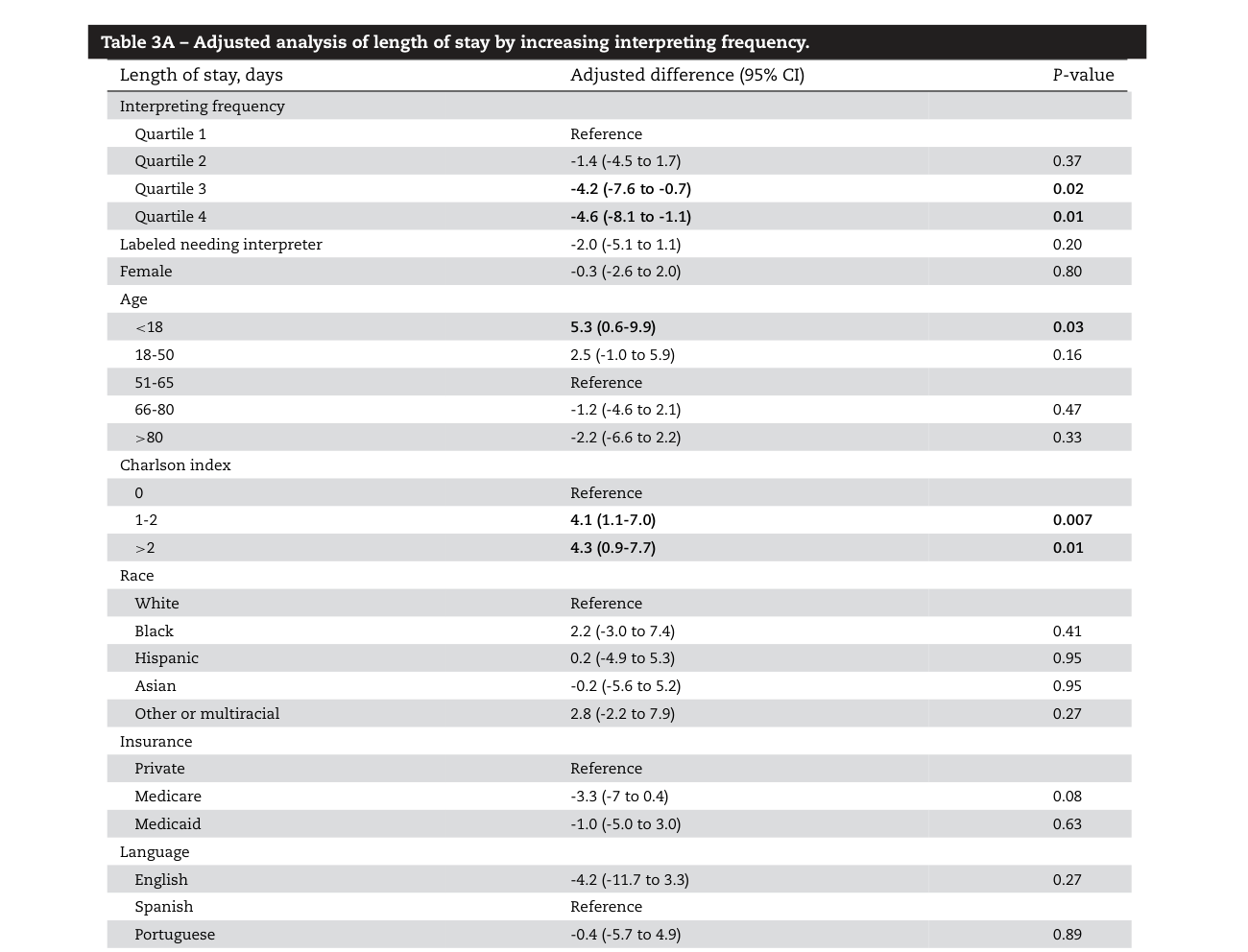
In the adjusted multiple linear regression, patients in the second interpreting-frequency quartile (quartile 2, 0.34–0.99 interpreting events/day) showed only a non-significant trend toward shorter peri-operative length of stay versus the lowest-frequency reference quartile 1: -1.4 days (95% CI -4.5 to 1.7, P = 0.37) (Table 3A). This is a null result — the confidence interval crosses zero — and it is the reason the paper describes the benefit as concentrated in the "highest two quartiles" rather than any increase over baseline. It is consistent with a dose/threshold effect (no detectable benefit at low interpreting frequency), but as a direct test of "more frequent interpreting → shorter LOS" at this exposure level it does not support the association.
"LOS trended shorter for the second quartile by 1.4 d (CI -4.5 to 1.7, P = 0.37)" (de Crescenzo, 2022, p. 183)
"Quartile 2 -1.4 (-4.5 to 1.7) 0.37" (de Crescenzo, 2022, p. 182, Table 3A)
Methods Context #
What? #ⓘ
The observable: peri-operative length of stay in days, modeled as the regression outcome with interpreting-frequency quartile as the exposure of interest.
"The primary outcome was length of stay in days and the independent variable of interest was frequency of interpreting, measured in interpreting events per day." (de Crescenzo, 2022, p. 179)
How? #ⓘ
Multiple linear regression on LOS in days, adjusted for sex, age, CCI, race, insurance, language, "Needs Interpreter" label, multiple operations, first-level CPT buckets, RVU quartiles, and admission/discharge location; quartile 1 was the reference.
"Multiple linear regression was performed on the outcome, length of stay in days. The regression was adjusted for the sex, age, CCI, race, insurance, language spoken, multiple operations, "Needs Interpreter" label, first level CPT buckets, RVU quartiles, and whether the patient was admitted and discharged from home or a facility." (de Crescenzo, 2022, p. 180)
Who? #ⓘ
Peri-operative admissions in 2018 at a Boston academic medical center; 41 of 574 admissions (7.1%) were excluded from the adjusted analysis for missing data.
"In the adjusted analysis, 41 of 574 (7.1%) of admissions were excluded for missing data; 30 (5.2%) due to missing race and 11 (1.9%) due to missing CPT code." (de Crescenzo, 2022, p. 180)
Other Notes #
Quartile 2 = "One event every 3 d to less than one event every day (0.34-0.99 interpreting events per day)." The authors note roughly half of study patients had interpreting frequency below one event daily, and argue this dilution may explain prior binary-exposure studies finding no LOS effect.
Caveats #
- Language-concordant staff and non-spoken communication gaps were not captured, misclassifying true communication frequency (Claire 2022) The exposure (interpreting events per day from the interpreting office) undercounts actual language-concordant communication: encounters where a language-concordant provider communicated directly with an LEP patient without engaging an interpreter are not recorded in the data, so some patients coded as low-frequency may in fact have had adequate communication. The measure also captures only spoken-language interpreting and does not account for other patient-provider communication gaps such as reading and health literacy or the navigability of written discharge and follow-up materials. Both forms of misclassification blur the mapping between the recorded interpreting frequency and the true adequacy of communication that the LOS association is meant to reflect.