LEP was not associated with number of postoperative pain assessments (6 vs 5)
Source
Plancarte (2021). Association Between English Proficiency and Timing of Analgesia Administration After Surgery. Hospital Pediatrics.
Description #
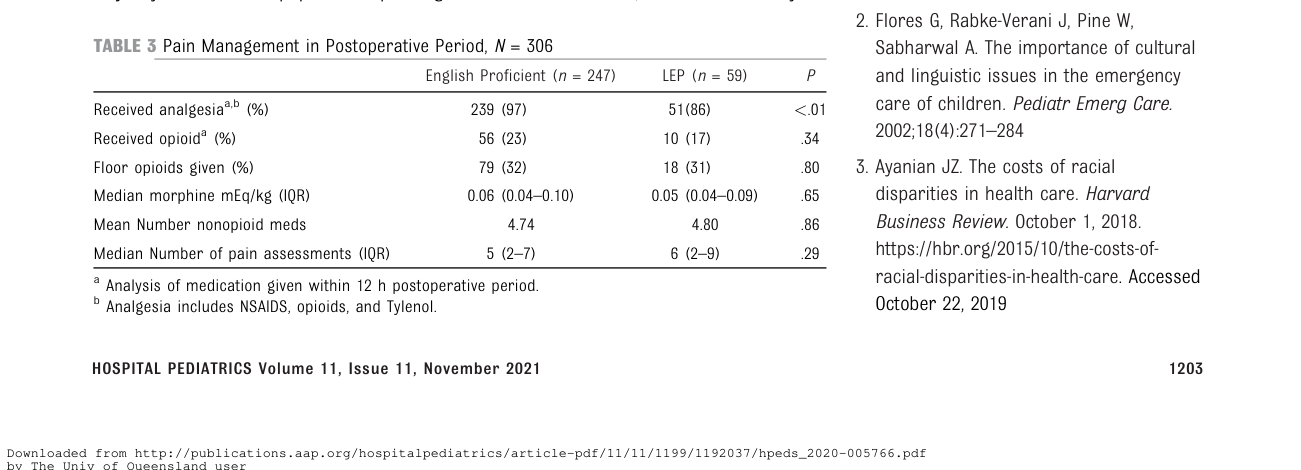
The median number of nurse-administered pain assessments in the postoperative period did not differ significantly between LEP and EP children (6 vs 5, P = .29) (Table 3). This is a null finding — and the LEP median was numerically higher, not lower. This contrasts with prior ED-based studies reporting fewer pain assessments for LEP children.
"Lastly, the median number of nursing administered pain assessments was also not significantly associated with LEP (6 vs 5, P = .29)." (Plancarte, 2021, p. 1201)
Methods Context #
What? #ⓘ
The observable: the number of nursing-recorded pain assessments in the postoperative period.
"number of pain assessments recorded" (Plancarte, 2021, p. 1200)
How? #ⓘ
Bivariate comparison of the median number of assessments between LEP and EP families using Mann-Whitney/appropriate tests on retrospective chart-abstracted data.
"Bivariate association tests comparing the demographic, clinical characteristics, and secondary outcomes between pediatric patients in English proficient and LEP families were performed by using t tests, Mann-Whitney, v2, or Fisher's exact tests as appropriate." (Plancarte, 2021, p. 1201)
Who? #ⓘ
306 children aged 1 to <18 years after single-limb-fracture surgery at one urban tertiary-care children's hospital in New York; 59 (19%) LEP vs 247 EP.
"A total of 337 patients were examined. Of these, 306 met inclusion criteria, of which 59 (19%) were in families with LEP." (Plancarte, 2021, p. 1201)
Other Notes #
Table 3 reports the medians with IQRs: 5 (2–7) EP vs 6 (2–9) LEP (P = .29).