LEP was not associated with cumulative 24h opioid dose after surgery (0.05 vs 0.06 mEq per kg)
Source
Plancarte (2021). Association Between English Proficiency and Timing of Analgesia Administration After Surgery. Hospital Pediatrics.
Description #
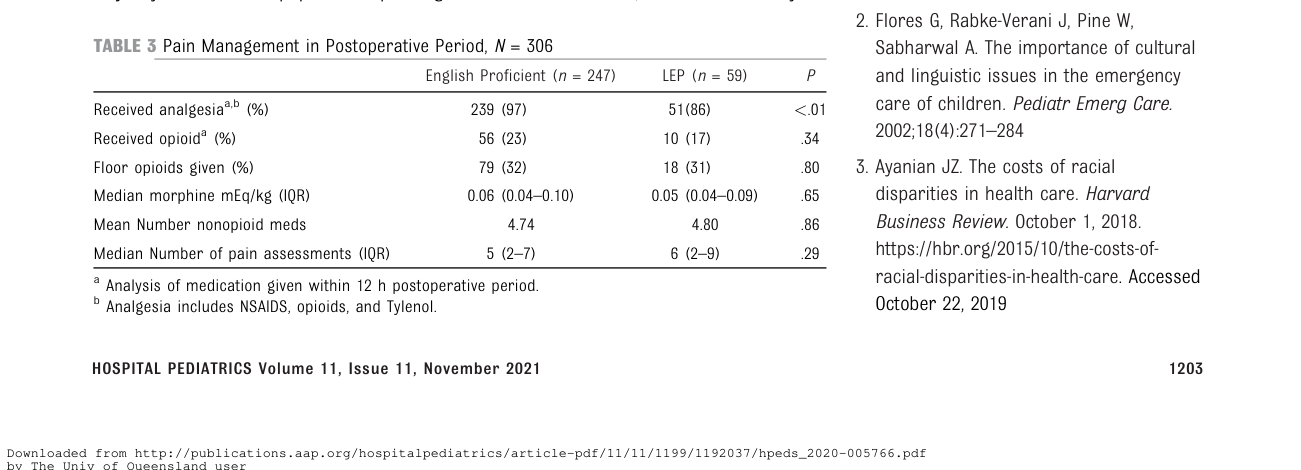
The total cumulative opioid dose administered within 24 hours (measured as mEq/kg intravenous morphine equivalents) did not differ significantly between LEP and EP children (0.05 vs 0.06 mEq/kg, P = .65) (Table 3). This is a null finding.
"...the total dose of opioid medication (0.05 vs 0.06 mEq/kg, P = .65)..." (Plancarte, 2021, p. 1201)
Methods Context #
What? #ⓘ
The observable: total cumulative opioid dose over the 24-hour postoperative period, expressed as mEq/kg intravenous morphine equivalents.
"total cumulative opioid dosing (defined as mEq/kg intravenous morphine)" (Plancarte, 2021, p. 1200)
How? #ⓘ
Bivariate comparison of the (median) dose between LEP and EP families using Mann-Whitney/appropriate tests on retrospective chart-abstracted data.
"Bivariate association tests comparing the demographic, clinical characteristics, and secondary outcomes between pediatric patients in English proficient and LEP families were performed by using t tests, Mann-Whitney, v2, or Fisher's exact tests as appropriate." (Plancarte, 2021, p. 1201)
Who? #ⓘ
306 children aged 1 to <18 years after single-limb-fracture surgery at one urban tertiary-care children's hospital in New York; 59 (19%) LEP vs 247 EP.
"A total of 337 patients were examined. Of these, 306 met inclusion criteria, of which 59 (19%) were in families with LEP." (Plancarte, 2021, p. 1201)
Other Notes #
Table 3 reports the medians with IQRs: 0.06 (0.04–0.10) mEq/kg EP vs 0.05 (0.04–0.09) mEq/kg LEP (P = .65).
Caveats #
- Opioid and 24-hour null findings may be underpowered given few opioid recipients and wide confidence intervals The opioid-related and 24-hour null findings should not be read as evidence of no effect. Only 66 of 306 patients (22%) received any opioid within 12 hours, and the LEP subgroup is small (n = 59), so these comparisons are likely underpowered. This is reflected in the very wide confidence interval on the unadjusted time-to-first-opioid hazard ratio (0.16–1.40), which spans large effects in both directions. The point estimates for opioids are directionally consistent with the significant analgesia disparity (LEP received opioids less often: 17% vs 23%; HR < 1), so absence of significance may reflect low power rather than true equivalence.