LEP was not associated with proportion receiving opioids within 12h after surgery (17% vs 23%)
Source
Plancarte (2021). Association Between English Proficiency and Timing of Analgesia Administration After Surgery. Hospital Pediatrics.
Description #
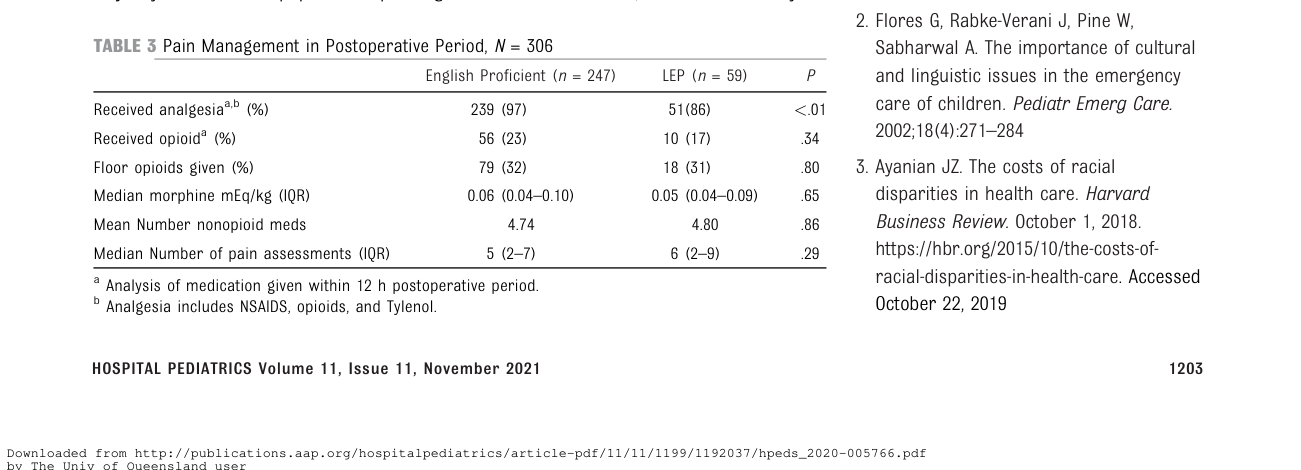
Within the first 12 postoperative hours, a numerically lower proportion of LEP children received opioids than EP children (17% vs 23%), but the difference was not statistically significant (P = .34) (Table 3). This is a null finding. It contrasts with the significant disparity for "any analgesia" (opioid + NSAID + acetaminophen) in the same window.
"A lower percentage of the LEP population received opioids compared with the English-proficient population (17% vs 23%), but the difference was not significant (P = .34)." (Plancarte, 2021, p. 1201)
Methods Context #
What? #ⓘ
The observable: the proportion of patients who received any opioid analgesic within 12 hours after surgery.
"Received opioid" (Plancarte, 2021, p. 1203, Table 3)
How? #ⓘ
Proportions receiving an opioid within the first 12 hours were compared between LEP and EP families using a χ² test on retrospective chart-abstracted data.
"To examine the difference between proportions of patients receiving any analgesic or opioid within the first 12 hours, v2 tests were used." (Plancarte, 2021, p. 1201)
Who? #ⓘ
306 children aged 1 to <18 years after single-limb-fracture surgery at one urban tertiary-care children's hospital in New York; 59 (19%) LEP vs 247 EP.
"A total of 337 patients were examined. Of these, 306 met inclusion criteria, of which 59 (19%) were in families with LEP." (Plancarte, 2021, p. 1201)
Other Notes #
Table 3 gives the counts: 56/247 (23%) EP vs 10/59 (17%) LEP received an opioid within 12 h (P = .34).
Caveats #
- Opioid and 24-hour null findings may be underpowered given few opioid recipients and wide confidence intervals The opioid-related and 24-hour null findings should not be read as evidence of no effect. Only 66 of 306 patients (22%) received any opioid within 12 hours, and the LEP subgroup is small (n = 59), so these comparisons are likely underpowered. This is reflected in the very wide confidence interval on the unadjusted time-to-first-opioid hazard ratio (0.16–1.40), which spans large effects in both directions. The point estimates for opioids are directionally consistent with the significant analgesia disparity (LEP received opioids less often: 17% vs 23%; HR < 1), so absence of significance may reflect low power rather than true equivalence.