LEP was not significantly associated with time to first opioid after surgery (adjusted HR 0.76)
Source
Plancarte (2021). Association Between English Proficiency and Timing of Analgesia Administration After Surgery. Hospital Pediatrics.
Description #
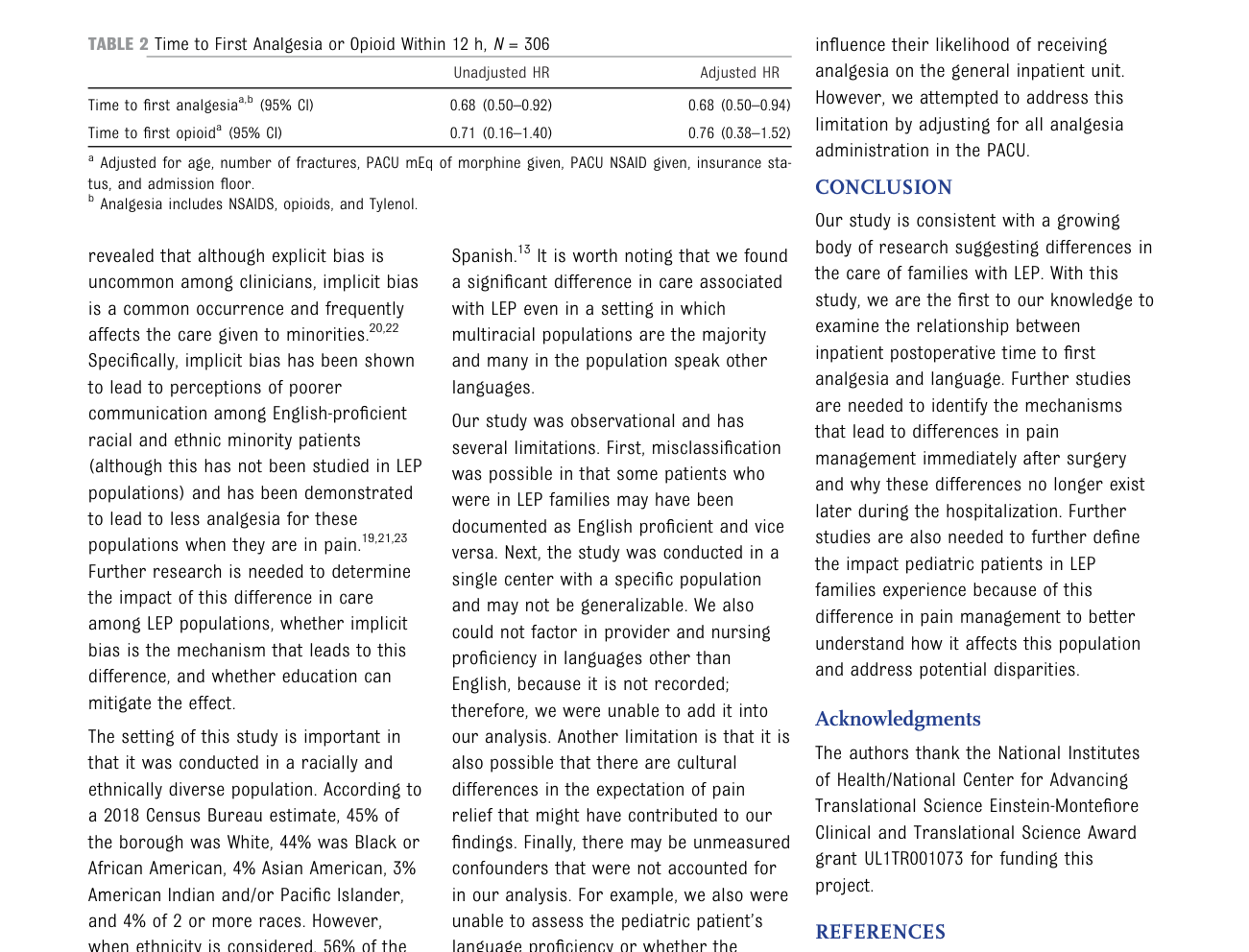
In contrast to the significant delay in time to first (any) analgesia, LEP status was not significantly associated with time to first opioid analgesia. The Cox hazard ratio was 0.71 unadjusted (95% CI 0.16–1.40) and 0.76 adjusted (95% CI 0.38–1.52); both confidence intervals cross 1, so the null cannot be rejected (Table 2). This is a null finding.
"In the time to first opioid analysis, LEP was not significantly associated with a longer time to administration of opioid in unadjusted analysis (HR = 0.71, 95% CI: 0.16–1.40) or after adjustment for age, number of fractures, milliequivalents of morphine given in the PACU, if NSAID was given in the PACU, insurance status, and admission floor (HR = 0.76, 95% CI: 0.38–1.52)." (Plancarte, 2021, p. 1201)
Methods Context #
What? #ⓘ
The observable: time to first opioid analgesia on the inpatient floor — from post-procedure sedation end time to the first opioid administered.
"A secondary outcome was time to first opioid analgesia, defined as time from documented sedation end time, after the procedure, to the first opioid that the patient received on the inpatient floor." (Plancarte, 2021, p. 1200)
How? #ⓘ
Univariate and multivariate Cox proportional-hazards models (observations censored at 12 hours), the same modeling approach used for the primary time-to-analgesia outcome.
"The independent associations between language proficiency and the time to first analgesic and time to first opioid were assessed by using univariate and multivariate Cox proportional hazards models." (Plancarte, 2021, p. 1201)
Who? #ⓘ
306 children aged 1 to <18 years after single-limb-fracture surgery at one urban tertiary-care children's hospital in New York; 59 (19%) LEP vs 247 EP. Only 66 (22%) of the full cohort received any opioid within 12 h.
"Overall, 66 (22%) of the patients received opioids in the first 12 hours after the procedure." (Plancarte, 2021, p. 1201)
Other Notes #
The wide confidence intervals (unadjusted lower bound 0.16, upper bound 1.40) reflect the small number of opioid recipients and warrant caution about interpreting this null as evidence of no effect (see qualifying caveat on underpowering).
Caveats #
- Opioid and 24-hour null findings may be underpowered given few opioid recipients and wide confidence intervals The opioid-related and 24-hour null findings should not be read as evidence of no effect. Only 66 of 306 patients (22%) received any opioid within 12 hours, and the LEP subgroup is small (n = 59), so these comparisons are likely underpowered. This is reflected in the very wide confidence interval on the unadjusted time-to-first-opioid hazard ratio (0.16–1.40), which spans large effects in both directions. The point estimates for opioids are directionally consistent with the significant analgesia disparity (LEP received opioids less often: 17% vs 23%; HR < 1), so absence of significance may reflect low power rather than true equivalence.