LEP was associated with longer time to first analgesia after surgery (adjusted HR 0.68)
Source
Plancarte (2021). Association Between English Proficiency and Timing of Analgesia Administration After Surgery. Hospital Pediatrics.
Description #
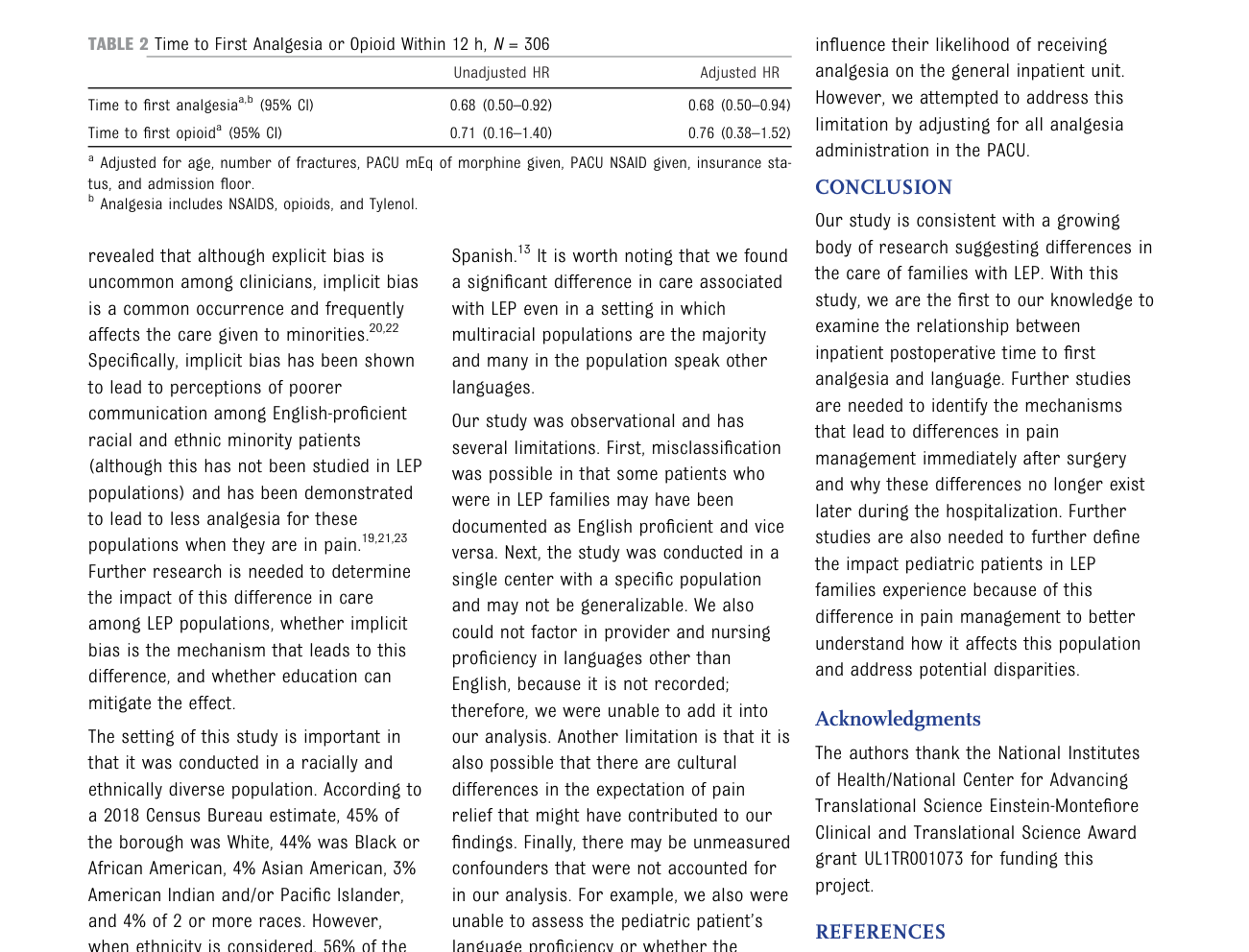
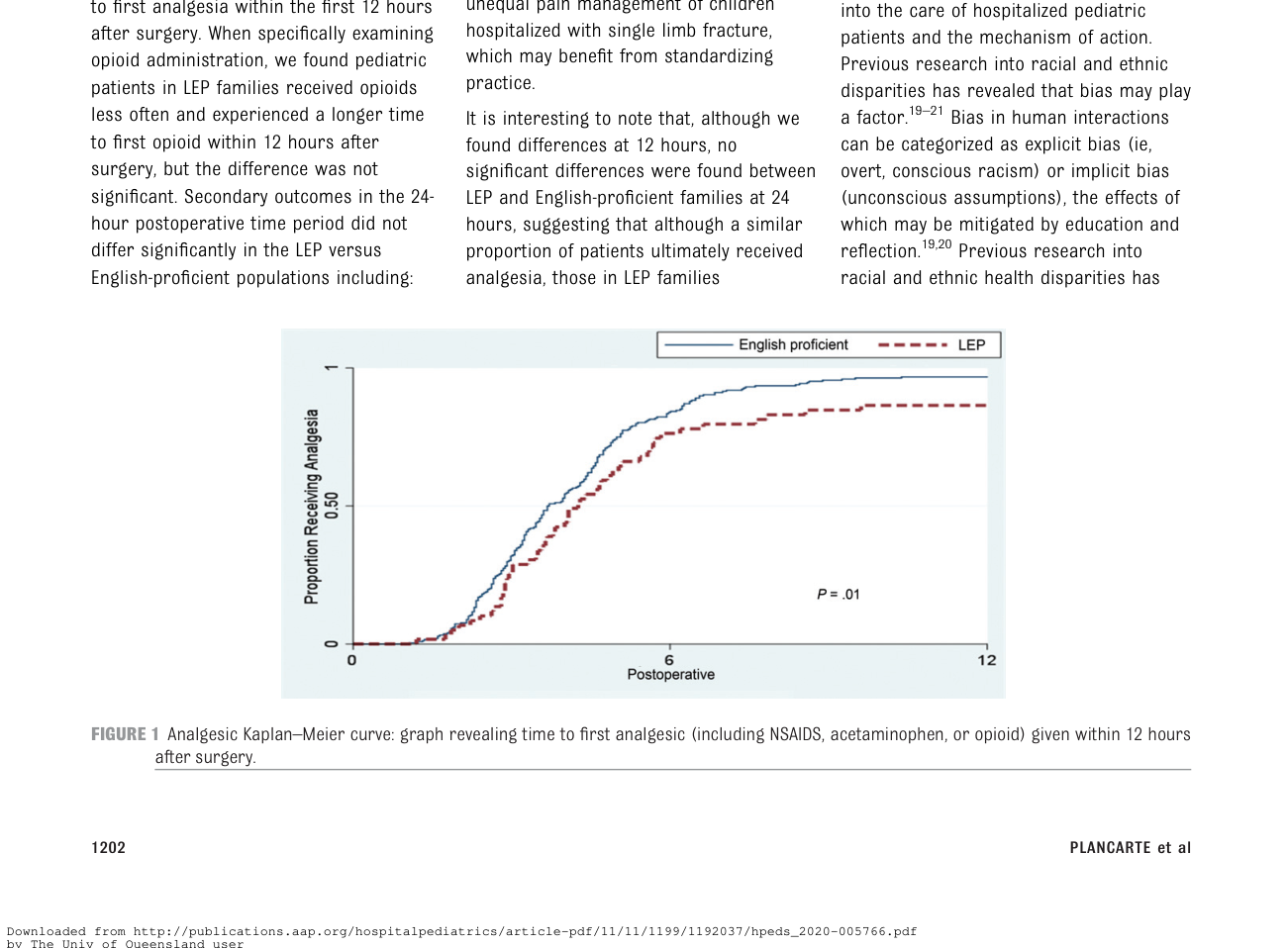
In this retrospective pediatric cohort, LEP family status was significantly associated with a longer time to first analgesia after surgery. On Cox proportional-hazards analysis the hazard ratio for receiving analgesia was 0.68 both unadjusted (95% CI 0.50–0.92) and after adjustment for age, number of fractures, PACU morphine dose, PACU NSAID, insurance status, and admission floor (95% CI 0.50–0.94) — an HR below 1 meaning LEP patients reached first analgesia more slowly (Table 2, Fig 1). The Kaplan–Meier curve shows the LEP curve lagging the EP curve across the 12-hour window (Fig 1).
"...experienced longer time to first analgesia in unadjusted (hazard ratio = 0.68, 95% confidence interval: 0.50–0.92) and adjusted analyses (hazard ratio = 0.68, 95% confidence interval: 0.50–0.94)." (Plancarte, 2021, p. 1199)
"In the time to first analgesia analysis, LEP was significantly associated with a longer time to administration of analgesia in unadjusted analysis (hazard ratio [HR] = 0.68, 95% confidence interval [CI]: 0.50–0.92) and after adjustment for age, number of fractures, mEqs of morphine given in the PACU, if NSAID was given in the PACU, insurance status, and admit floor (HR = 0.68, 95% CI: 0.50–0.94)." (Plancarte, 2021, p. 1201)
Methods Context #
What? #ⓘ
The observable: time to first analgesia on the inpatient floor — from documented post-procedure sedation end time to the first analgesic administered.
"Time to first analgesia was defined as time from documented sedation end time, after the procedure, to the first analgesia that the patient received on the inpatient floor." (Plancarte, 2021, p. 1200)
How? #ⓘ
Univariate and multivariate Cox proportional-hazards models with observations censored at 12 hours; the multivariate covariates were chosen a priori as potential confounders.
"The independent associations between language proficiency and the time to first analgesic and time to first opioid were assessed by using univariate and multivariate Cox proportional hazards models." (Plancarte, 2021, p. 1201)
Who? #ⓘ
306 children aged 1 to <18 years admitted after single-limb-fracture surgery at one urban tertiary-care children's hospital in New York; 59 (19%) LEP vs 247 EP.
"A total of 337 patients were examined. Of these, 306 met inclusion criteria, of which 59 (19%) were in families with LEP." (Plancarte, 2021, p. 1201)
Other Notes #
Adjustment barely changed the estimate (HR 0.68 → 0.68; CI upper bound 0.92 → 0.94), indicating the measured confounders did not explain the disparity. Fig 1 is the analgesic Kaplan–Meier curve (P = .01 annotated on the figure).
Caveats #
- Single-center retrospective observational cohort with possible LEP misclassification limits causal inference and generalizability The study is a single-center, retrospective observational cohort drawn from one urban tertiary-care children's hospital with a specific (majority Hispanic/Medicaid) population, so its findings may not generalize to other settings. LEP status was ascertained by chart review (consent-form language and interpreter-use documentation), which the authors note is subject to misclassification in both directions. Because the design is observational, the association between LEP and delayed analgesia cannot be interpreted as causal.
- Unmeasured confounders (patient proficiency, caregiver presence, PACU time, provider language skills, cultural pain expectations) not accounted for The adjusted models could not account for several potentially important confounders because they were not documented: provider/nursing proficiency in non-English languages, the pediatric patient's own language proficiency, whether a caregiver was at the bedside after surgery, the time each patient spent in the PACU, and the timing of PACU pain medications relative to floor transfer. The authors also raise possible cultural differences in expectations of pain relief. Any of these could partially explain the observed disparity in time to first analgesia, so the adjusted hazard ratio may still be confounded.