LEP children were less likely to receive any analgesia within 12h after surgery (86% vs 97%)
Source
Plancarte (2021). Association Between English Proficiency and Timing of Analgesia Administration After Surgery. Hospital Pediatrics.
Description #
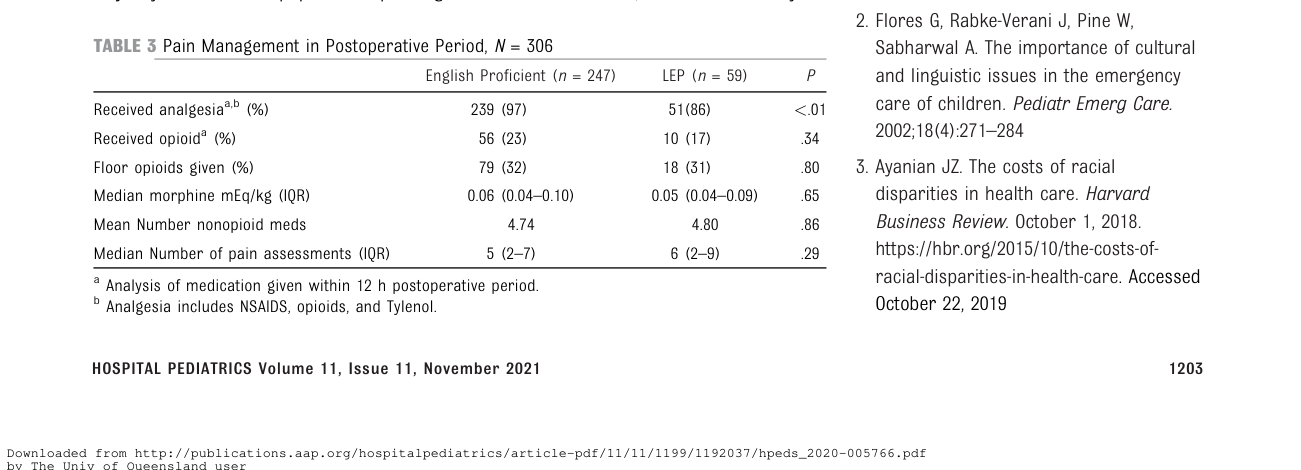
Among hospitalized children after single-limb-fracture surgery, a significantly lower proportion of those from limited-English-proficiency (LEP) families received any pharmacologic analgesia within the first 12 postoperative hours compared with English-proficient (EP) families (86.4% vs 96.8%, P ≤ .01) (Table 3). The Results text reports the same comparison with rounded percentages (86% vs 97%). "Any analgesia" here includes NSAIDs, opioids, and acetaminophen.
"Children in LEP families were significantly less likely to receive any analgesia (86.4% vs 96.8%, P ≤ .01)..." (Plancarte, 2021, p. 1199)
"However, a significantly lower percentage (86% vs 97%, P ≤ .01) in the LEP population received analgesia within 12 hours when compared with the English-proficient population." (Plancarte, 2021, p. 1201)
Methods Context #
What? #ⓘ
The observable: the proportion of patients who received any pharmacologic analgesia (NSAID, opioid, or acetaminophen) within 12 hours after surgery.
"Received analgesia" ... "Analgesia includes NSAIDS, opioids, and Tylenol." (Plancarte, 2021, p. 1203, Table 3)
How? #ⓘ
Proportions of patients receiving any analgesic within the first 12 hours were compared between LEP and EP families using a χ² test on retrospective chart-abstracted data.
"To examine the difference between proportions of patients receiving any analgesic or opioid within the first 12 hours, v2 tests were used." (Plancarte, 2021, p. 1201)
Who? #ⓘ
306 children aged 1 to <18 years hospitalized on the general inpatient floor after single-limb-fracture surgery (July 2016–July 2019) at one urban tertiary-care children's hospital in New York; 59 (19%) were from LEP families, 247 EP.
"A total of 337 patients were examined. Of these, 306 met inclusion criteria, of which 59 (19%) were in families with LEP." (Plancarte, 2021, p. 1201)
Other Notes #
Table 3 gives the underlying counts: 239/247 (97%) EP vs 51/59 (86%) LEP received analgesia within 12 h. The abstract (86.4% vs 96.8%) and Results/Table (86% vs 97%) differ only by rounding, not substantively.
Caveats #
- Single-center retrospective observational cohort with possible LEP misclassification limits causal inference and generalizability The study is a single-center, retrospective observational cohort drawn from one urban tertiary-care children's hospital with a specific (majority Hispanic/Medicaid) population, so its findings may not generalize to other settings. LEP status was ascertained by chart review (consent-form language and interpreter-use documentation), which the authors note is subject to misclassification in both directions. Because the design is observational, the association between LEP and delayed analgesia cannot be interpreted as causal.
- Unmeasured confounders (patient proficiency, caregiver presence, PACU time, provider language skills, cultural pain expectations) not accounted for The adjusted models could not account for several potentially important confounders because they were not documented: provider/nursing proficiency in non-English languages, the pediatric patient's own language proficiency, whether a caregiver was at the bedside after surgery, the time each patient spent in the PACU, and the timing of PACU pain medications relative to floor transfer. The authors also raise possible cultural differences in expectations of pain relief. Any of these could partially explain the observed disparity in time to first analgesia, so the adjusted hazard ratio may still be confounded.