Interpreter use was not associated with number of postoperative clinic visits (beta 0.029, P=0.37) after breast reduction
Source
Wang Fei (2024). Limited English Proficiency Is Not Associated With Poor Postoperative Outcomes or Follow-Up Rates in Patients Undergoing Breast Reduction Mammoplasty – A Single Institution Retrospective Cohort Study. Journal of Surgical Research.
Description #
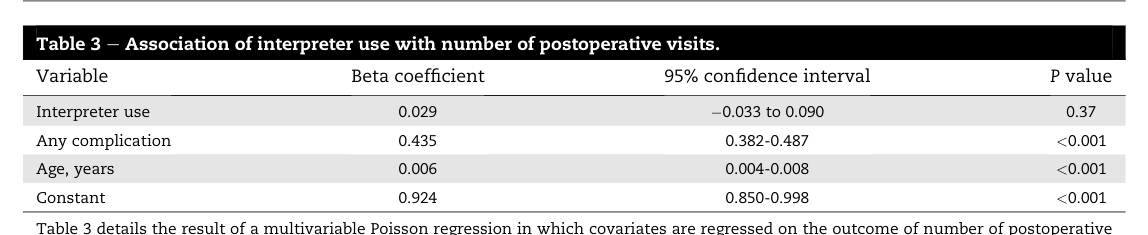
In a multivariable Poisson regression predicting the number of postoperative office visits within 3 months, interpreter use (the proxy for LEP status) was not a significant predictor: beta coefficient 0.029 (95% CI −0.033 to 0.090, P = 0.37; Table 3). The confidence interval spans zero, so this is a null result that opposes the claim that LEP raises postoperative clinic-visit utilization. In the same model, having any complication (beta 0.435, 95% CI 0.382–0.487, P < 0.001) and increasing age (beta 0.006 per year, 95% CI 0.004–0.008, P < 0.001) were significant drivers of visit count instead.
"LEP status was not significantly associated with the number of postoperative clinic visits (Table 3)." (Fei, 2024, p. 691)
"Interpreter use was not significantly associated with postoperative clinic visits." (Fei, 2024, p. 689)
Methods Context #
What? #ⓘ
The observable: the count of postoperative office (clinic) visits within 3 months of surgery.
"Perioperative details of interest included number of preoperative office visits, number of postoperative office visits, number of postoperative emergency department (ED) visits within 3 mo of the surgery." (Fei, 2024, p. 690)
How? #ⓘ
Multivariable Poisson regression built with a backwards model-building approach, regressing interpreter use, any complication, and age on the number of postoperative office visits; coefficients interpreted as e^beta.
"A backwards model building approach was utilized for a Poisson regression model used to determine the association between LEP status and postoperative clinic visits adjusting for potential confounders such as age and complications." (Fei, 2024, p. 691)
Who? #ⓘ
All 1023 breast-reduction patients in the analytic cohort (single urban academic center, 2015–2019).
"Table 3 details the result of a multivariable Poisson regression in which covariates are regressed on the outcome of number of postoperative office visits within 3 mo. N = 1023." (Fei, 2024, p. 691)
Other Notes #
Interpreter use served as the proxy for LEP status (see qualifying caveat). Table 3 constant term: 0.924 (95% CI 0.850–0.998).
Caveats #
- LEP status was proxied by documented interpreter use and non-English consent forms, not directly measured (Wang 2024) The exposure of interest, LEP status, was never measured directly. It was operationalized as a proxy — patients who had documented interpreter use and/or required non-English consent forms in the chart were classified as LEP. Because all LEP patients in the cohort used interpreters, the study cannot separate the effect of language discordance from the effect of receiving interpreting services, and any LEP patients who did not have interpreter use or non-English consent documented would be misclassified as non-LEP. [Inferred: non-differential misclassification of the exposure of this kind tends to bias effect estimates toward the null, so the reported null associations may partly reflect exposure measurement error rather than a true absence of effect.]
- Retrospective single-center BRM cohort, predominantly Spanish-speaking and possibly underpowered to detect a small LEP association (Wang 2024) The null LEP associations come from a retrospective, observational, single-institution cohort — not a randomized trial — so measured and unmeasured confounders could not be fully controlled despite multivariable adjustment. The authors explicitly note the sample may be inadequate to detect a small but genuine LEP effect, which is the central threat to interpreting these nulls as true absence of effect. The cohort was also predominantly Spanish-speaking, precluding stratification by language, and drawn from a single urban academic center with an LEP rate nearly double the U.S. average, limiting generalizability (especially to rural settings and non-Spanish LEP groups). Together these features make the null findings hypothesis-consistent but not confirmatory of "no effect."