LEP patients were more likely to have mature cataracts (5.1% vs 2.3%) at cataract surgery
Source
Zafar Gill (2023). Comparison of cataract surgery outcomes in English proficient and limited English proficiency patients. journal of catact and refractive surgery.
Description #
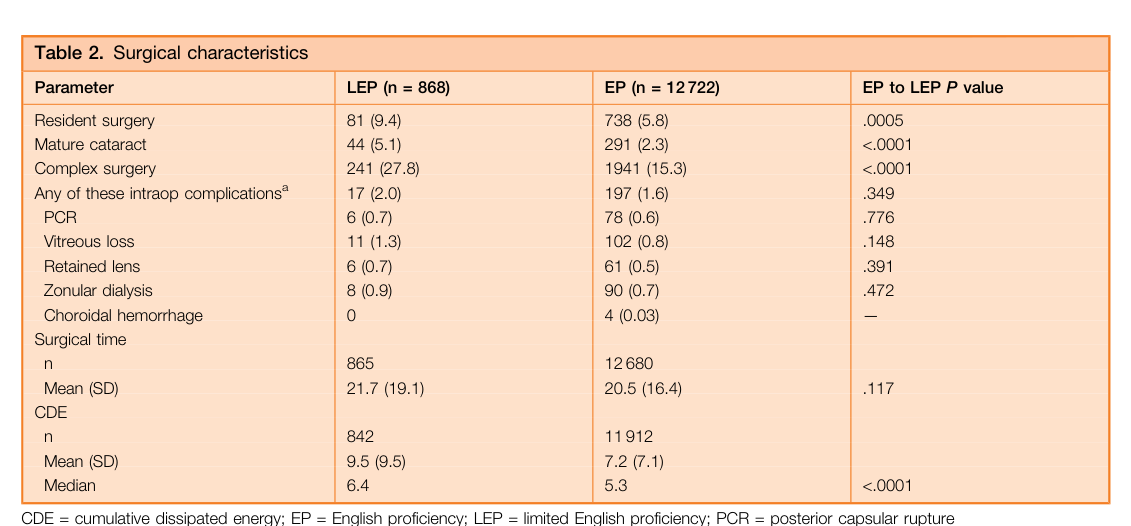
In this retrospective cohort, eyes of LEP patients were more than twice as likely to present with mature cataracts than eyes of EP patients (5.1% vs 2.3%, P < .0001) (Table 2). This indicates more advanced disease at the time of surgery in the LEP group.
"LEP patients were more likely to have mature cataracts (5.1% vs 2.3%, P < .0001)." (Zafar, 2023, p. 595)
"Mature cataract 44 (5.1) 291 (2.3) <.0001" (Zafar, 2023, p. 597, Table 2)
Methods Context #
What? #ⓘ
The observable: cataract maturity, a graded surgical characteristic abstracted from the medical chart.
"Surgical characteristics and outcomes collected included cataract maturity, complexity of surgery, intraoperative and postoperative complications, whether a resident or attending physician was the primary surgeon, surgical time, postoperative CDVA, change in visual acuity, refractive surprise, cumulative dissipated energy (CDE), usage of steroid eyedrops at 4 weeks postoperatively, and whether the patient received subsequent Nd:YAG laser capsulotomy." (Zafar, 2023, p. 596)
How? #ⓘ
Retrospective comparison by LEP status using logistic regression with generalized estimating equations to account for correlation between fellow eyes of the same subject.
"Comparisons by LEP status were analyzed using logistic regression with generalized estimating equations to account for correlation between eyes from the same subject." (Zafar, 2023, p. 596)
Who? #ⓘ
13,590 eyes that underwent phacoemulsification at the University of Colorado Sue Anschutz-Rogers Eye Center (January 2014–February 2020); 868 (6.4%) from LEP patients (self-identified as needing/preferring an interpreter) vs 12,722 from EP patients.
"A total of 13 590 eyes were included in the analytic database. Of these, 868 (6.4%) were identified from LEP patients." (Zafar, 2023, p. 596)
Caveats #
- Single tertiary-referral academic center limits generalizability of LEP cataract findings (Zafar) The study drew from a single academic tertiary-referral eye center whose LEP population may differ from LEP patients elsewhere. Its LEP rate (6.4%) was below the metro Denver average, which the authors attribute to access barriers under-representing LEP patients and to the center serving patients from outside the metro area. The authors explicitly caution that this specific LEP group may not generalize to other practice settings.
- LEP identified only by EMR interpreter-need flag, risking misclassification (Zafar cataract) LEP status was operationalized solely from an electronic-medical-record designation of "needing or preferring an interpreter," recorded by call-center or front-desk staff when the appointment was booked. The authors concede this process may not have accurately captured all LEP patients, and note their observed LEP rate (6.4%) was well below the metro Denver average (8%), suggesting under-ascertainment. Misclassification of the exposure could bias any of the LEP-versus-EP comparisons (mature cataract, complex surgery, preoperative acuity, steroid use, YAG capsulotomy, comorbidity).