No significant difference in postoperative complications between LEP and EP cataract surgery
Source
Zafar Gill (2023). Comparison of cataract surgery outcomes in English proficient and limited English proficiency patients. journal of catact and refractive surgery.
Description #
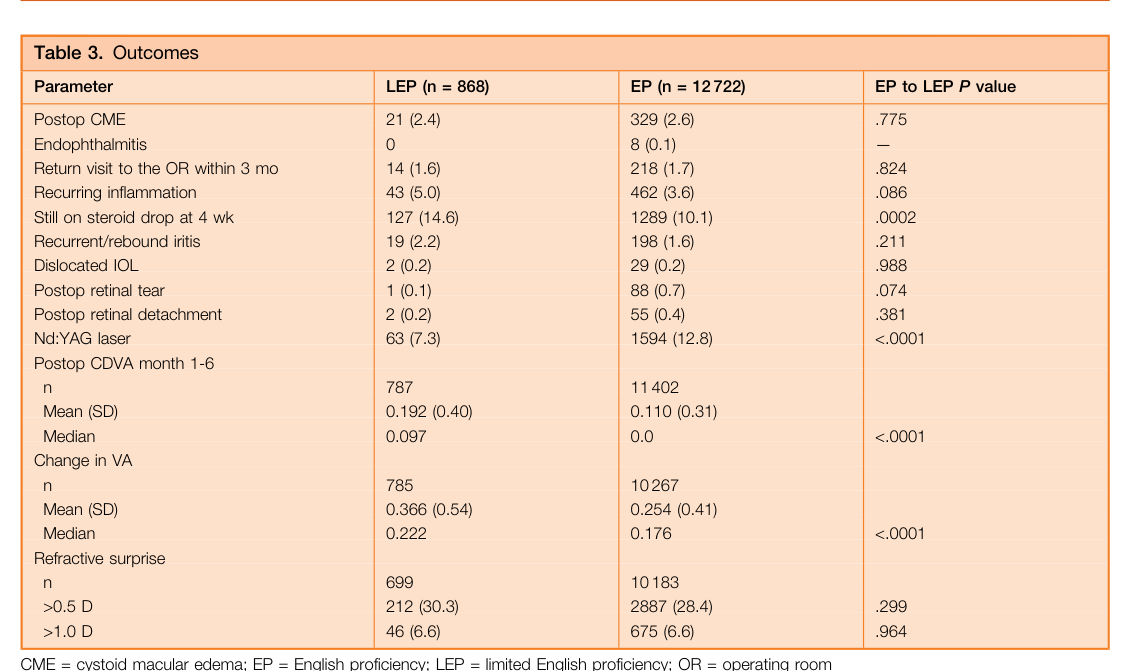
There were no statistically significant differences in postoperative complications between LEP and EP cataract patients, including cystoid macular edema (2.4% vs 2.6%, P = .775), endophthalmitis, return to OR within 3 months (1.6% vs 1.7%, P = .824), recurring inflammation (5.0% vs 3.6%, P = .086), dislocated IOL, refractive surprise, and retinal tear/detachment (Table 3). This is a null result across the complication panel.
"There were also no significant differences in postoperative complications including cystoid macular edema, endophthalmitis, return to operating room in 3 months, recurring inflammation, dislocated intraocular lens (IOL), refractive surprise, or retinal tear or detachment." (Zafar, 2023, p. 598)
"Postop CME 21 (2.4) 329 (2.6) .775" (Zafar, 2023, p. 598, Table 3)
Methods Context #
What? #ⓘ
The observable: postoperative complications after cataract surgery, recorded as categorical events.
"Surgical characteristics and outcomes collected included cataract maturity, complexity of surgery, intraoperative and postoperative complications" (Zafar, 2023, p. 596)
How? #ⓘ
Retrospective comparison by LEP status using logistic regression with generalized estimating equations to account for correlation between fellow eyes.
"Comparisons by LEP status were analyzed using logistic regression with generalized estimating equations to account for correlation between eyes from the same subject." (Zafar, 2023, p. 596)
Who? #ⓘ
13,590 phacoemulsification eyes at a single academic eye center (2014–2020); 868 (6.4%) LEP vs 12,722 EP. The authors note serious complications (endophthalmitis, IOL dislocation) were too infrequent to be adequately powered.
"A total of 13 590 eyes were included in the analytic database. Of these, 868 (6.4%) were identified from LEP patients." (Zafar, 2023, p. 596)
Caveats #
- Small LEP sample underpowered to detect differences, especially rare complications (Zafar cataract) The LEP group (n = 868 eyes) was far smaller than the EP group (n = 12,722), and the authors state the small LEP sample limited their ability to detect further significant differences. They specifically note that serious complications such as endophthalmitis and IOL dislocation were too infrequent for the study to be adequately powered to detect between-group differences. The non-significant (null) findings for intraoperative complications, operative time, and postoperative complications should therefore be read as inconclusive rather than as demonstrated equivalence.