LEP cataract surgeries used higher cumulative dissipated energy (mean 9.5 vs 7.2)
Source
Zafar Gill (2023). Comparison of cataract surgery outcomes in English proficient and limited English proficiency patients. journal of catact and refractive surgery.
Description #
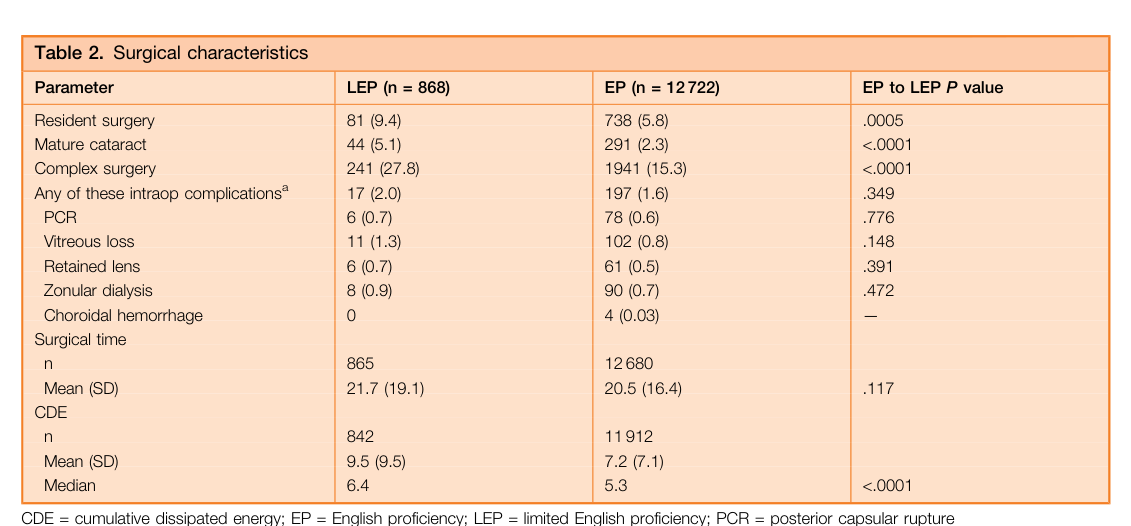
LEP patients' cataract surgeries used higher cumulative dissipated energy (CDE), a measure of phacoemulsification energy delivered, than EP patients' surgeries (mean 9.5 [SD = 9.5] vs 7.2 [SD = 7.1], P < .0001; median 6.4 vs 5.3, P < .0001) (Table 2). Higher CDE reflects a denser/more challenging cataract. Note a minor internal inconsistency: the abstract reports the EP value as "7.2 [SD = 7.1]" while the Results text on p. 596 reports it as "7.2 [mean = 7.1]," an apparent typographical error for the SD.
"use higher cumulative dissipated energy (mean of 9.5 [SD = 9.5] vs 7.2 [SD = 7.1], P < .0001)" (Zafar, 2023, p. 595)
"and higher CDE (mean 9.5 [SD = 9.5] vs 7.2 [mean = 7.1], P < .0001)." (Zafar, 2023, p. 596)
Methods Context #
What? #ⓘ
The observable: cumulative dissipated energy (CDE), a continuous intraoperative measure of phacoemulsification energy.
"cumulative dissipated energy (CDE)" (Zafar, 2023, p. 596)
How? #ⓘ
Retrospective analysis of a cataract-surgery outcomes database; CDE compared by LEP status as a continuous variable (medians, means, and standard deviations reported for continuous variables).
"We performed a retrospective analysis using the Cataract Surgery Outcomes Database developed by the Department of Ophthalmology at the University of Colorado School of Medicine." (Zafar, 2023, p. 596)
Who? #ⓘ
CDE was available for 842 LEP eyes and 11,912 EP eyes out of the 13,590-eye cohort at a single academic eye center (2014–2020).
"A total of 13 590 eyes were included in the analytic database. Of these, 868 (6.4%) were identified from LEP patients." (Zafar, 2023, p. 596)