LEP patients had greater visual acuity improvement after cataract surgery (change 0.366 vs 0.254)
Source
Zafar Gill (2023). Comparison of cataract surgery outcomes in English proficient and limited English proficiency patients. journal of catact and refractive surgery.
Description #
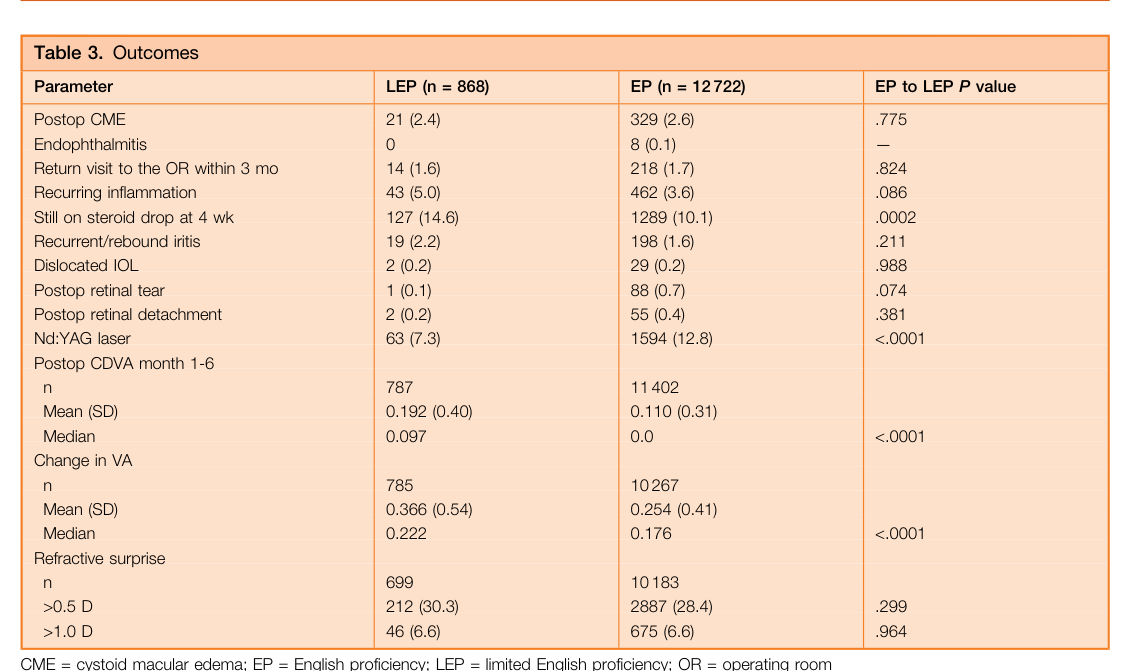
Despite (and consistent with) their worse baseline acuity, LEP patient eyes showed greater improvement in CDVA after cataract surgery than EP eyes (change in logMAR 0.366 [SD = 0.54] vs 0.254 [SD = 0.41], P < .0001; median change 0.222 vs 0.176) (Table 3). A larger positive change denotes greater visual gain.
"showed greater improvement after surgery (logMAR 0.366 [SD = 0.54] vs 0.254 [SD = 0.41], P < .0001)." (Zafar, 2023, p. 595)
"Change in VA ... Mean (SD) 0.366 (0.54) 0.254 (0.41) ... Median 0.222 0.176 <.0001" (Zafar, 2023, p. 598, Table 3)
Methods Context #
What? #ⓘ
The observable: change in visual acuity (preoperative minus postoperative CDVA), in logMAR.
"Surgical characteristics and outcomes collected included cataract maturity, complexity of surgery, intraoperative and postoperative complications, whether a resident or attending physician was the primary surgeon, surgical time, postoperative CDVA, change in visual acuity, refractive surprise, cumulative dissipated energy (CDE), usage of steroid eyedrops at 4 weeks postoperatively, and whether the patient received subsequent Nd:YAG laser capsulotomy." (Zafar, 2023, p. 596)
How? #ⓘ
Retrospective analysis of a cataract-surgery outcomes database; change in CDVA compared by LEP status as a continuous variable.
"We performed a retrospective analysis using the Cataract Surgery Outcomes Database developed by the Department of Ophthalmology at the University of Colorado School of Medicine." (Zafar, 2023, p. 596)
Who? #ⓘ
Change in VA was available for 785 LEP eyes and 10,267 EP eyes of the 13,590-eye cohort at a single academic eye center (2014–2020).
"A total of 13 590 eyes were included in the analytic database. Of these, 868 (6.4%) were identified from LEP patients." (Zafar, 2023, p. 596)