LEP patients were more likely to have residents perform their cataract surgery (9.4% vs 5.8%)
Source
Zafar Gill (2023). Comparison of cataract surgery outcomes in English proficient and limited English proficiency patients. journal of catact and refractive surgery.
Description #
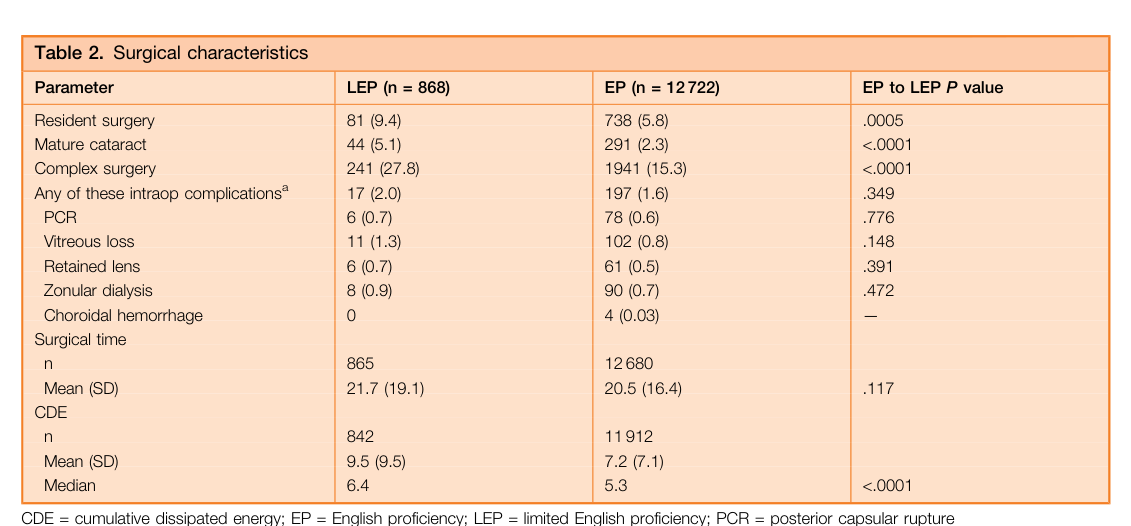
LEP patients were more likely than EP patients to have a resident physician (rather than an attending) perform their cataract surgery (9.4% vs 5.8%, P = .0005) (Table 2). The authors note residents are also more likely to use anterior capsule staining, which itself classifies a surgery as complex.
"LEP patients were also more likely to have resident physicians perform their surgeries (9.4% vs 5.8% P < .0005)." (Zafar, 2023, p. 596)
"Resident surgery 81 (9.4) 738 (5.8) .0005" (Zafar, 2023, p. 597, Table 2)
Methods Context #
What? #ⓘ
The observable: whether a resident or attending physician was the primary surgeon, a categorical characteristic.
"whether a resident or attending physician was the primary surgeon" (Zafar, 2023, p. 596)
How? #ⓘ
Retrospective comparison by LEP status using logistic regression with generalized estimating equations to account for correlation between fellow eyes.
"Comparisons by LEP status were analyzed using logistic regression with generalized estimating equations to account for correlation between eyes from the same subject." (Zafar, 2023, p. 596)
Who? #ⓘ
13,590 phacoemulsification eyes at a single academic (teaching) eye center (2014–2020); 868 (6.4%) LEP vs 12,722 EP.
"A total of 13 590 eyes were included in the analytic database. Of these, 868 (6.4%) were identified from LEP patients." (Zafar, 2023, p. 596)