LEP cataract patients had higher type 2 diabetes prevalence than EP patients (44.9% vs 21.5%)
Source
Zafar Gill (2023). Comparison of cataract surgery outcomes in English proficient and limited English proficiency patients. journal of catact and refractive surgery.
Description #
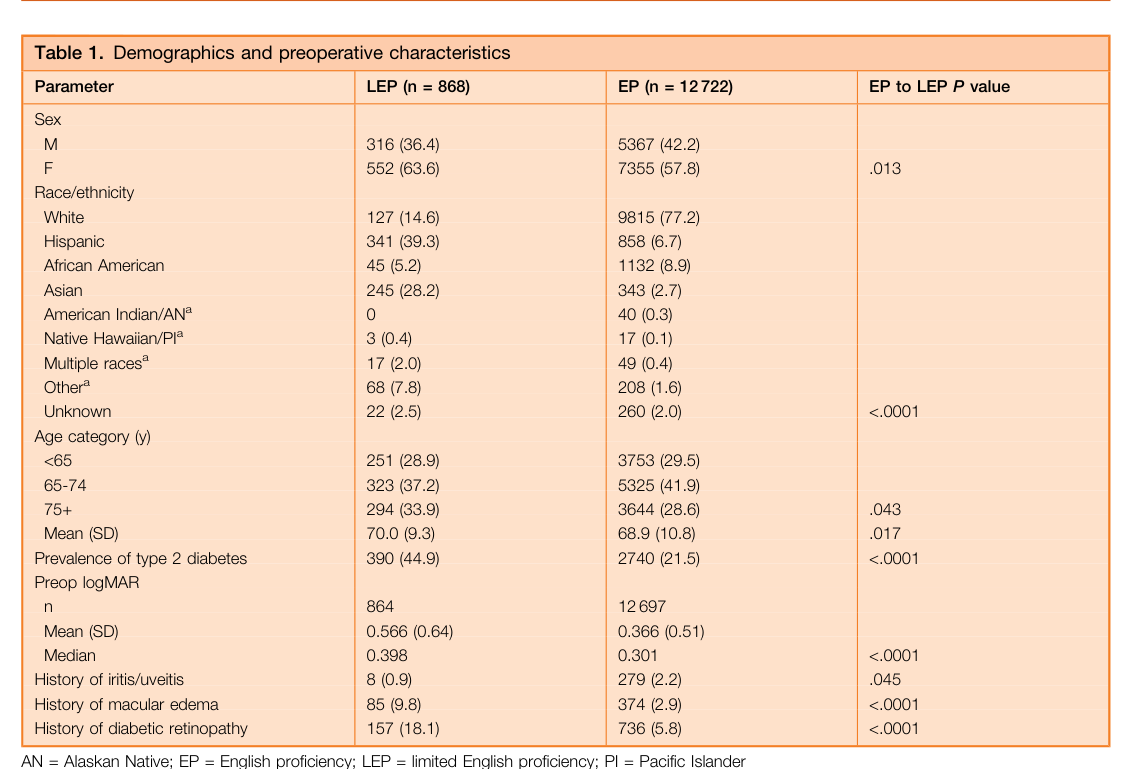
LEP cataract patients had a substantially higher prevalence of type 2 diabetes than EP patients (44.9% vs 21.5%, P < .0001) (Table 1), along with more macular edema (9.8% vs 2.9%) and diabetic retinopathy (18.1% vs 5.8%). This reflects a heavier baseline comorbidity burden in the LEP group.
"LEP patients were more likely to have a history of type 2 diabetes (44.9% vs 21.5%, P < .0001), macular edema (9.8% vs 2.9% P < .0001), and diabetic retinopathy (18.1% vs 5.8%, P < .0001)." (Zafar, 2023, p. 596)
"Prevalence of type 2 diabetes 390 (44.9) 2740 (21.5) <.0001" (Zafar, 2023, p. 597, Table 1)
Methods Context #
What? #ⓘ
The observable: history of type 2 diabetes, a categorical preoperative characteristic.
"as well as a history of type 2 diabetes, uveitis, macular edema, and diabetic retinopathy." (Zafar, 2023, p. 596)
How? #ⓘ
Retrospective comparison by LEP status; categorical frequencies compared between groups.
"Comparisons by LEP status were analyzed using logistic regression with generalized estimating equations to account for correlation between eyes from the same subject." (Zafar, 2023, p. 596)
Who? #ⓘ
13,590 phacoemulsification eyes at a single academic eye center (2014–2020); 868 (6.4%) LEP vs 12,722 EP.
"A total of 13 590 eyes were included in the analytic database. Of these, 868 (6.4%) were identified from LEP patients." (Zafar, 2023, p. 596)
Caveats #
- Single tertiary-referral academic center limits generalizability of LEP cataract findings (Zafar) The study drew from a single academic tertiary-referral eye center whose LEP population may differ from LEP patients elsewhere. Its LEP rate (6.4%) was below the metro Denver average, which the authors attribute to access barriers under-representing LEP patients and to the center serving patients from outside the metro area. The authors explicitly caution that this specific LEP group may not generalize to other practice settings.