LEP patients had longer hospital length of stay than EP (3.4 vs 2.6 days) after arthroplasty
Source
Kevin H Nguyen (2023). Patients Who Have Limited English Proficiency Have Decreased Utilization of Revision Surgeries After Hip and Knee Arthroplasty. Journal of Arthroplasty.
Description #
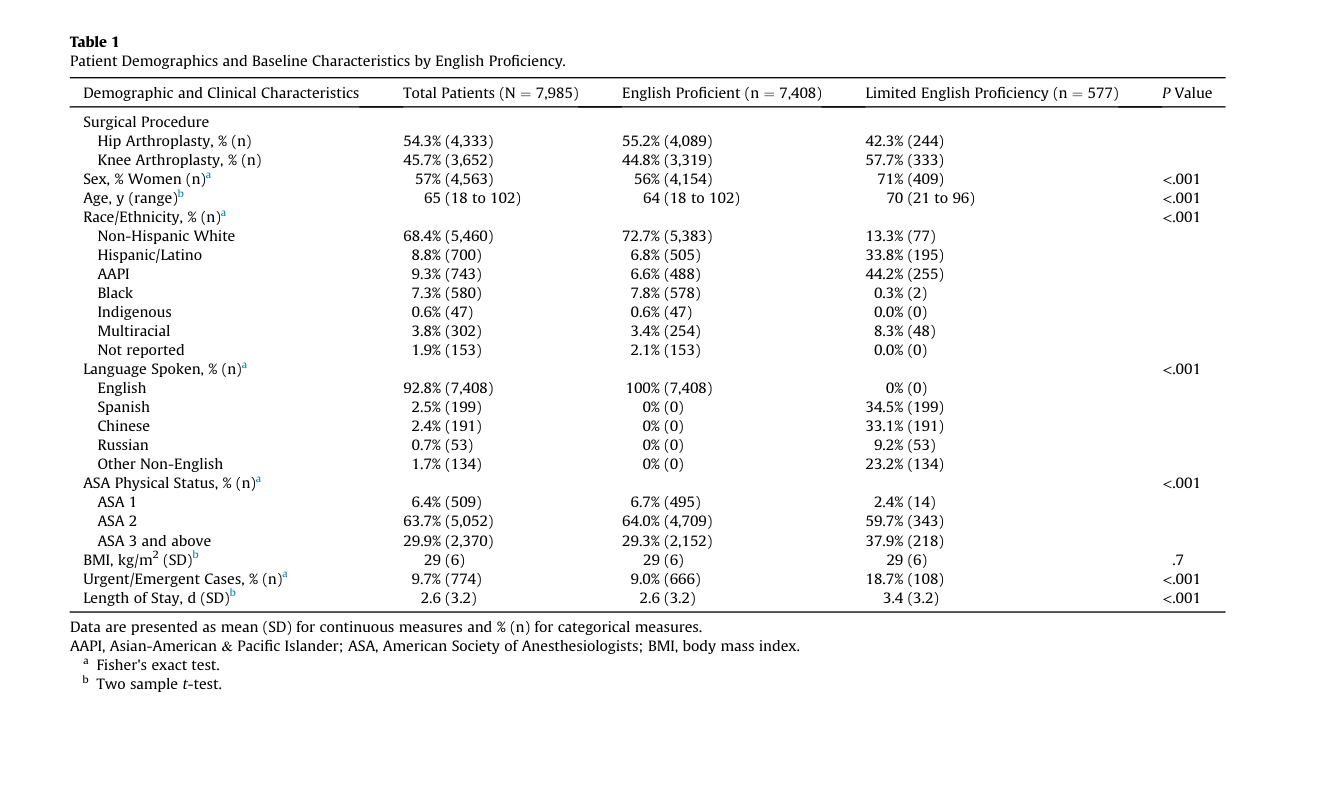
In the unadjusted bivariate comparison (two-sample t-test), patients who had limited English proficiency (LEP) had a longer average hospital length of stay after primary hip or knee arthroplasty than English-proficient (EP) patients (3.4 ± 3.2 days vs 2.6 ± 3.2 days, P < .001) (Table 1). This is a baseline cohort characteristic reported alongside the study's primary revision-surgery outcomes.
"Patients who have LEP were more likely than EP patients to undergo urgent/emergent arthroplasty (18.7% versus 9.0%, P < .001) and had longer average hospitalization lengths (3.4 ± 3.2 days versus 2.6 ± 3.2 days, P < .001) (Table 1)." (Kevin, 2023, p. 1431)
Methods Context #
What? #ⓘ
The observable: hospital length of stay in days.
"Length of Stay, d (SD)" (Kevin, 2023, p. 1430)
How? #ⓘ
Retrospective cohort study of electronic health records; LEP vs EP length of stay compared with a two-sample t-test.
"Bivariate analyses comparing LEP and EP patients' demographic variables, perioperative characteristics, and rates of revision surgeries were performed using t-tests for continuous variables and Fisher's exact tests for categorical variables." (Kevin, 2023, p. 1430)
Who? #ⓘ
7,985 hip and knee arthroplasty procedures at a single academic medical center (2013–2021), 577 (7.2%) classified as LEP by self-reported non-English primary language.
"A total of 7,985 hip and knee arthroplasty surgeries were included in the analysis. There were 577 (7.2%) patients who were classified as having LEP." (Kevin, 2023, p. 1429)
Other Notes #
This length-of-stay difference was reported descriptively (Table 1) and was not carried into a multivariable model in this paper; the study's adjusted analyses targeted revision-surgery utilization. A dedicated length-of-stay analysis from the same group is reported separately (Manuel et al., 2022; reference [5]).
Caveats #
- LEP dichotomized by self-reported primary language, risking proficiency misclassification (Kevin 2023 arthroplasty cohort) English proficiency was operationalized as a binary variable derived solely from self-reported primary language. This risks misclassification in both directions: patients coded English-proficient may have had inadequate health or English literacy to navigate postoperative care, and some patients with limited English proficiency may have self-reported English as their primary language. Such misclassification would tend to attenuate the true association between language proficiency and revision-surgery utilization. The authors note that future studies will aim to use more objective measures of language proficiency.