LEP was associated with longer length of stay (adjusted IRR 1.15) after total joint arthroplasty
Source
Manuel (2022). Association of English Language Proficiency With Hospitalization Cost, Length of Stay, Disposition Location, and Rea. JAMA.
Description #
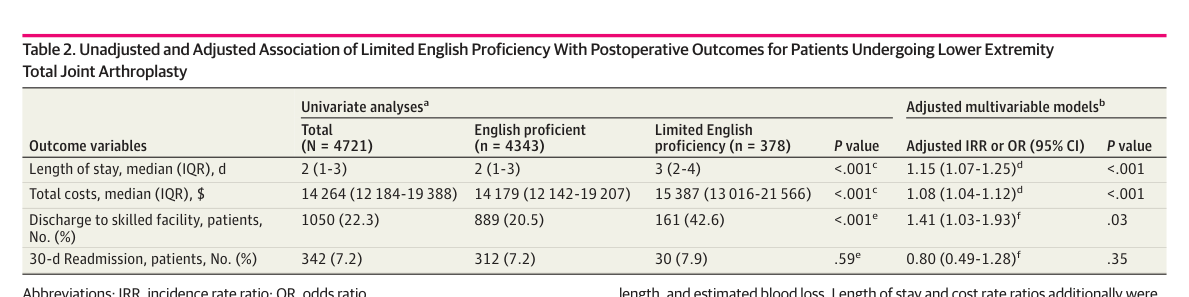
In this retrospective cohort of 4721 total joint arthroplasty (TJA) patients, those with limited English proficiency (LEP) had a longer surgical admission length of stay than English-proficient patients on univariate analysis (median [IQR], 3 [2-4] days vs 2 [1-3] days; P < .001). The association persisted in the adjusted negative binomial model: LEP was independently associated with longer LOS with an incidence rate ratio of 1.15 (95% CI, 1.07-1.25; P < .001) — a roughly 15% longer expected stay (Table 2).
"In univariate analysis, patients with LEP who underwent arthroplasty had longer LOS (median [IQR], 3 [2-4] days vs 2 [1-3] days) ... compared with patients with English proficiency." (Manuel, 2022, p. 3)
"In multivariable models adjusted for age, sex, race and ethnicity, body mass index, primary insurance, American Society of Anesthesiologists physical classification status, elective vs urgent case classification, surgical case length, estimated blood loss, and discharge disposition, LEP was associated with longer LOS (incidence rate ratio, 1.15; 95% CI, 1.07-1.25)" (Manuel, 2022, p. 3)
Methods Context #
What? #ⓘ
The observable: surgical admission length of stay, in days.
"we examine the association of LEP with surgical admission length of stay (LOS), discharge destination, hospitalization cost, and rate of 30-day readmission after TJA." (Manuel, 2022, p. 1)
How? #ⓘ
Negative binomial regression (to accommodate right-skewed LOS) adjusting for a pre-specified covariate set including demographics, insurance, ASA status, case class, case length, blood loss, and discharge disposition; reference group is English-proficient patients.
"The distribution of LOS and total hospitalization cost both exhibited overdispersion caused by right skew, which was accommodated using negative binomial regression." (Manuel, 2022, p. 1)
Who? #ⓘ
Patients aged 18 years or older who underwent TJA from 2015 to 2019 at a single urban academic medical center (N = 4721; 4343 English proficient, 378 LEP). LEP was defined as a non-English language preference plus a request for interpreter services.
"This study used electronic health data of patients aged 18 years or older who underwent TJA from 2015 to 2019 at an urban academic medical center" (Manuel, 2022, p. 1)
"The primary variable was LEP, defined as a language preference other than English and request for interpreter services." (Manuel, 2022, p. 1)
Other Notes #
The Results text states "369 (7.8%) had LEP" (p. 3), whereas Table 1 and Table 2 give the LEP group as n = 378; the adjusted models use n = 378. LOS and cost rate ratios were additionally adjusted for disposition location per the Table 2 footnote.
Caveats #
- Observational single-center EHR-derived cohort with LEP defined by interpreter request; residual confounding precludes causal inference The findings are from a retrospective observational cohort at a single urban academic medical center, using variables derived from the electronic health record, and can establish association but not causation. The authors explicitly acknowledge the limitations inherent to observational EHR-based analysis (with further detail deferred to an unavailable eAppendix). Residual and unmeasured confounding is possible despite multivariable adjustment; the exposure (LEP) was operationalized as a non-English language preference plus a recorded request for interpreter services, which may misclassify patients who are LEP but did not request an interpreter, and single-center results may not generalize to other settings or payer/case mixes.