Very urgent (under 6h) cases had lower documented consent concordance (57.1%) than elective (84.2%)
Source
Karen Trang (2024). The Impact of Using Electronic Consents on Documentation of Language-Concordant Surgical Consent for Patients with Limited English Proficiency. The Joint Commission Journal on Quality and Patient Safety.
Description #
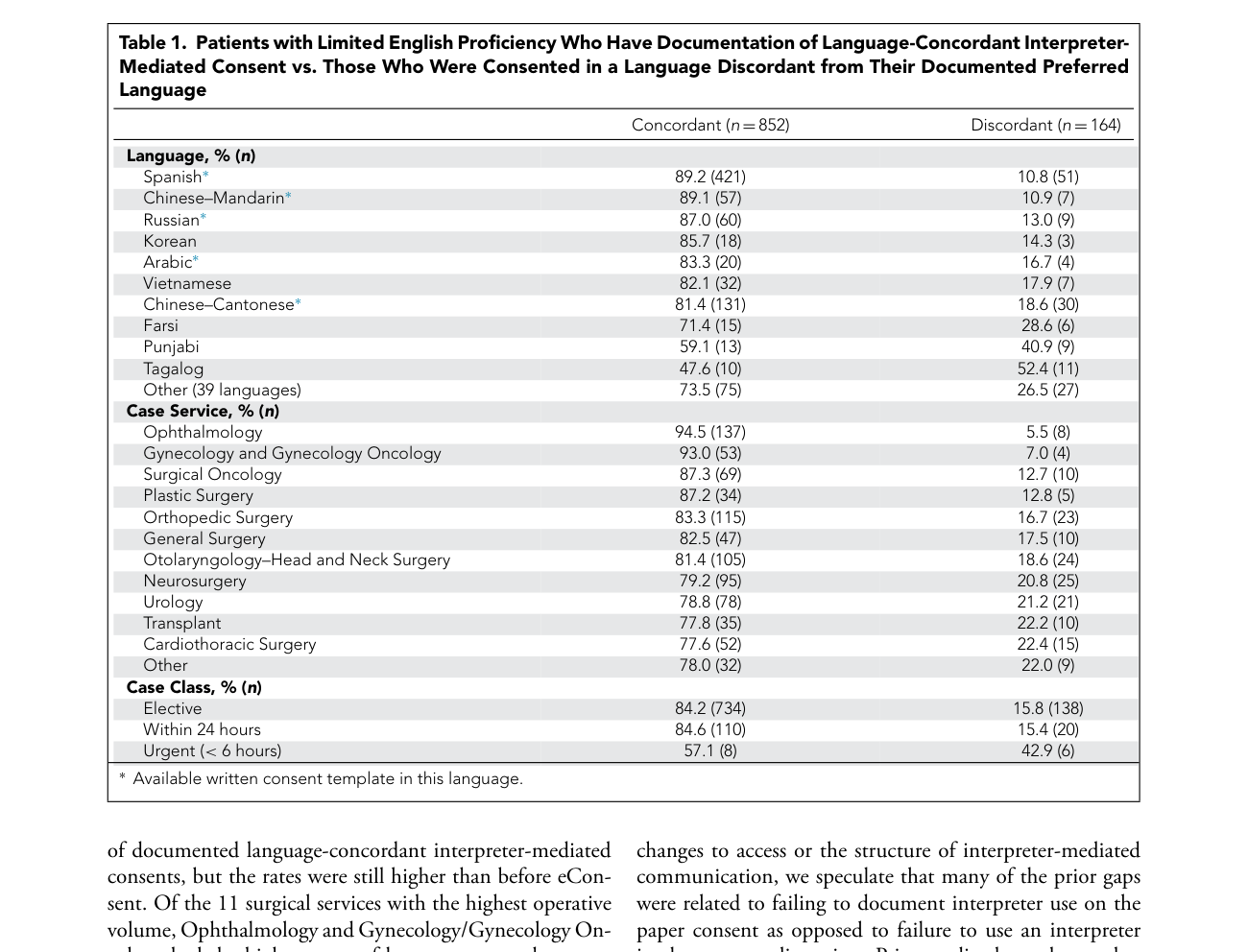
Under eConsent, documented language-concordant consent rates were similar for elective (84.2%) and within-24-hours (84.6%) cases, but lower for very urgent cases scheduled within 6 hours (57.1%, only 8/14 concordant) (Table 1). Only the most time-pressured cases showed reduced concordance.
"Elective cases and urgent cases performed within 24 hours had similar rates of language-concordant consents, whereas urgent cases performed within 6 hours had lower rates." (Trang, 2024, p. 530)
"Elective 84.2 (734) 15.8 (138) ... Urgent (< 6 hours) 57.1 (8) 42.9 (6)" (Trang, 2024, p. 530, Table 1)
Methods Context #
What? #ⓘ
The observable: the proportion of eConsent encounters with documented language-concordant interpreter-mediated consent, stratified by case-request scheduling urgency (case class).
"Case Class, % (n)" (Trang, 2024, p. 530, Table 1)
How? #ⓘ
Cross-sectional tabulation of the study-period eConsent encounters by case class (elective, within 24 hours, urgent < 6 hours), with concordant/discordant counts and percentages reported (Table 1) for the A-0007ArtifactA-0007Initial AI draftEpic eConsent with auto-translated consent templates and mandatory interpreter documentationTo improve language-concordant surgical informed consent for patients with limited English proficiency (LEP) by replacing paper consent forms with an EHR-integrated electronic consent (eConsent) that both delivers the wr….
"Chi-square tests were used to compare categorical variables, and all analysis was performed using R statistical software (version 4.3.0, R Core Team, 2023)." (Trang, 2024, p. 529)
Who? #ⓘ
The 1,016 LEP eConsent encounters classified by scheduling urgency; the very urgent (< 6 hours) stratum was small (14 encounters total) at an urban academic medical center.
"During the study period, patients with a preferred language other than English signed 1,016 eConsents." (Trang, 2024, p. 529)
Other Notes #
The authors interpret the urgent-case drop as expected because interpreter use takes time and providers may skip the step in urgent settings — settings that render patients even more vulnerable to miscommunication (Trang, 2024, p. 531). The very-urgent stratum is small (n = 14), so the 57.1% estimate is imprecise (see qualifying caveat).
Caveats #
- Single-institution retrospective interim analysis with a short study period and few supported languages The findings come from a single urban academic medical center, are retrospective, cover only a short study period (an interim analysis, Feb 8 – Jun 14 2023), and involve a limited number of languages with translated written consent templates (five). These features limit generalizability of the post-implementation concordance rates and the language/service/urgency subgroup patterns to other settings, later time points, and other language groups.