Documented consent concordance was lower for less commonly spoken languages (Spanish 89.2% vs Tagalog 47.6%)
Source
Karen Trang (2024). The Impact of Using Electronic Consents on Documentation of Language-Concordant Surgical Consent for Patients with Limited English Proficiency. The Joint Commission Journal on Quality and Patient Safety.
Description #
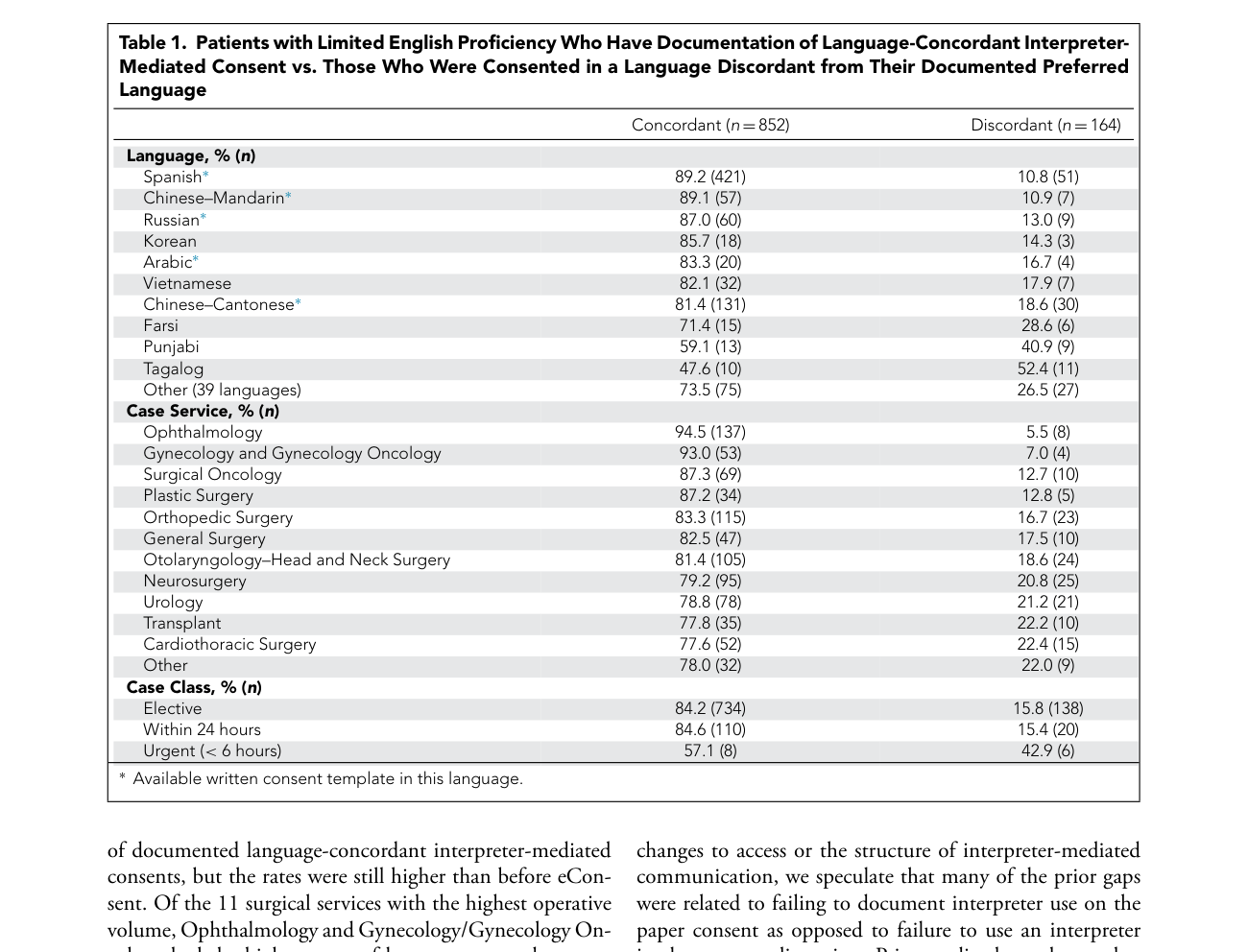
Under eConsent, the rate of documented language-concordant interpreter-mediated consent varied by the patient's preferred language, and patients speaking less widely spoken languages had lower concordance (Table 1). The most common languages had the highest concordance (Spanish 89.2%, Chinese–Mandarin 89.1%, Russian 87.0%), while several less common languages were much lower (Farsi 71.4%, Punjabi 59.1%, Tagalog 47.6%). Tagalog was the only listed language with majority-discordant consents (52.4% discordant).
"Patients with a preferred language that was less widely spoken had lower rates of documented language-concordant interpreter-mediated consents, but the rates were still higher than before eConsent." (Trang, 2024, p. 529)
"Spanish* 89.2 (421) 10.8 (51) ... Tagalog 47.6 (10) 52.4 (11)" (Trang, 2024, p. 530, Table 1)
Methods Context #
What? #ⓘ
The observable: the proportion of eConsent encounters with documented language-concordant interpreter-mediated consent, stratified by patient preferred language.
"Patients with Limited English Proficiency Who Have Documentation of Language-Concordant Interpreter-Mediated Consent vs. Those Who Were Consented in a Language Discordant from Their Documented Preferred Language" (Trang, 2024, p. 530, Table 1)
How? #ⓘ
Cross-sectional tabulation of the 1,016 study-period eConsent encounters by recorded preferred language, with each language's concordant/discordant counts and percentages reported (Table 1) for the A-0007ArtifactA-0007Initial AI draftEpic eConsent with auto-translated consent templates and mandatory interpreter documentationTo improve language-concordant surgical informed consent for patients with limited English proficiency (LEP) by replacing paper consent forms with an EHR-integrated electronic consent (eConsent) that both delivers the wr….
"Chi-square tests were used to compare categorical variables, and all analysis was performed using R statistical software (version 4.3.0, R Core Team, 2023)." (Trang, 2024, p. 529)
Who? #ⓘ
The 1,016 LEP eConsent encounters spanning 49 non-English preferred languages at an urban academic medical center.
"A total of 1,016 eConsent encounters for patients with LEP were included, with patients speaking 49 different languages, most commonly Spanish (46.5%), Chinese (22.1%), and Russian (6.8%)." (Trang, 2024, p. 528)
Other Notes #
The authors speculate lower concordance for less common languages may reflect greater difficulty obtaining interpreter services, greater willingness to use a family member, or patients' limited English use in the consent process (Trang, 2024, p. 530). Languages with an available written consent template are asterisked in Table 1 (Spanish, Chinese–Mandarin, Russian, Arabic, Chinese–Cantonese).
Caveats #
- Single-institution retrospective interim analysis with a short study period and few supported languages The findings come from a single urban academic medical center, are retrospective, cover only a short study period (an interim analysis, Feb 8 – Jun 14 2023), and involve a limited number of languages with translated written consent templates (five). These features limit generalizability of the post-implementation concordance rates and the language/service/urgency subgroup patterns to other settings, later time points, and other language groups.