Documented language-concordant interpreter-mediated consent rose from 56.9% to 83.9% after paper-to-eConsent transition
Source
Karen Trang (2024). The Impact of Using Electronic Consents on Documentation of Language-Concordant Surgical Consent for Patients with Limited English Proficiency. The Joint Commission Journal on Quality and Patient Safety.
Description #
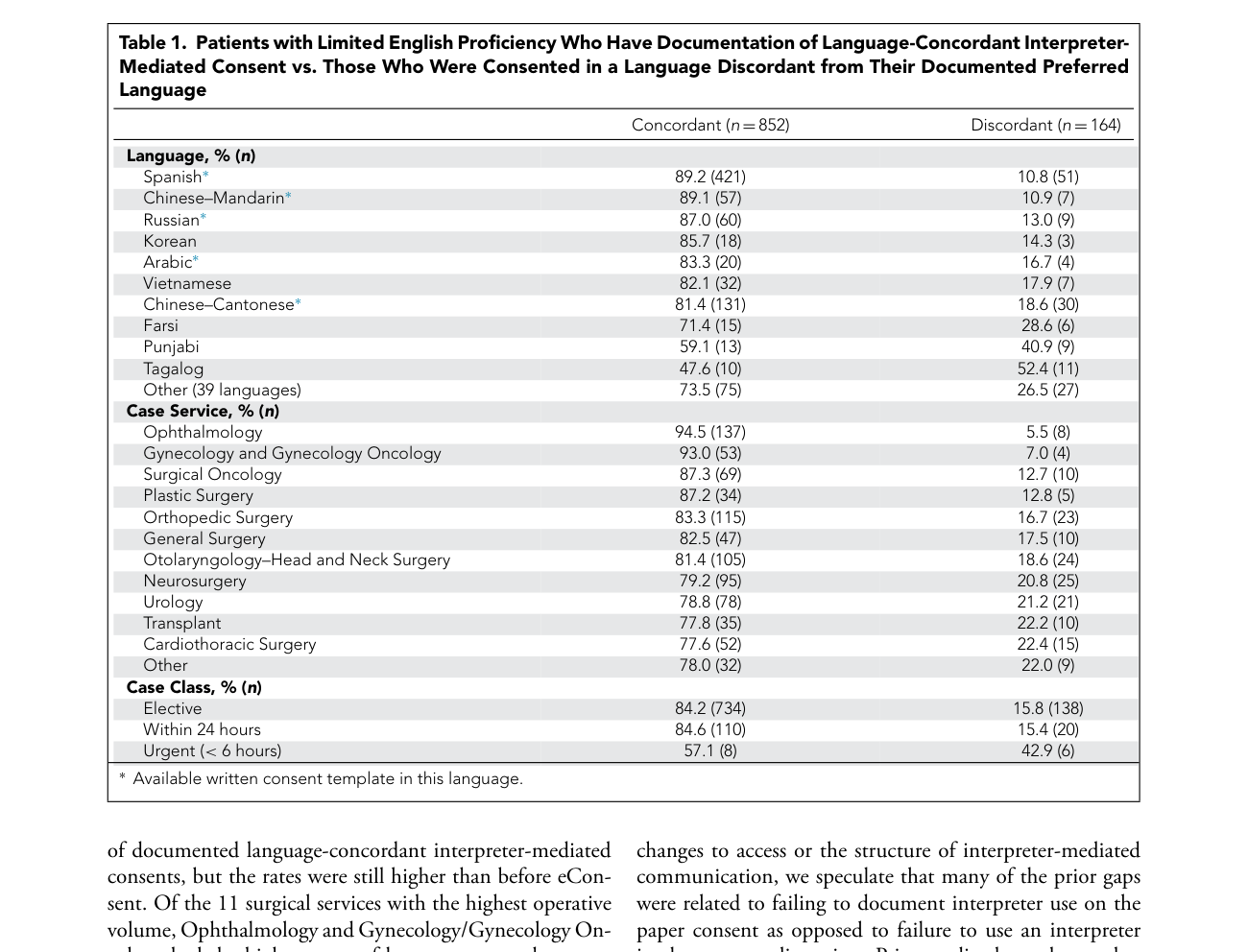
After the institution transitioned from paper consents to an EHR-integrated A-0007ArtifactA-0007Initial AI draftEpic eConsent with auto-translated consent templates and mandatory interpreter documentationTo improve language-concordant surgical informed consent for patients with limited English proficiency (LEP) by replacing paper consent forms with an EHR-integrated electronic consent (eConsent) that both delivers the wr…, overall documentation of language-concordant interpreter-mediated surgical consent for patients with LEP increased from 56.9% (721/1,267) at the paper-era baseline to 83.9% (852/1,016) during the eConsent period (p < 0.001). This is an absolute increase of ~27 percentage points; the Discussion frames the same change as a "47.4% improvement" (a relative gain: (83.9−56.9)/56.9 ≈ 47.4%). The baseline denominator (1,267 audited paper consents) and the study denominator (1,016 eConsents) come from different sampling methods (see qualifying caveat).
"Overall documentation of language-concordant interpreter-mediated communication increased from 56.9% (721/1,267) to 83.9% (852/1,016) (p < 0.001), but there were differences between languages and surgical services (Table 1)." (Trang, 2024, p. 529)
"Our study shows that the transition from paper consents to eConsent was associated with a 47.4% improvement in documentation of language-concordant surgical consent delivery in patients with LEP." (Trang, 2024, p. 530)
Methods Context #
What? #ⓘ
The observable: documented provision of an interpreter-mediated consent discussion conducted in the patient's preferred (concordant) language.
"the documented provision of the consent discussion mediated by an interpreter in the appropriate language for patients with LEP." (Trang, 2024, p. 529)
How? #ⓘ
A single-center pre/post quality-improvement comparison: the post-implementation rate came from all eConsents in the study period, compared against a paper-era baseline derived from monthly random regulatory audits, using chi-square tests. Language concordance was defined as the documented consent-discussion language matching the patient's recorded preferred language on the A-0007ArtifactA-0007Initial AI draftEpic eConsent with auto-translated consent templates and mandatory interpreter documentationTo improve language-concordant surgical informed consent for patients with limited English proficiency (LEP) by replacing paper consent forms with an EHR-integrated electronic consent (eConsent) that both delivers the wr….
"The baseline language-concordant documentation compliance rate was determined by calculating the overall language concordance rate for the audited paper surgical consents between January and December 2022." (Trang, 2024, p. 529)
"Chi-square tests were used to compare categorical variables, and all analysis was performed using R statistical software (version 4.3.0, R Core Team, 2023)." (Trang, 2024, p. 529)
Who? #ⓘ
Adult (>18 years) surgical patients with a documented preferred language other than English at an urban academic medical center with high language diversity: 1,016 self-signed eConsent encounters (post) versus 1,267 audited paper consents (Jan–Dec 2022 baseline).
"During the study period, patients with a preferred language other than English signed 1,016 eConsents." (Trang, 2024, p. 529)
"This study was conducted at an urban academic medical center with high language diversity and a large population with LEP." (Trang, 2024, p. 529)
Other Notes #
The authors speculate the improvement reflects better documentation of interpreter use rather than a change in actual interpreter use, since access and interpreter-mediated communication structure did not change: "we speculate that many of the prior gaps were related to failing to document interpreter use on the paper consent as opposed to failure to use an interpreter in the consent discussion." (Trang, 2024, p. 530)
Caveats #
- Outcome captured documentation of language-concordant consent, not actual practice The study measured only documentation of language-concordant informed consent, not the actual consent practice. Documented rates can under-represent true language-concordant care (more concordant discussions may have occurred than were documented), and — conversely — the post-eConsent gain may partly reflect improved documentation of interpreter use rather than a real change in interpreter use. The documented-consent measure is therefore a proxy for, not a direct measure of, language-concordant care delivered.
- Single-institution retrospective interim analysis with a short study period and few supported languages The findings come from a single urban academic medical center, are retrospective, cover only a short study period (an interim analysis, Feb 8 – Jun 14 2023), and involve a limited number of languages with translated written consent templates (five). These features limit generalizability of the post-implementation concordance rates and the language/service/urgency subgroup patterns to other settings, later time points, and other language groups.
- No precise before-after comparison; paper-era baseline came from separate regulatory-audit sample The reported before-after increase (56.9% → 83.9%) is not a precise like-for-like comparison. Because paper consents were not reliably digitized, the pre-implementation baseline was not derived from the same data pipeline as the eConsent period but from pre-existing monthly regulatory-compliance audits of ~100 paper consents per month over 2022 (a different, smaller-sample denominator, 721/1,267, than the 852/1,016 eConsent denominator). This confounds the comparison with differences in sampling and measurement method rather than a clean pre/post of the same population.