Professional interpreter use at consent signing rose non-significantly post-implementation (29.8% to 39.7%)
Source
Lee (2017). Increased Access to Professional Interpreters in the Hospital Improves Informed Consent for Patients with Limited English Proficiency. Journal of General Internal Medicine.
Description #
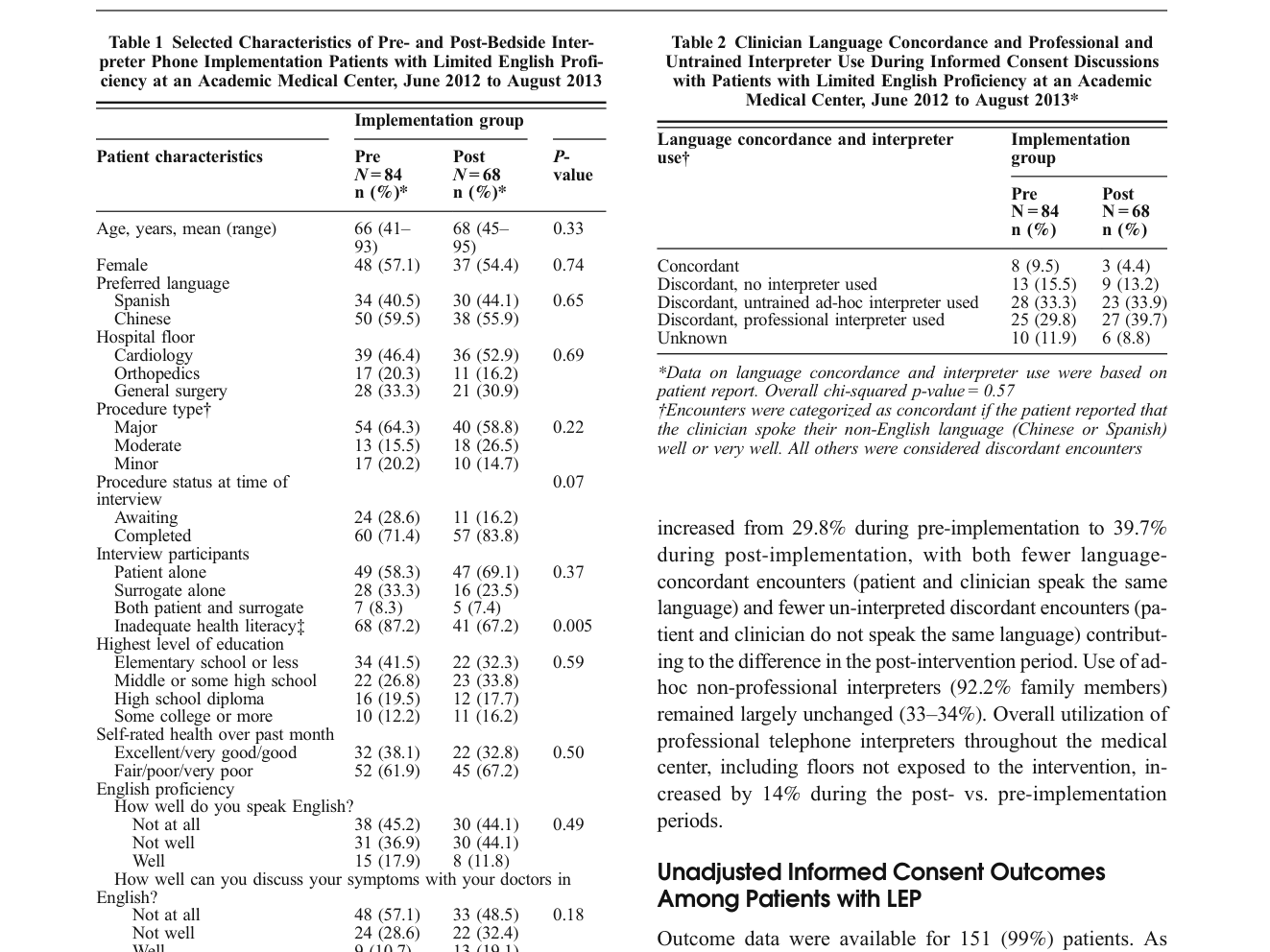
Patient-reported use of a professional interpreter specifically at the time the informed consent form was signed increased from 29.8% pre-implementation to 39.7% post-implementation, but this shift was not statistically significant (overall chi-squared p = 0.57 for the language-concordance/interpreter-use distribution) (Table 2). Both fewer language-concordant encounters and fewer un-interpreted discordant encounters contributed to the post-intervention shift, while use of ad-hoc non-professional interpreters (92.2% family members) remained largely unchanged at 33–34% (Table 2).
"As shown in Table 2, patient-reported use of professional interpreters at the time informed consent forms were signed increased from 29.8% during pre-implementation to 39.7% during post-implementation, with both fewer language-concordant encounters (patient and clinician speak the same language) and fewer un-interpreted discordant encounters (patient and clinician do not speak the same language) contributing to the difference in the post-intervention period. Use of ad-hoc non-professional interpreters (92.2% family members) remained largely unchanged (33–34%)." (Lee, 2017, p. 866)
"Overall chi-squared p-value = 0.57" (Lee, 2017, p. 866)
Methods Context #
What? #ⓘ
The observable: patient-reported category of language concordance and interpreter use (concordant; discordant with no interpreter; discordant with untrained ad-hoc interpreter; discordant with professional interpreter) during the encounter when the consent form was signed.
"we also asked patients about clinician language ability and professional and untrained ad-hoc interpreter use during the encounter when the consent form was signed." (Lee, 2017, p. 865)
How? #ⓘ
Structured patient/surrogate interviews during hospitalization; pre- vs. post-implementation distributions compared with chi-squared tests (A-0005ArtifactA-0005Initial AI draftBedside interpreter phone systemTo remove the time and availability barriers that keep clinicians from using professional interpreters in the hospital, by putting immediate, round-the-clock access to remote professional medical interpreters at every pa… was the intervening change between periods).
"We used chi-squared and t-tests to compare patient characteristics and the frequency of patient-reported professional interpreter use during the consent discussion between the pre- and post-implementation LEP groups." (Lee, 2017, p. 865)
Who? #ⓘ
152 Chinese- and Spanish-speaking hospitalized LEP patients (84 pre-, 68 post-implementation) on the cardiovascular, general surgery, and orthopedic surgery floors; a number had missing interpreter-use data ("Unknown": 10 pre, 6 post).
"there were a number of participants for whom we had missing data on interpreter use" (Lee, 2017, p. 868)
Other Notes #
This process measure is a null (non-significant) result. The authors suggest the intervention provided interpreter access throughout hospitalization, not only at consent signing, which may explain why the gain in adequately informed consent exceeded this point-of-consent utilization change.
Caveats #
- Outcomes rely on patient-reported comprehension and self-reported interpreter use, not objective measures The informed-consent outcomes are patient-reported comprehension — patient perception of whether they understood the reasons and risks and had their questions answered — rather than objective measures of knowledge, and the authors caution this perception may not correlate with objective knowledge (though they argue perception is itself a crucial, if imperfect, measure of whether consent was informed). Likewise, the study lacked objective measures of professional interpreter use during consent discussions and relied on patient self-report, so the interpreter-use estimates are vulnerable to recall and reporting error (compounded by missing interpreter-use data for a number of participants).