Length of stay did not differ between NES and ES groups (69.91 vs 67.8 hours) after spine surgery
Source
Tejas Subramanian (2025). Spine Surgery Outcomes in Patients With Limited English Proficiency. Clinical spine surgery.
Description #
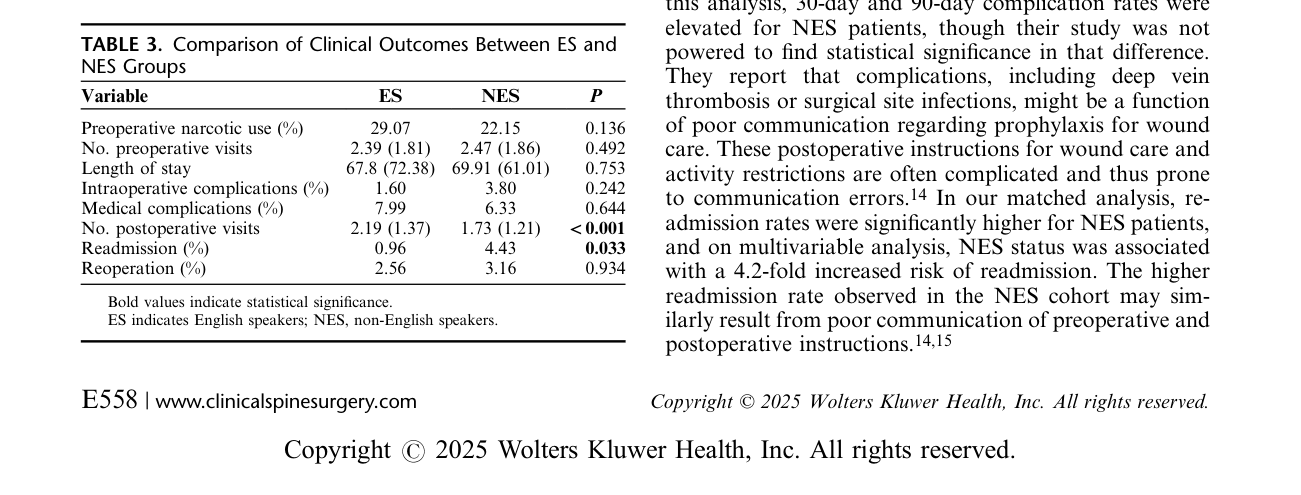 In the matched cohort, hospital length of stay did not differ significantly between groups: mean 67.8 (SD 72.38) hours for ES versus 69.91 (SD 61.01) hours for NES (P = 0.753; Table 3). This null result contrasts with prior arthroplasty literature reporting substantially longer stays for NES patients. The authors also noted that NES status and insurance status were collinear predictors of length of stay, and after accounting for insurance, NES status was no longer a significant predictor.
"Length of stay was no different between the cohorts (67.8 ± 72.38 h vs 69.91 ± 61.01 h, P = 0.753)." (Tejas, 2025, p. E557)
Methods Context #
What? #ⓘ
The observable: hospital length of stay (hours), abstracted as an outcome measure from the electronic health record.
"Outcome measures, including length of stay, any intraoperative or postoperative surgical or medical complications, discharge disposition, readmission, and reoperation, were collected." (Tejas, 2025, p. E557)
How? #ⓘ
Retrospective matched cohort (1:2 nearest-neighbor match on demographic, comorbidity, and operative factors); continuous length of stay compared with a 2-tailed independent-sample t test.
"NES patients were then matched in a 1:2 "greedy" nearest neighbor match with ES to control for demographic, comorbidity, and operative differences between the two groups." (Tejas, 2025, p. E557)
Who? #ⓘ
The matched cohort of 158 NES and 313 ES spine-surgery patients (from 214 NES and 9217 ES reviewed) at a single large academic hospital, 2017–2023.
"After matching, 158 NES patients and 313 ES patients. No significant difference existed between any demographic factors analyzed, indicating appropriate matching (Table 2)." (Tejas, 2025, p. E557)
Other Notes #
The authors flag insurance status as a confounder of the language–length-of-stay relationship.
"Interestingly, in our data set, NES status and insurance status were collinear variables in predicting length of stay. After accounting for insurance status, NES status was no longer a significant predictor of length of stay." (Tejas, 2025, p. E559)
Caveats #
- Single academic institution limits generalizability of the NES spine-surgery outcomes The study was conducted at a single large academic institution (Hospital for Special Surgery, New York). The authors caution that their NES population may not represent NES spine-surgery patients across the United States, whose demographics vary substantially by geography. A majority of NES patients were coded as "other" race in the EMR, so residual baseline differences may persist despite matching. Findings therefore may not generalize to other settings, payer mixes, or language populations.
- Translator usage in the EMR was a binary proxy for limited English proficiency, not a validated LEP measure The exposure (non-English speaker / limited English proficiency) was defined solely by whether the electronic medical record contained a binary "yes/no" flag for translator usage, used as a proxy for poor English proficiency. This is not a validated measure of language proficiency: patients who needed but were not flagged for a translator, or who were flagged but were reasonably proficient, could be misclassified. It also captures documented translator need rather than whether an interpreter was actually used throughout each encounter — the authors note interpreter services are not always used at every interaction — so the NES/ES contrast may misclassify true language discordance and its downstream care.
- Retrospective heterogeneous-cohort design leaves residual confounding in the NES spine-surgery outcomes This is a retrospective EMR chart review, so despite 1:2 matching and multivariable adjustment, unmeasured confounding and data-quality limitations remain. Because the small NES cohort prevented per-procedure analysis, matching was done across many different spine procedures, producing intrinsically heterogeneous comparison groups. The NES cohort was also heterogeneous in the specific languages spoken, plausibly varying the translators and translation quality across patients and introducing additional bias into the measured outcomes.