NES status independently predicted increased readmission (OR 4.22) on multivariable analysis after spine surgery
Source
Tejas Subramanian (2025). Spine Surgery Outcomes in Patients With Limited English Proficiency. Clinical spine surgery.
Description #
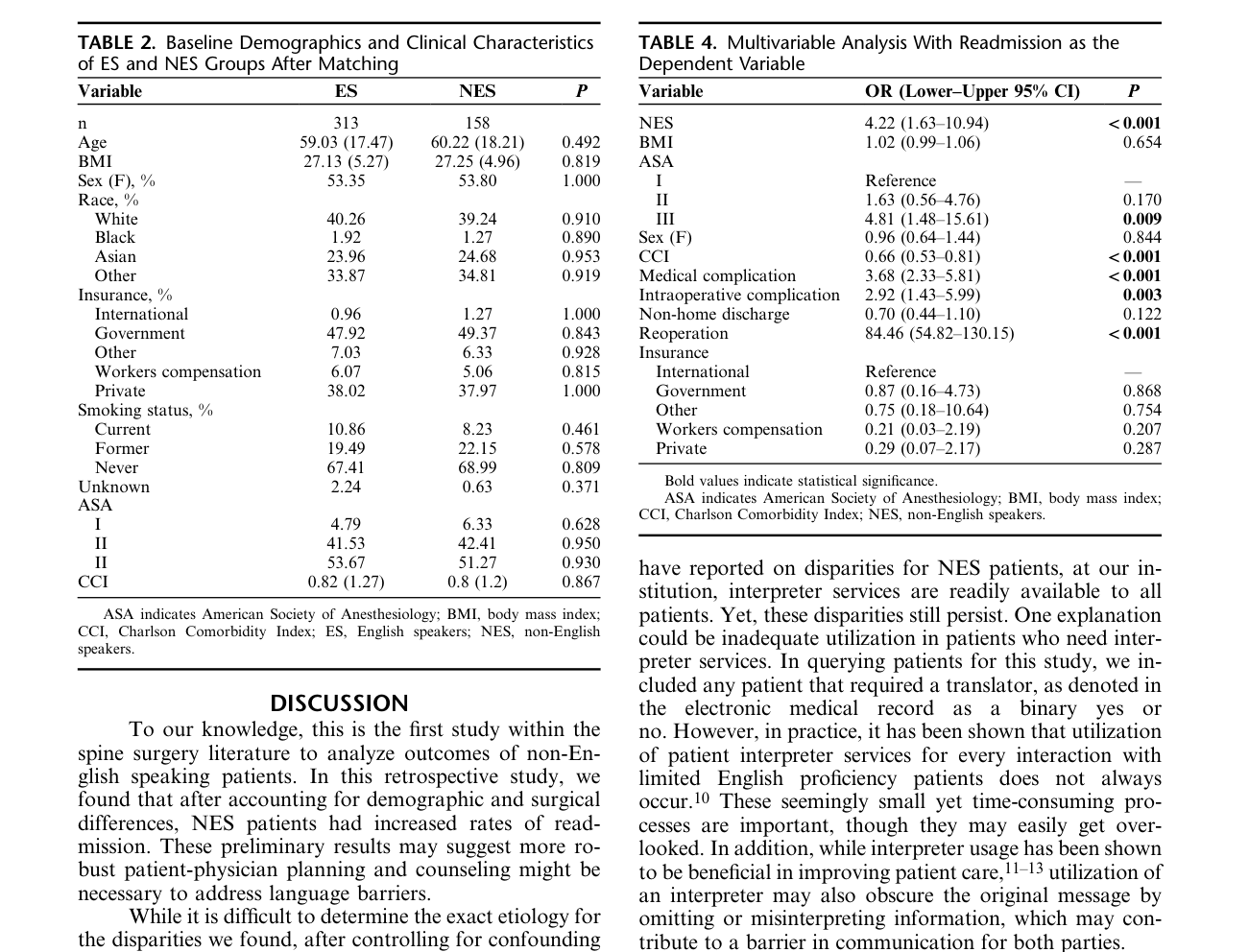 On multivariable logistic regression with stepwise elimination (readmission as the dependent variable), non-English-speaker status was an independent predictor of increased readmission, with an odds ratio of 4.22 (95% CI 1.63–10.94) — a roughly 4.2-fold increased risk. Other independent predictors of readmission in the model included ASA class III, CCI, medical complications, intraoperative complications, and revision surgery. The abstract reports this association at P = 0.039, whereas Table 4 and the Results text report P < 0.001.
"On multivariable analysis, NES status was an independent predictor of increased readmission [OR = 4.22 (1.63–10.94), P < 0.001; Table 4]." (Tejas, 2025, p. E557)
"On multivariable analysis, NES were predictive of readmission (OR = 4.22; P = 0.039)." (Tejas, 2025, p. E556)
Methods Context #
What? #ⓘ
The observable: hospital readmission, modeled as the binary dependent variable in the multivariable analysis.
"Multivariable Analysis With Readmission as the Dependent Variable" (Tejas, 2025, p. E558)
How? #ⓘ
Multivariable logistic regression with stepwise elimination run on the entire (unmatched) patient dataset; the dependent variables were the outcome measures that were significantly different on the matched univariate analysis.
"Multivariable regressions with stepwise elimination were performed on the entire patient data set to generate predictive models for the outcome variables." (Tejas, 2025, p. E557)
Who? #ⓘ
The entire study population of 214 NES and 9217 ES unmatched patients (aged ≥18, spine surgery 2017–2023) at a single large academic hospital — a broader denominator than the matched univariate cohort.
"A total of 214 NES and 9217 ES unmatched patients were included in this analysis." (Tejas, 2025, p. E557)
Other Notes #
The 95% CI (1.63–10.94) is wide, reflecting the small number of readmission events in the cohort (see qualifying caveat on low event counts).
Caveats #
- Single academic institution limits generalizability of the NES spine-surgery outcomes The study was conducted at a single large academic institution (Hospital for Special Surgery, New York). The authors caution that their NES population may not represent NES spine-surgery patients across the United States, whose demographics vary substantially by geography. A majority of NES patients were coded as "other" race in the EMR, so residual baseline differences may persist despite matching. Findings therefore may not generalize to other settings, payer mixes, or language populations.
- Readmission findings rest on very low event counts, yielding an imprecise effect estimate The readmission findings rest on very few events. With readmission rates of 0.96% among 313 ES (≈3 patients) and 4.43% among 158 NES (≈7 patients), both the univariate significance test and the multivariable odds ratio are driven by roughly a dozen readmissions across the whole cohort. This is reflected in the wide 95% confidence interval for the multivariable estimate (OR 4.22, 95% CI 1.63–10.94), which signals substantial imprecision. The authors separately acknowledge that the overall NES sample was small.
- Translator usage in the EMR was a binary proxy for limited English proficiency, not a validated LEP measure The exposure (non-English speaker / limited English proficiency) was defined solely by whether the electronic medical record contained a binary "yes/no" flag for translator usage, used as a proxy for poor English proficiency. This is not a validated measure of language proficiency: patients who needed but were not flagged for a translator, or who were flagged but were reasonably proficient, could be misclassified. It also captures documented translator need rather than whether an interpreter was actually used throughout each encounter — the authors note interpreter services are not always used at every interaction — so the NES/ES contrast may misclassify true language discordance and its downstream care.
- Retrospective heterogeneous-cohort design leaves residual confounding in the NES spine-surgery outcomes This is a retrospective EMR chart review, so despite 1:2 matching and multivariable adjustment, unmeasured confounding and data-quality limitations remain. Because the small NES cohort prevented per-procedure analysis, matching was done across many different spine procedures, producing intrinsically heterogeneous comparison groups. The NES cohort was also heterogeneous in the specific languages spoken, plausibly varying the translators and translation quality across patients and introducing additional bias into the measured outcomes.