Within the LEP group, more frequent interpretation was associated with receiving opioids at any recorded pain level (not statistically significant)
Source
Jimenez (2014). Postoperative pain management in children, parental English proficiency, and access to interpretation. Hospital Pediatrics.
Description #
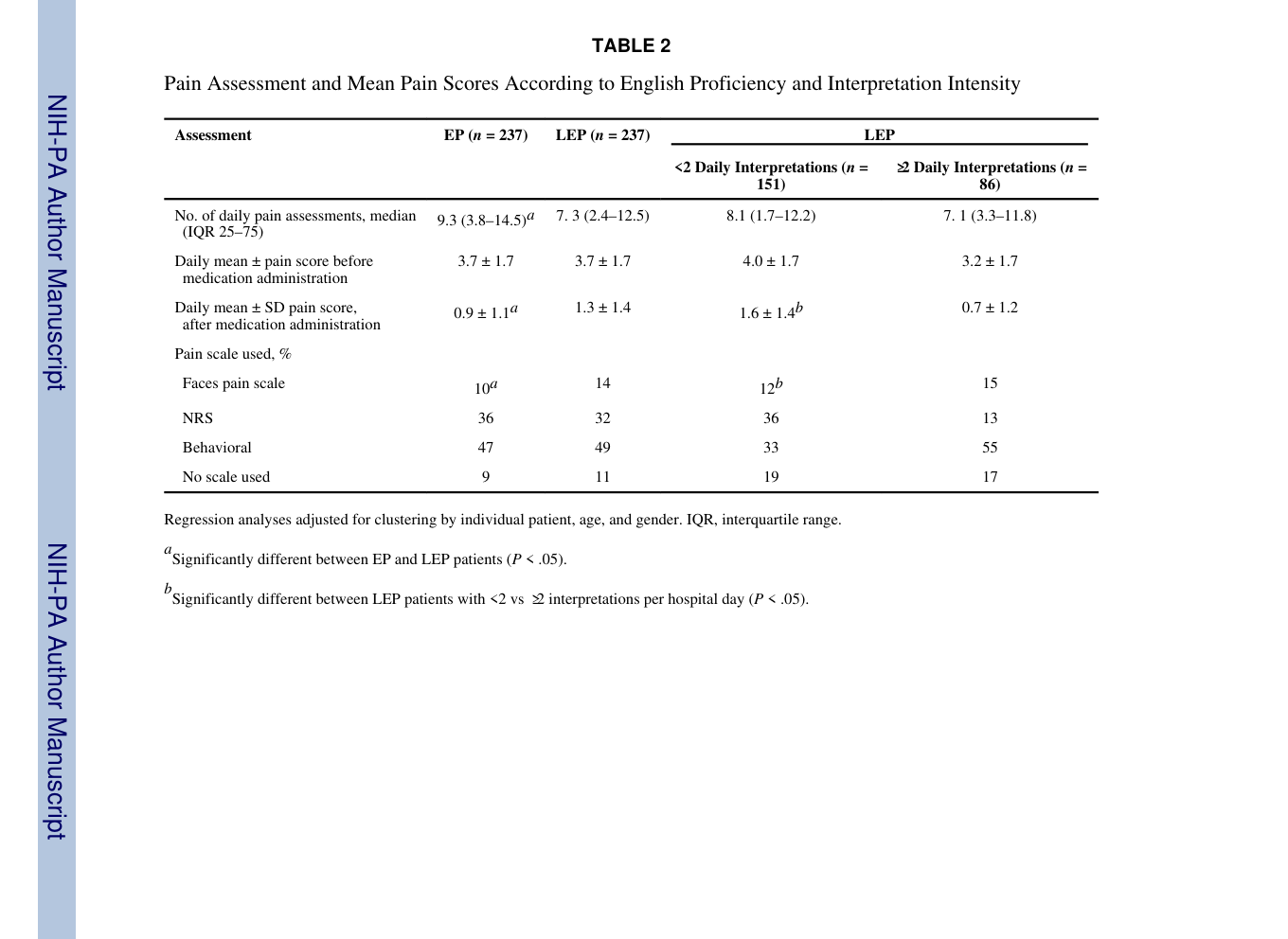 Within the LEP group, children whose families received more frequent professional interpretation were more likely to be given opioid analgesics at any recorded level of pain than children with fewer interpretations, though this difference did not reach statistical significance. Framed the other way, lower interpretation was associated with a reduced likelihood of receiving opioid medication at a given pain score. Overall, pain management for LEP children with higher interpretation resembled that of EP children, consistent with interpretation narrowing the treatment gap.
"Children whose families received more frequent interpretation were also more likely to be given opioid analgesics at any level of recorded pain, relative to children with fewer interpretations; however, these differences did not reach statistical significance (Table 2)." (Jimenez, 2014, p. 6)
"Pain management for patients with LEP parents with higher levels of interpretation was similar to that for patients from EP families, supporting the hypothesis that higher rates of interpretation might help mitigate health disparities." (Jimenez, 2014, p. 7)
Methods Context #
What? #ⓘ
The observable: the likelihood of receiving an opioid (vs nonopioid) analgesic at a given recorded pain score.
"Analgesics were grouped into 2 main categories: nonopioids (acetaminophen, ketorolac, and ibuprofen) and opioids (oxycodone, hydrocodone, fentanyl, morphine, meperidine, and hydromorphone)." (Jimenez, 2014, p. 3)
How? #ⓘ
Within-LEP subgroup comparison relating interpretation frequency (<2 vs ≥2/day) to type of analgesic given, using generalized estimating equations to account for patient-level clustering and regression models controlling for age and gender.
"Relationship between interpretation service and pain scores was assessed by using generalized estimating equations to account for clustering of individual patient measurements, and regression models controlled for age and gender. We tested the association between frequency of interpretations per day and type of analgesic given." (Jimenez, 2014, p. 5)
Who? #ⓘ
The 237 LEP children, split into 86 whose families received ≥2 interpretations/day and 151 who received <2/day, at a tertiary-care referral pediatric hospital (Seattle Children's Hospital), 2008–2009.
"One-third of patients from LEP families (n = 86) had ≥2 mean interpretations per day." (Jimenez, 2014, p. 5)
Other Notes #
The discussion restates the direction and the non-significance: "lower levels of interpretation were associated with a reduced likelihood of being given opioid medication at a given pain score, although this difference did not reach statistical significance." (Jimenez, 2014, p. 7). Directionally consistent with the interpretation-helps hypothesis, but underpowered.
Caveats #
- Interpretation frequency was counted from documentation and interpreters were not used exclusively for pain assessments, so counted interpretation does not confirm interpreter presence at each assessment The interpretation "dose" was measured from documentation — electronic record orders for in-person interpretation plus a separate billing record of in-person and telephone interpretations — rather than from observation of the encounters themselves. The authors note that interpreters were not used exclusively for pain assessments, so a high per-day interpretation count does not confirm that an interpreter was present for the specific pain assessments or medication decisions being compared. This weakens the link between the measured interpretation frequency and the pain-management outcomes attributed to it.
- Findings come from a single tertiary pediatric hospital with a long-running program to expand interpreter access, limiting generalizability All data come from a single tertiary-care referral pediatric hospital (Seattle Children's Hospital) that had already invested in a multi-year institutional program to expand interpreter access, universal language-needs screening, and a twice-daily interpreted-care target. Both the observed LEP–EP disparities and the interpretation dose-response may differ at institutions with weaker interpreter infrastructure or different case mixes, so the single-center setting limits generalizability of the effect sizes.
- The within-LEP interpretation contrast is confounded by age and English proficiency, since families with fewer interpretations were older and likelier proficient in English The within-LEP comparison of interpretation frequency is subject to residual confounding. LEP was defined by parent-reported language preference and need for interpreted care, but many children of LEP parents are themselves English-proficient and communicate with providers directly. Children in families receiving fewer interpretations per day were also older on average and may have been more English-proficient, so the observed pain-management advantage for the higher-interpretation subgroup could partly reflect age or child English proficiency rather than interpretation itself. The authors controlled for age in the analysis but could not fully remove this confounding.