Within the LEP group, children with ≥2 interpretations per day had lower post-medication pain scores (0.7 vs 1.6)
Source
Jimenez (2014). Postoperative pain management in children, parental English proficiency, and access to interpretation. Hospital Pediatrics.
Description #
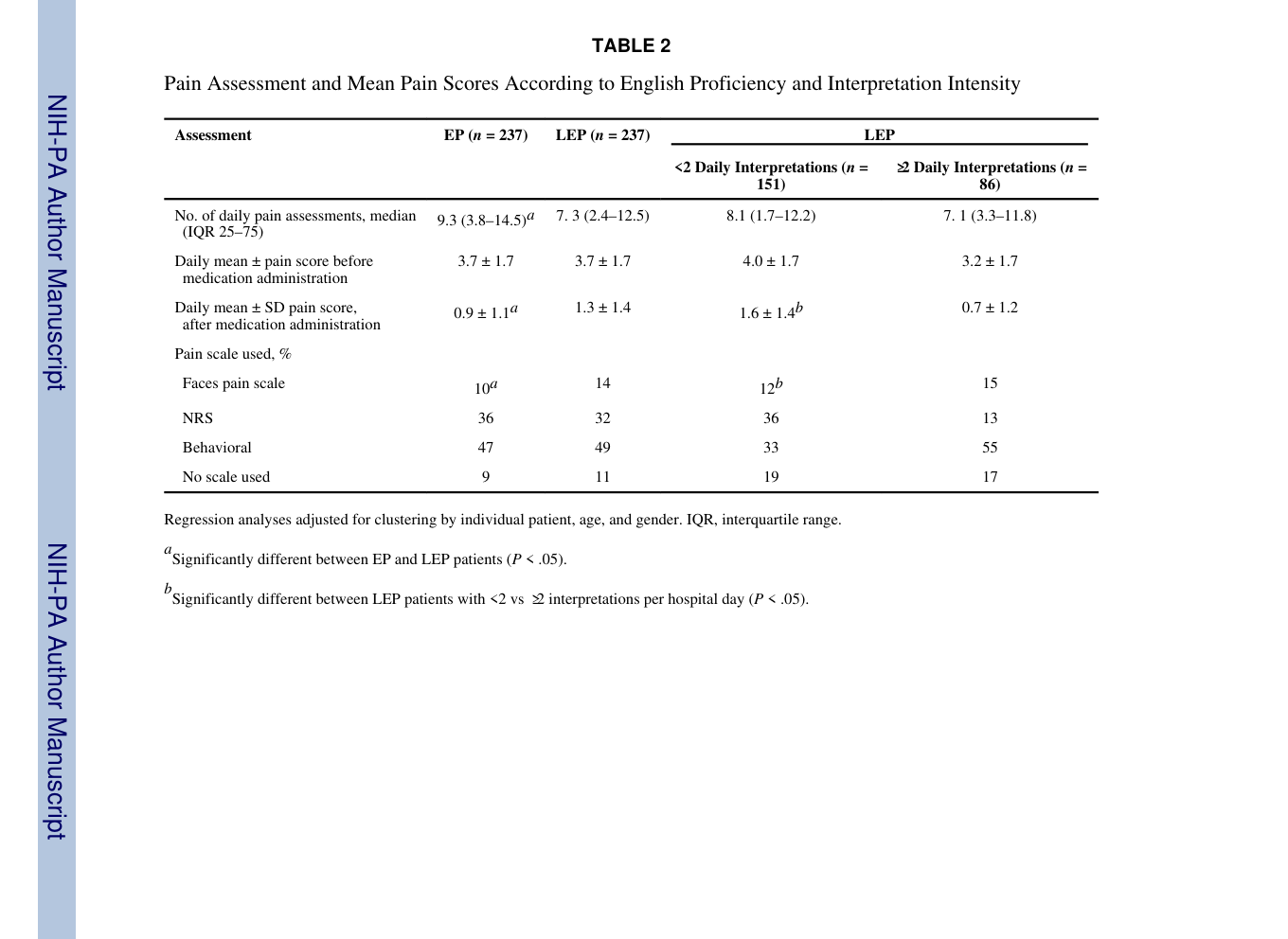 Within the LEP group, children whose families received fewer than 2 professional interpretations per day had significantly higher mean postanalgesic (post-medication) pain scores than children whose families received ≥2 interpretations per day (1.6 ± 1.4 vs 0.7 ± 1.2; P = .004). The two interpretation-frequency groups did not differ significantly in the frequency of pain assessment, so the gap appeared in residual pain after treatment rather than in how often pain was measured. More frequent interpretation was thus associated with better-controlled post-medication pain among LEP children.
"Nonetheless, children of families who received <2 interpreted visits per day had higher mean postanalgesic pain scores (1.6 ± 1.4 vs 0.7 ± 1.2; P = .004) relative to children with more frequent interpretation (Table 2)." (Jimenez, 2014, p. 6)
"There was no statistically significant difference in the frequency of pain assessment for children of families with <2 interpreted visits per day, relative to children of families with ≥2 interpreted visits per day." (Jimenez, 2014, p. 6)
Methods Context #
What? #ⓘ
The observable: mean daily pain score recorded after analgesic (medication) administration.
"Pain assessment and medication variables were as follows: (1) mean number of daily pain assessments; (2) mean daily pain scores before and after analgesic administration; and (3) type of analgesic given." (Jimenez, 2014, p. 3)
How? #ⓘ
Within-LEP subgroup comparison contrasting children of families with a mean of <2 vs ≥2 professional interpretations per day (a binary variable set at the institution's twice-daily interpreted-care goal); interpretation counts came from electronic interpretation orders and billing records, and postanalgesic pain scores were compared with Wilcoxon signed rank tests and regression models controlling for age and gender.
"For the purpose of this study, we created a binary variable for patient interpretation; "<2" versus "≥2" mean interpretations per day, consistent with our institutional goal for interpreted care (at least 2 interpretations per patient-day)." (Jimenez, 2014, p. 4)
"Additional subgroup analyses were conducted within the LEP group to compare mean number of daily pain assessments, mean daily pain scores before and after medication administration, and type of analgesic between patients with a mean of <2 vs ≥2 professional interpretations per day." (Jimenez, 2014, p. 5)
Who? #ⓘ
The 237 LEP children, split into 86 whose families received ≥2 interpretations/day and 151 who received <2/day, at a tertiary-care referral pediatric hospital (Seattle Children's Hospital), 2008–2009.
"One-third of patients from LEP families (n = 86) had ≥2 mean interpretations per day." (Jimenez, 2014, p. 5)
Other Notes #
The ≥2-interpretations subgroup was somewhat younger on average than the <2 subgroup (Table 1), a between-group difference the authors control for but which is the basis of the residual-confounding caveat.
Caveats #
- Interpretation frequency was counted from documentation and interpreters were not used exclusively for pain assessments, so counted interpretation does not confirm interpreter presence at each assessment The interpretation "dose" was measured from documentation — electronic record orders for in-person interpretation plus a separate billing record of in-person and telephone interpretations — rather than from observation of the encounters themselves. The authors note that interpreters were not used exclusively for pain assessments, so a high per-day interpretation count does not confirm that an interpreter was present for the specific pain assessments or medication decisions being compared. This weakens the link between the measured interpretation frequency and the pain-management outcomes attributed to it.
- Findings come from a single tertiary pediatric hospital with a long-running program to expand interpreter access, limiting generalizability All data come from a single tertiary-care referral pediatric hospital (Seattle Children's Hospital) that had already invested in a multi-year institutional program to expand interpreter access, universal language-needs screening, and a twice-daily interpreted-care target. Both the observed LEP–EP disparities and the interpretation dose-response may differ at institutions with weaker interpreter infrastructure or different case mixes, so the single-center setting limits generalizability of the effect sizes.
- The within-LEP interpretation contrast is confounded by age and English proficiency, since families with fewer interpretations were older and likelier proficient in English The within-LEP comparison of interpretation frequency is subject to residual confounding. LEP was defined by parent-reported language preference and need for interpreted care, but many children of LEP parents are themselves English-proficient and communicate with providers directly. Children in families receiving fewer interpretations per day were also older on average and may have been more English-proficient, so the observed pain-management advantage for the higher-interpretation subgroup could partly reflect age or child English proficiency rather than interpretation itself. The authors controlled for age in the analysis but could not fully remove this confounding.