Spanish instructional video reduced preoperative anxiety vs no video (median reduction 2 vs 0) in Spanish-speaking surgical patients
Source
West (2014). The effects of preoperative, video-assisted anesthesia education in Spanish on Spanish-speaking patients' anxiety, knowledge, and satisfaction: a pilot study. Journal of Clinical Anesthesia.
Description #
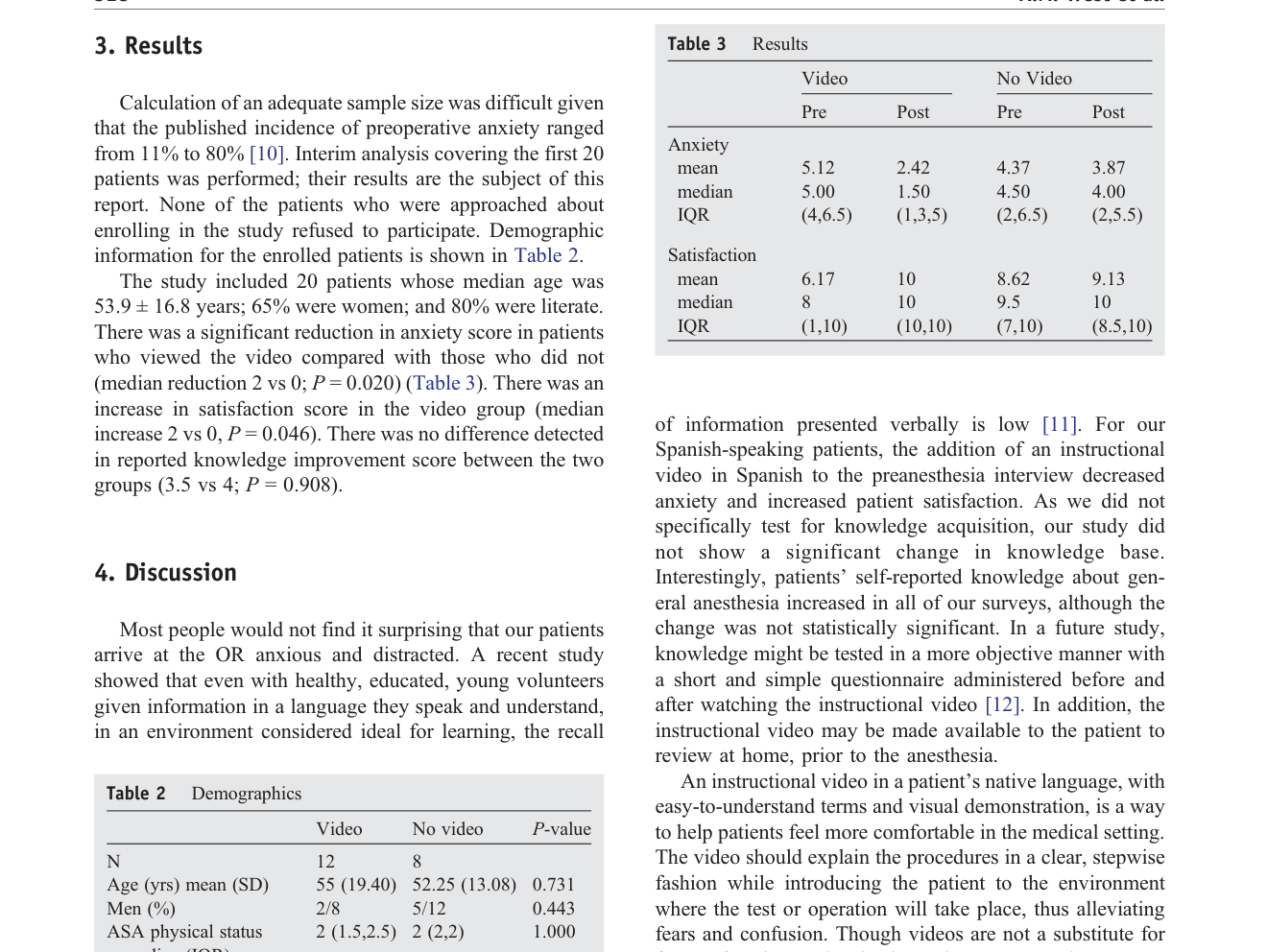 In this prospective, randomized, nonblinded pilot at Massachusetts General Hospital, Spanish-speaking surgical patients who watched a 4-minute Spanish-language anesthesia video before their preanesthesia interview showed a significantly larger pre-to-post reduction in visual-analog-scale (VAS) anxiety score than patients who did not view the video (median reduction 2 vs 0; P = 0.020). The video-group median anxiety score fell from 5.00 to 1.50, whereas the no-video-group median fell only from 4.50 to 4.00.
"There was a significant reduction in anxiety score in patients who viewed the video compared with those who did not (median reduction 2 vs 0; P = 0.020) (Table 3)." (West, 2014, p. 328)
"For our Spanish-speaking patients, the addition of an instructional video in Spanish to the preanesthesia interview decreased anxiety and increased patient satisfaction." (West, 2014, p. 328)
Methods Context #
What? #ⓘ
The observable: the pre-to-post change in self-reported anxiety recorded on a 10-inch visual analog scale (VAS) anchored from "no anxiety" to "maximal anxiety."
"On confirmation of patient's participation, an assessment of anxiety, knowledge, and satisfaction was obtained using a visual analog scale (VAS). The VAS was based on a 10-inch (25.4 cm) line drawn on paper. The extreme left side indicated no anxiety, no knowledge, or dissatisfaction; the extreme right denoted maximal anxiety, knowledge, or satisfaction." (West, 2014, p. 326)
How? #ⓘ
Prospective, randomized, nonblinded pilot: patients were randomized by a computer-generated algorithm to view A-0003ArtifactA-0003Initial AI draftPreoperative Spanish-language anesthesia instructional videoTo reduce preoperative anxiety and improve knowledge and satisfaction for Spanish-speaking patients with limited English proficiency (LEP) by delivering standardized anesthesia education in the patient's native language,… (Group V) or not (Group NV) before the preanesthesia interview, and pre-to-post VAS changes were compared between arms with a two-sample t-test or Wilcoxon rank sum test as appropriate.
"Following a computer-generated algorithm, patients were randomized to Group V (video) or Group NV (no video)." (West, 2014, p. 327)
"Continuous variables (summarized by means with SD or medians with interquartile ranges) were compared using the two-sample t-test or Wilcoxon rank sum test for normally and nonnormally distributed variables, respectively." (West, 2014, p. 327)
Who? #ⓘ
20 adult, ASA physical status 1–3 Spanish-speaking patients requiring a Spanish interpreter, scheduled for elective gynecological, orthopedic, and intra-abdominal surgery under general anesthesia at Massachusetts General Hospital.
"Twenty adult, ASA physical status 1, 2, and 3 patients, scheduled for elective surgery (gynecological, orthopedic, and intrabdominal surgery) during general anesthesia were studied." (West, 2014, p. 325)
Other Notes #
This was an interim analysis of the first 20 enrolled patients; none of the patients approached about enrolling refused to participate (West, 2014, p. 328).
Caveats #
- Tiny (n=20), single-center, nonblinded pilot with self-report VAS outcomes The findings come from a very small (n = 20), single-center, prospective randomized but nonblinded pilot — an interim analysis of the first 20 patients — with outcomes captured only by self-report on a visual analog scale rather than objective measurement. The tiny, single-institution Spanish-speaking sample constrained extrapolation to LEP patients of other ethnic/cultural backgrounds, the study was not powered to assess modifiers such as prior anesthetic experience, PATA visit, gender, or age, and the knowledge outcome in particular reflected self-reported improvement rather than objectively tested knowledge acquisition. Together these features (small n, no blinding, single site, subjective self-report) make the effect estimates fragile and imprecise, and warrant treating the anxiety, satisfaction, and null-knowledge results as hypothesis-generating.