Among LEP ED patients interpreter use was associated with significantly longer length of stay
Source
Wallbrecht (2014). No difference in emergency department length of stay for patients with limited proficiency in English. Southern Medical Journal.
Description #
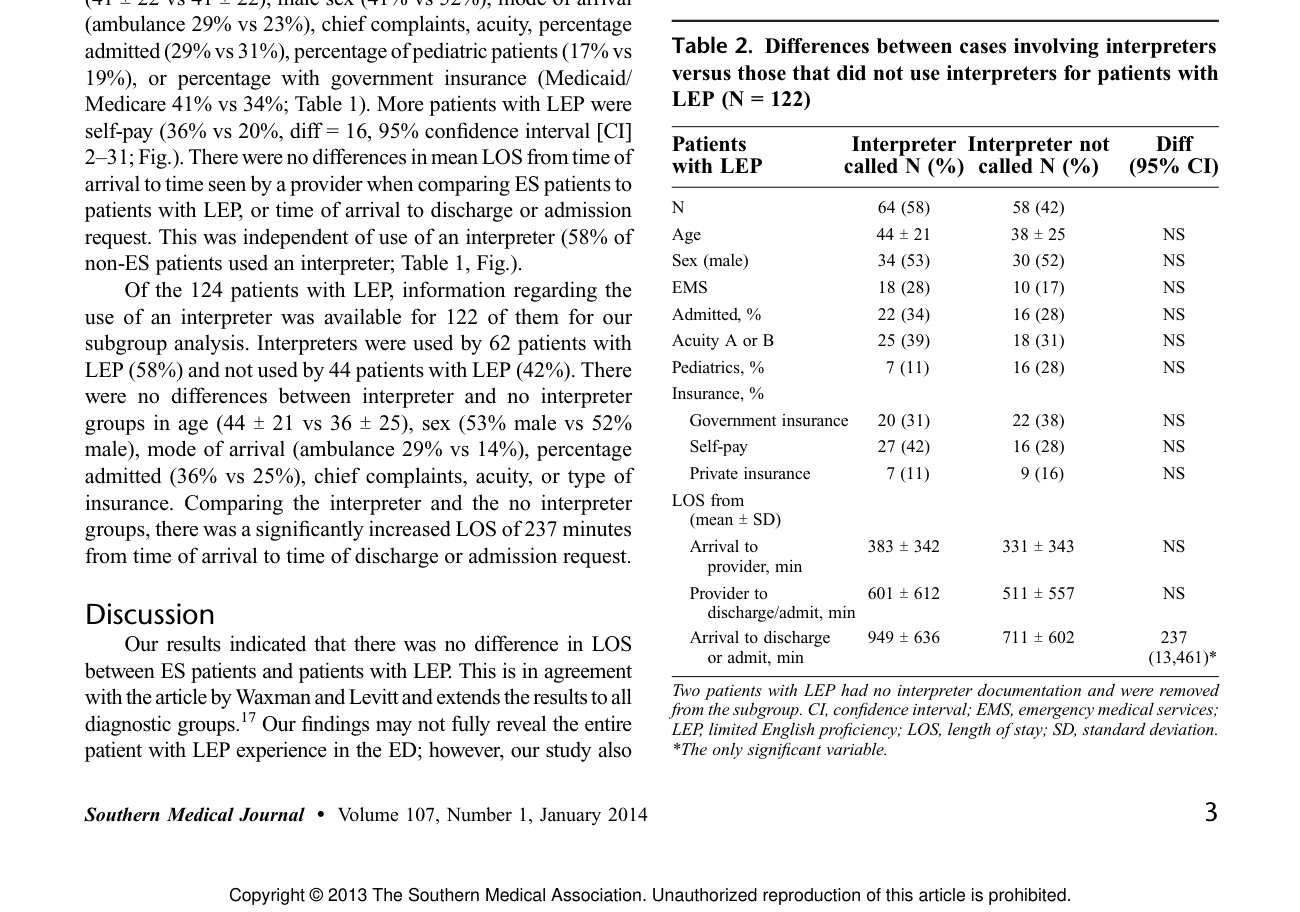
In a subgroup analysis of the 122 LEP patients with interpreter-use documentation, those for whom an interpreter was called had a significantly longer arrival-to-discharge/admission LOS than those for whom no interpreter was called: 949 ± 636 vs 711 ± 602 minutes, a difference of 237 minutes (95% CI 13–461), the only significant variable (Table 2; Fig.). The interpreter and no-interpreter groups did not differ significantly on age, sex, mode of arrival, acuity, admission rate, or insurance, and the earlier LOS components (arrival-to-provider, provider-to-discharge) were not individually significant.
"Comparing the interpreter and the no interpreter groups, there was a significantly increased LOS of 237 minutes from time of arrival to time of discharge or admission request." (Wallbrecht, 2014, p. 3)
"The study also shows that there was a significant difference in LOS between the patients with LEP who used an interpreter and those who did not." (Wallbrecht, 2014, p. 3)
Methods Context #
What? #ⓘ
The observable: mean ED arrival-to-discharge/admission LOS in minutes, compared within the LEP cohort between encounters where an interpreter was called and where one was not.
"In a subgroup analysis, patients with LEP were dichotomized into those who used interpreters and those who did not." (Wallbrecht, 2014, p. 2)
How? #ⓘ
Within-LEP subgroup analysis of the prospective cohort: 122 of 124 LEP patients with documented interpreter use (62 used, 44/58 not used per text/table) dichotomized and compared on LOS with a grouped t test; two LEP patients lacking interpreter documentation were excluded.
"Of the 124 patients with LEP, information regarding the use of an interpreter was available for 122 of them for our subgroup analysis. Interpreters were used by 62 patients with LEP (58%) and not used by 44 patients with LEP (42%)." (Wallbrecht, 2014, p. 3)
Who? #ⓘ
The 122 LEP patients (of 124) with interpreter-use documentation, drawn from the adult level I trauma academic ED (University of New Mexico) over the Oct–Dec 2011 study period; interpreter request was at the discretion of treating personnel and not consistently applied (only ~53–58% of LEP patients used an interpreter).
"Two patients with LEP had no interpreter documentation and were removed from the subgroup." (Wallbrecht, 2014, p. 3)
"Requesting an interpreter is at the discretion of the treating physician or personnel." (Wallbrecht, 2014, p. 3)
Other Notes #
This is an association, not a causal/intervention effect: interpreter use was determined by clinical discretion, not randomized, so the longer LOS may reflect indication (sicker or more complex patients getting interpreters) or the added time of arranging/conducting interpretation rather than a pure effect of interpreting. The authors note they "did not characterize why this occurred." The abstract reports a larger difference (330 min; 958 ± 644 vs 628 ± 595) than the Results text and Table 2 (237 min; 949 ± 636 vs 711 ± 602); the in-article numbers are used here. The authors align the direction with Hampers and McNulty's pediatric finding of increased LOS when an interpreter is engaged.
Caveats #
- Non-randomized convenience sample with small N and long baseline ED wait times limited power to detect a LOS difference (Wallbrecht) Patients were selected by a non-randomized convenience sample (data collectors hand-picked 2–8 patients per day with no randomization software), creating room for selection bias, and the small sample entered over a short period combined with the site's unusually long baseline ED wait times produced very wide confidence intervals. The authors explicitly state these features may explain their inability to detect a significant overall LOS difference — so the null LEP-vs-ES result should be read as possibly underpowered rather than as evidence of no effect.